John Scott
| Name | John Scott |
| Title | Scottish politician and general |
| Gender | Male |
| Birthday | 1725-00-00 |
| nationality | Great Britain |
| Source | https://www.wikidata.org/wiki/Q6257051 |
| pptrace | View Family Tree |
| LastUpdate | 2025-11-26T12:30:20.779Z |
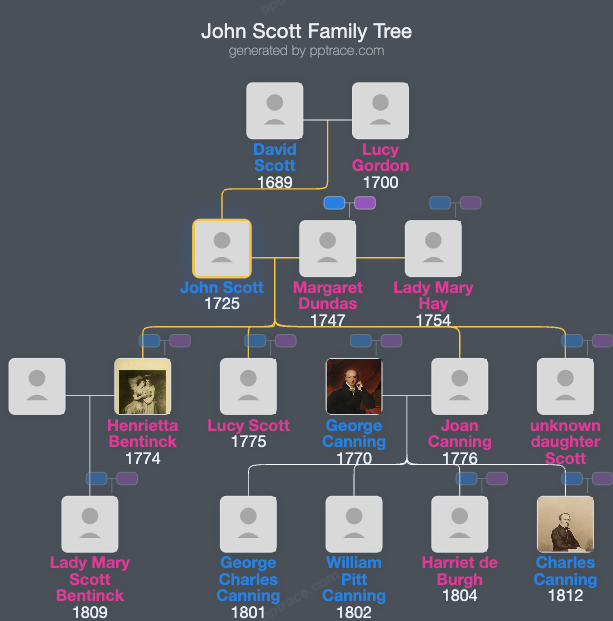
Family Tree
Tap  to expand more relatives
Introduction
John Scott (1725–1775) was a Scottish politician and senior officer in the British Army. He held the title of Major General and was associated with Balcomie and Scotstarvit. He was born at Balcomie House near Crail in Fife, Scotland, in 1725. His parents were David Scott of Scotstarvit Tower and Lucy Gordon.
Scott began his military career in 1741 when he joined the British Army as an ensign in the 12th Regiment of Foot. Over the course of his service, he advanced through various regiments to attain the rank of Major General in 1770. He served as Colonel of the 108th Regiment of Foot between 1762 and 1763, and subsequently as Colonel of the 26th (Cameronian) Regiment of Foot from 1763 until his death.
In politics, Scott represented multiple constituencies. He was Member of Parliament (MP) for Caithness from 1754 to 1761, for Tain Burghs from 1761 to 1768, and for Fife from 1768 until his death in 1775.
In 1766, Scott inherited Scotstarvit Tower following the death of his father. That same year, he was involved in a notable financial event through gambling, which is reputed to have resulted in him acquiring approximately £500,000 in modern currency terms—equivalent to around £60 million today. His gambling ventures are also associated with a famous bet against Sir Lawrence Dundas, which Scott won, resulting in Dundas House (the headquarters of the Royal Bank of Scotland) coming into his possession. Following this, Scott commissioned the construction of a new residence to the north of Dundas House, called Bellevue Lodge, which served as his residence in Edinburgh.
Scott purchased Denmylne Castle in Fife in 1772, though he allowed it to fall into disrepair, as he did not require the property actively. He died at Scotstarvit in 1775. After his death, Bellevue House was repurposed as the Edinburgh Excise House. It was later demolished in 1842 to make way for the construction of the Scotland Street tunnel.
Regarding his personal life, Scott married Lady Mary Hay on 5 November 1770; she was the daughter of James Hay, 15th Earl of Erroll. The marriage was short-lived, and they divorced in 1771. Reports indicate that Lady Mary Hay eloped with another man. Scott married secondly on 5 June 1773 to Hon. Margaret Dundas, daughter of Robert Dundas of Arniston, the younger. They had three daughters: Henrietta (born 1774), who married William Bentinck, 4th Duke of Portland; Lucy (born 28 March 1775), who married Francis Stuart, 10th Earl of Moray; and Joan (born 15 March 1776), who married George Canning, Prime Minister of the United Kingdom, and became the 1st Viscountess Canning in 1828.
In addition to his military and political careers, Scott was known for his gambling success, notably making a significant fortune through games of chance and strategic betting, including winnings at White's club. George Devol noted that Scott was responsible for one of the largest known gambling winnings, amounting to one million dollars, attributed to his sobriety and proficiency in the game of whist.
Scott died on 7 December 1775 at Scotstarvit.