Sir Watkin Williams-Wynn, 4th Baronet
| Name | Sir Watkin Williams-Wynn, 4th Baronet |
| Title | Welsh politician |
| Gender | Male |
| Birthday | 1749-09-23 |
| nationality | — |
| Source | https://www.wikidata.org/wiki/Q7529426 |
| pptrace | View Family Tree |
| LastUpdate | 2025-11-26T23:23:22.545Z |
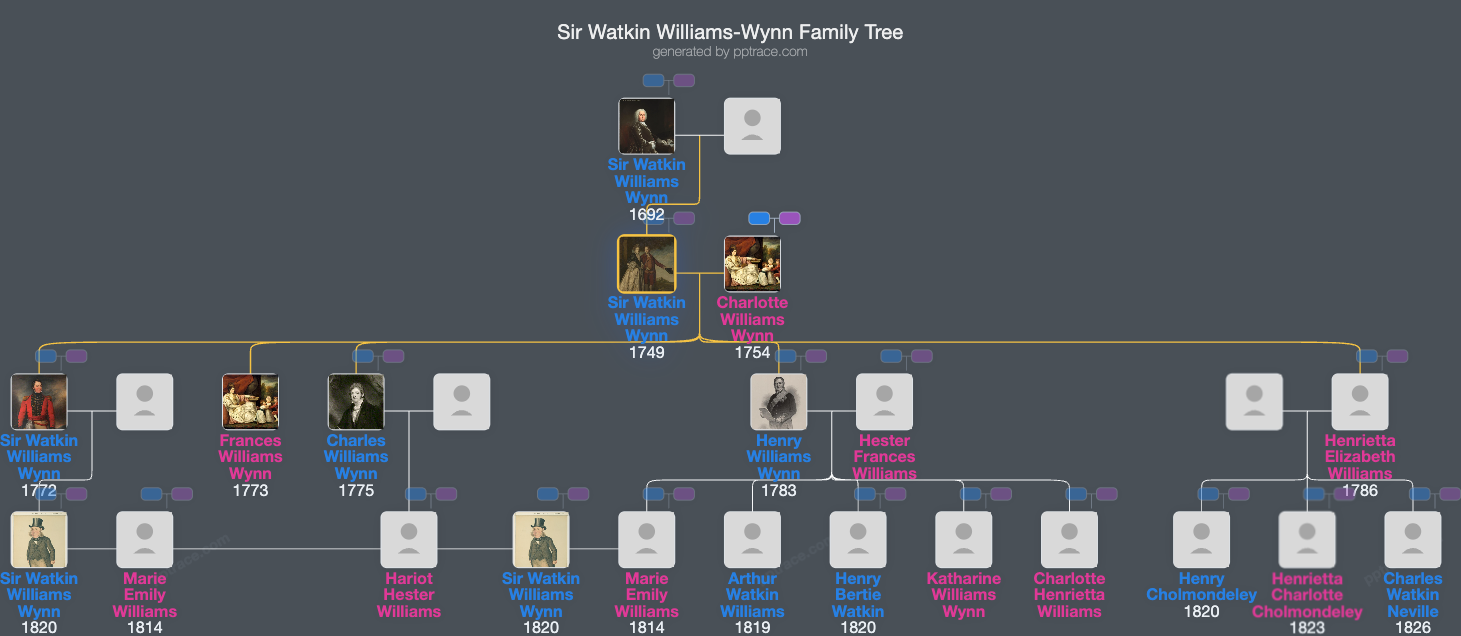
Family Tree
Tap  to expand more relatives
Introduction
Sir Watkin Williams-Wynn, 4th Baronet (23 September 1749 – 24 July 1789), was a British politician and landowner. He served as a Member of Parliament for Shropshire from 1772 to 1774 and for Denbighshire from 1774 until his death in 1789. He was the eldest son of Sir Watkin Williams-Wynn, 3rd Baronet, and Frances Shackerley of Cheshire, from the second marriage of his father.
Williams-Wynn inherited the Wynnstay estates in North Wales upon the death of his father, who was killed in a fall from his horse during a hunting outing. The estates covered at least five Welsh counties and extended into Shropshire, England, with an estimated rental income of approximately £20,000. Upon reaching adulthood in 1770, he held a notable celebration attended by 15,000 guests, characterized by substantial provisions such as 31 bullocks, 50 hogs, 50 calves, 80 sheep, and 18,000 eggs. An embroidered suit associated with this event is preserved at the National Museum of Wales.
In his political career, Williams-Wynn was a member of a historically influential family, with control over several parliamentary seats and leadership of a Tory faction in the House of Commons. His influence, however, had declined during his minority. He held the office of Lord Lieutenant of Merionethshire from 1775 to 1789 and was often criticized for poor attendance in parliament.
Williams-Wynn was a patron of the arts and an early supporter of landscape painting in Wales. He traveled extensively across Europe from June 1768 to February 1769, during which Pompeo Batoni painted his portrait in Rome. Batoni also created a classical painting of Bacchus and Ariadne in 1774 for him. Furthermore, he gifted a Rococo silver-gilt toilet service, crafted by Thomas Heming, to his first wife. This marriage was brief due to her death shortly after their union in July 1769.
In December 1771, he married Lady Charlotte Grenville, daughter of a former Whig Prime Minister, and they had seven children: four sons and three daughters. Notable among them was Sir Watkin Williams-Wynn, 5th Baronet, and Frances Williams-Wynn, whose Diaries were published posthumously.
Williams-Wynn played a significant role in promoting art in Wales, bringing Richard Wilson and Paul Sandby to Wynnstay. Sandby visited Wales in 1770 and 1771, producing aquatint views that were published in 1776 and 1777. He also supported the Concerts of Ancient Music and appeared in caricatures by James Gilray depicting King George III attending these events.
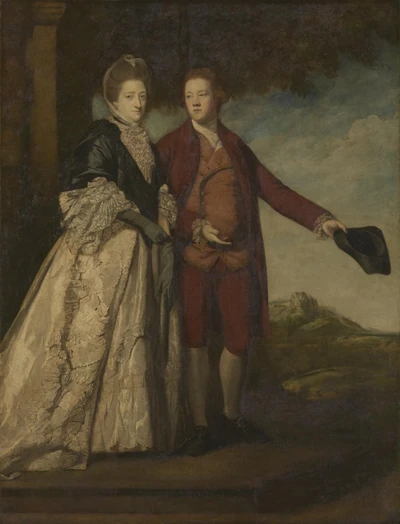
His London residence included the construction of 20–21 St James's Square, designed by Robert Adam between 1771 and 1775. Several portraits by Sir Joshua Reynolds depict him, including images of him with his wives, his family, and in roles such as presiding over the Society of Dilettanti.
Sir Watkin Williams-Wynn died on 24 July 1789 at the age of 39.