Sir Watkin Williams-Wynn, 3rd Baronet
| Name | Sir Watkin Williams-Wynn, 3rd Baronet |
| Title | Welsh politician and prominent Jacobite |
| Gender | Male |
| Birthday | 1692-01-01 |
| nationality | Wales |
| Source | https://www.wikidata.org/wiki/Q7529420 |
| pptrace | View Family Tree |
| LastUpdate | 2025-11-26T23:23:37.422Z |
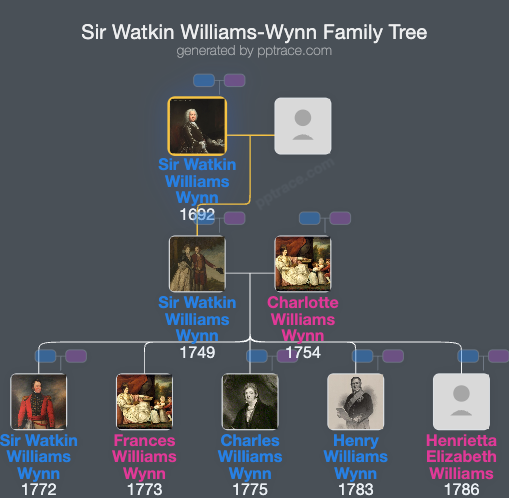
Family Tree
Tap  to expand more relatives
Introduction
Sir Watkin Williams-Wynn, 3rd Baronet (circa 1692 – 26 September 1749), was a British politician and landowner active during the early 18th century. He was born in Wales, the eldest son of Sir William Williams, 2nd Baronet of Llanforda, and Jane Thelwall. His paternal grandfather was Sir William Williams, who served as Solicitor General under James II and was known for prosecuting the Seven Bishops in 1688. His maternal lineage included descendants of Sir John Wynn, an antiquary.
In 1719, upon the death of a kinsman named Sir John Wynn, Williams-Wynn inherited the Wynnstay estates on the condition that he added "Wynn" to his surname. Following his father's death in 1740, he also inherited the family lands and title. His first marriage was to Ann Vaughan (circa 1695–1748), through whom he acquired extensive estates in Montgomeryshire and Denbighshire, establishing himself as a leading landowner in North Wales. After Ann's death, he married Frances Shackerley (1721–1803), a wealthy heiress and his god-daughter. Their son and heir, Sir Watkin Williams-Wynn, 4th Baronet, was born shortly before his father's death.
Williams-Wynn was educated at Jesus College, Oxford. Politically, he served as Member of Parliament (MP) for Denbighshire beginning in 1716. Although he did not deliver his first speech until 1727, he was notably active within the Tory Jacobite faction, supporting the interests of the exiled Stuarts and engaging in Jacobite societies such as the Cycle of the White Rose. During elections in the early 1720s, he participated in actions that demonstrated his political influence, including the "burning of the King's picture" during the 1722 General Election and opposition to measures perceived as supportive of the Whigs and George I's government.
Williams-Wynn served as Mayor of Oswestry for 1728–1729 and Mayor of Chester for 1736–1737. His political influence was reinforced by his financial resources and relationships, which allowed him to dominate local elections, including in North Wales. While he was a strong supporter of Tory and Jacobite causes, overt displays of Jacobitism were generally discreet or rooted in opposition to religious and political minorities, such as Nonconformists and Catholics.
After the death of Sir William Wyndham, the Tory leader, in 1740, Williams-Wynn became a prominent figure in opposition to Prime Minister Robert Walpole. In the 1741 general election, Walpole sought to unseat Williams-Wynn, but although winning the popular vote, disallowed votes prevented his return for Denbighshire; he was elected for Montgomeryshire instead. Following Walpole's resignation in 1742, Williams-Wynn regained his seat for Denbighshire via an appeal.
Williams-Wynn participated in the political shifts that occurred thereafter, including negotiations with Jacobite agents such as Francis Sempill. In 1744, he accepted a government position under Henry Pelham's ministry and traveled to Versailles, where King Louis XV assured him of French support for a Jacobite rising. During the 1745 Jacobite uprising led by Charles Stuart, Williams-Wynn remained in London, communicating orally with the Jacobite leadership about potential support, but he did not actively participate in the rebellion.
Following the rebellion's suppression, Williams-Wynn was implicated through testimony from Prince Charles' former secretary but was not prosecuted. He remained involved in Jacobite sympathies and demonstrations, including participating in the 1747 Lichfield Races. Despite his political activities, he was not directly involved in the 1745 Rising's military efforts but maintained correspondence promising support.
Sir Watkin Williams-Wynn died in a hunting accident on 26 September 1749 and was buried at Ruabon in the parish church of St Mary’s. His widow commissioned a monument for him from sculptor Michael Rysbrack, completed in 1755. He also commissioned the building of a new mansion at Wynnstay in 1616, which was later destroyed by fire in 1858. His estates, which included properties across five Welsh counties and in Shropshire, reportedly generated an annual rental income of approximately £20,000. His holdings were substantial, although there were rumors of significant debts inherited by his heir.
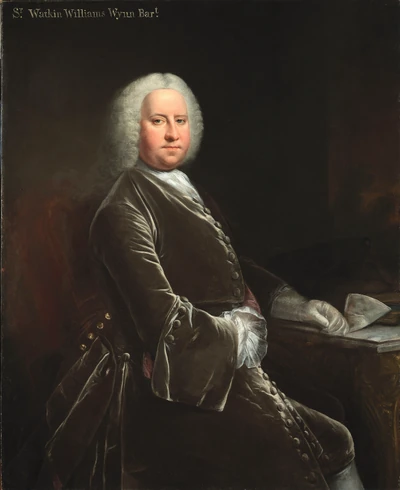
He left various items to Jesus College, including a notable silver-gilt punch bowl used in 1814 during a celebration of Napoleon's defeat. A portrait of Williams-Wynn by Thomas Hudson, acquired by Jesus College in 1997, depicts him in a sky-blue coat, a symbol associated with Tory Jacobite sympathies.