Sir Watkin Williams-Wynn, 5th Baronet
| Name | Sir Watkin Williams-Wynn, 5th Baronet |
| Title | Welsh politician |
| Gender | Male |
| Birthday | 1772-10-25 |
| nationality | United Kingdom of Great Britain and Ireland |
| Source | https://www.wikidata.org/wiki/Q7529424 |
| pptrace | View Family Tree |
| LastUpdate | 2025-11-26T23:23:20.883Z |
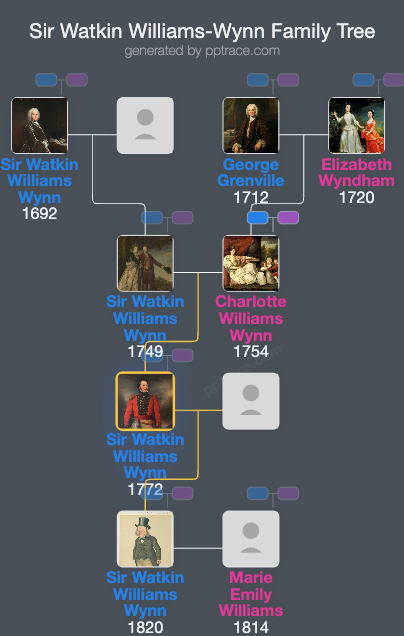
Family Tree
Tap  to expand more relatives
Introduction
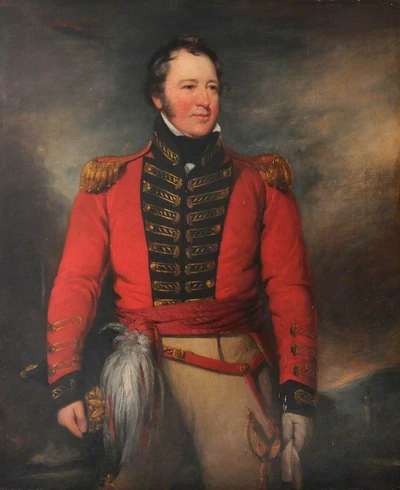
Colonel Sir Watkin Williams-Wynn, 5th Baronet (25 October 1772 – 6 January 1840), was a Welsh landowner and politician associated with the Tory party. His career spanned several decades during which he served as a Member of Parliament (MP) and held numerous military and civic positions.
He was born in Wales as the son of Sir Watkin Williams-Wynn, 4th Baronet, and Charlotte Grenville, daughter of George Grenville, a former Prime Minister of Great Britain. Through his mother's family, he was related to influential political figures; her sister Hester was married to William Pitt, 1st Earl of Chatham, making Williams-Wynn a cousin to Pitt the Younger.
Williams-Wynn received his early education at Westminster School and later attended Christ Church, Oxford. He succeeded his father to the baronetcy on 29 July 1789. In 1793, he was awarded an honorary Doctor of Civil Law (D.C.L.) from Oxford. Later, in 1819, he was admitted to Magdalene College, Cambridge, and received a Master of Arts degree. Despite receiving several offers for a peerage, he declined titles granting him a peerage.
His civic service included appointments as Lord Lieutenant of Merionethshire from 1793 to 1840 and of Denbighshire from 1796 to 1840. He also served as Mayor of Oswestry in 1800 and again in 1831, and as Mayor of Chester in 1813. In 1800, he acted as treasurer of the Salop Infirmary in Shrewsbury.
Williams-Wynn was elected MP for Beaumaris in 1794, serving until 1796. He then became MP for Denbighshire in 1796, a position he held until his death in 1840. His political influence was reinforced by his status as the largest landowner in North Wales and his control over several parliamentary seats, leading to the sobriquet "Prince in Wales" for himself.
He had a pronounced interest in military affairs. In 1794, he raised a regiment called the "Ancient British Fencibles," which participated in suppressing the Irish rebellion of 1798. The regiment was known colloquially as "Sir Watkin's lambs" and was reputedly effective against rebels, though he faced and had to defend against accusations of cruelty. Williams-Wynn commanded this regiment until 1800 when they disbanded after he unsuccessfully requested deployment abroad.
He also held the position of Colonel of the Royal Denbigh Rifles from 1797 and organized a militia battalion he led to serve alongside the Marquess of Buckingham in France in early 1814, stationed in Bordeaux. He was known among locals there as "le gros commandant Whof Whof Whof," due to his portly stature. In 1820, he became Colonel of the Denbighshire Yeomanry Cavalry; later, he served as Welsh Militia aide-de-camp to King William IV (1830–1837) and to Queen Victoria (from 1837 until his death).
Physically, Williams-Wynn was described as a portly man weighing approximately 17.5 stone (about 238 pounds or 108 kilograms), which occasionally caused chairs to break under him. Contemporary observations note his manner and speech could be impeded by his size and the size of his tongue. Starting in the winter of 1826–27, after contracting erysipelas, he suffered from increasing deafness, which was most severe in 1831.
He passed away at Wynnstay Hall in January 1840 at the age of 67 and was buried at Ruabon, Denbighshire. His son, Watkin Williams-Wynn, succeeded to the baronetcy and also served as MP for Denbighshire.
He was married to Lady Henrietta Antonia Clive, the eldest daughter of Edward Clive, 1st Earl of Powis, and Lady Henrietta Herbert. The marriage took place on 4 February 1817; Lady Henrietta predeceased him in 1835 at age 49.