Charles Williams-Wynn
| Name | Charles Williams-Wynn |
| Title | British politician (1775-1850) |
| Gender | Male |
| Birthday | 1775-10-09 |
| nationality | United Kingdom of Great Britain and Ireland |
| Source | https://www.wikidata.org/wiki/Q213150 |
| pptrace | View Family Tree |
| LastUpdate | 2025-11-26T23:23:20.014Z |
Family Tree
Tap  to expand more relatives
Introduction
Charles Watkin Williams-Wynn (9 October 1775 – 2 September 1850) was a British politician active during the early to mid-19th century. He served in both Tory and Whig governments and held the position of Father of the House of Commons from 1847 until his death in 1850.
**Early Life and Education**
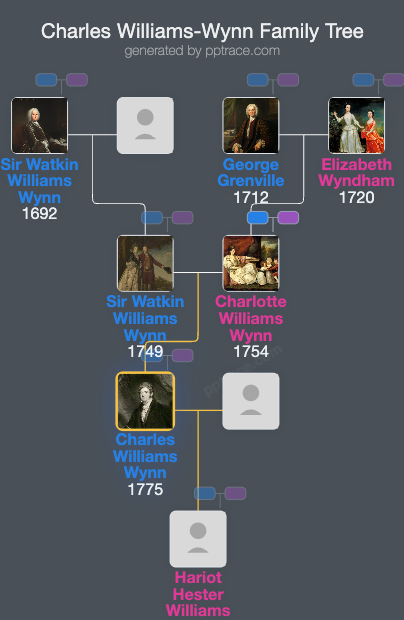
Williams-Wynn was born into a prominent Welsh family, as the second son of Sir Watkin Williams-Wynn, 4th Baronet, and his second wife Charlotte Grenville. His mother was the daughter of Prime Minister George Grenville, making Williams-Wynn related to several notable political figures: he was the nephew of William Wyndham Grenville, 1st Baron Grenville, and George Nugent-Temple-Grenville, 1st Marquess of Buckingham. William Williams-Wynn was descended from Sir William Williams, 1st Baronet, who served as Speaker of the House of Commons from 1680 to 1685.
Williams-Wynn received private education, attending Westminster School and Christ Church, Oxford. He was called to the Bar at Lincoln's Inn in 1798. While at Westminster School, he befriended the poet Robert Southey, whom he later supported financially.
**Political Career**
In 1797, Williams-Wynn was elected to Parliament for Old Sarum, a notorious "rotten borough," succeeding Richard Wellesley, 2nd Earl of Mornington. He resigned this seat in 1799 to represent Montgomeryshire, a constituency he served continuously for 51 years. During the French Revolutionary Wars, Montgomeryshire's local defense was initially neglected; however, Williams-Wynn organized local military units. By August 1803, he had helped form two troops of Yeomanry Cavalry, and he served as Major-Commandant. The force expanded into the Montgomeryshire Volunteer Legion, an all-arms unit including cavalry and infantry. The cavalry units, known as the Montgomeryshire Yeomanry, existed until disbanded in 1828, but Williams-Wynn attempted to reform the regiment in 1831, and it saw service during the Chartist riots in 1838–39. He retired from command in 1844 at age 77.
In 1806, Williams-Wynn was appointed Under-Secretary of State for the Home Department in the Ministry of All the Talents, led by his uncle Lord Grenville, and served until the government fell in 1807. He was known for his expertise in the procedural aspects of the House of Commons and was considered a contender for the Speakership in 1817 but was defeated by Charles Manners-Sutton.
Throughout the late 1810s, he led a group seeking to establish a third political party within Parliament, acting on behalf of his cousin Lord Buckingham. This group ultimately aligned with the Tories.
In January 1822, Williams-Wynn was admitted to the Privy Council and appointed President of the Board of Control, serving in the cabinet of the Earl of Liverpool. He retained this post through the governments of George Canning and Lord Goderich. With the accession of the Duke of Wellington in 1828, Williams-Wynn was excluded from the cabinet, leading to his opposition stance. When the Whigs under Lord Grey formed government in November 1830, he was appointed Secretary at War, though he was not a cabinet member, serving until April 1831. During the subsequent Tory government of Sir Robert Peel in 1834, he was appointed Chancellor of the Duchy of Lancaster but was again not part of the cabinet, and he remained in this role until the government’s fall in April 1835.
Williams-Wynn declined the position of Governor-General of India three times. He remained a Member of Parliament for Montgomeryshire until his death and was the last MP in Parliament to have begun serving in the 18th century. From 1823 to 1841, he served as the first president of the Royal Asiatic Society of Great Britain and Ireland, and he was elected a Fellow of the Royal Society in 1827.
**Family**
In 1806, Williams-Wynn married Mary Cunliffe, daughter of Sir Foster Cunliffe, 3rd Baronet. They had seven children: two sons and five daughters. His eldest daughter, Charlotte Williams-Wynn, was a noted diarist. His son, also named Charles, followed him into Parliament. Williams-Wynn died in September 1850 at the age of 74.