
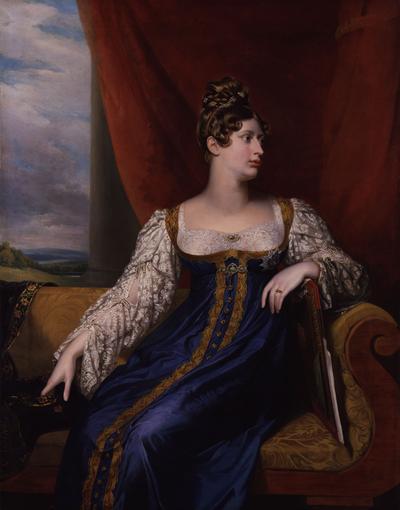
Princess Charlotte Augusta Of Wales
| Name | Princess Charlotte Augusta Of Wales |
| Title | British princess (1796-1817); only child of George, Prince of Wales (later King George IV) |
| Gender | Female |
| Birthday | 1796-01-07 |
| nationality | United Kingdom of Great Britain and Ireland |
| Source | https://www.wikidata.org/wiki/Q132440 |
| pptrace | View Family Tree |
| LastUpdate | 2025-11-12T01:16:58.394Z |
Family Tree
Tap  to expand more relatives
Introduction
Princess Charlotte of Wales (Charlotte Augusta) was born on 7 January 1796 and died on 6 November 1817. She was the only child of George, Prince of Wales (later King George IV), and Caroline of Brunswick. She was considered the heir to the British throne after the deaths of her grandfather, King George III, and her father. Her death at age 21 occurred during childbirth, prior to her father’s accession, preventing her from becoming monarch.
Charlotte’s parents’ marriage was arranged, but they harbored mutual dislike from the outset and separated shortly after their wedding on 8 April 1795. George, the Prince of Wales, primarily left Charlotte’s upbringing to governesses and servants, restricting her contact with her mother, who eventually left the country. Charlotte’s early childhood was marked by family conflicts, with her mother residing separately and visits being limited. In December 1798, George invited Caroline to spend winter at Carlton House, a request she declined, marking the end of any serious reconciliation.
Charlotte’s early years were characterized by her health and the tumult of her family environment. She was described as having a warm heart and a lively personality, with her biographer Thea Holme noting her happy recklessness. Her childhood involved frequent moves and changes in household staff, including the dismissal of her governess Lady Elgin and the hiring of Lady de Clifford, who was fond of Charlotte and her playmate, George Keppel. Her education included instruction in music, where she became an accomplished pianist, and lessons in the Anglican faith from Bishop of Exeter.
Throughout her adolescence, Charlotte's behavior drew mixed opinions from court observers, with descriptions of her as lively and candid, and occasionally undignified. As the final years of King George III’s reign approached, Charlotte witnessed her father’s descent into madness and the assumption of regency by his son, the Prince Regent. Charlotte’s personal relationships included infatuations with her cousin George FitzClarence and Lieutenant Charles Hesse, though her main romantic attachment developed later with Leopold of Saxe-Coburg-Saalfeld.
In 1814, negotiations began for her marriage to William, Hereditary Prince of Orange, designed to strengthen British influence in Europe, but the arrangement was ultimately abandoned after Charlotte refused to marry a foreigner without her mother’s approval. She then turned her affections toward Leopold, with whom she maintained a relationship that was eventually formalized. Her marriage to Leopold took place on 2 May 1816 at Carlton House. The wedding was attended by crowds and noteworthy for its grandeur, including her wedding dress, which cost over £10,000.
Following her marriage, Charlotte and Leopold honeymooned at Oatlands Palace and later at Claremont. She was pregnant again by 1817, and her pregnancy attracted significant public interest, with betting shops and stock markets reflecting the anticipation of her child’s sex. Her health deteriorated in late 1817 following complications during childbirth. On 5 November 1817, she gave birth to a stillborn boy. Tragically, she died shortly afterward, on the evening of 6 November, due to postpartum complications. Her death was mourned nationwide, with widespread public grief.
Charlotte was buried in St. George’s Chapel, Windsor Castle, on 19 November 1817. Her death caused a succession crisis, as her father, King George III, had no further legitimate grandchildren at the time. The event also prompted reforms in obstetric practice and had a lasting impact on the royal succession. Her legacy includes her influence on British monarchy and public memory as a symbol of hope and national mourning.
Her ancestry traces to European royal families, including her grandfather King George III. She was the granddaughter of Queen Charlotte and Augusta of Brunswick.
