
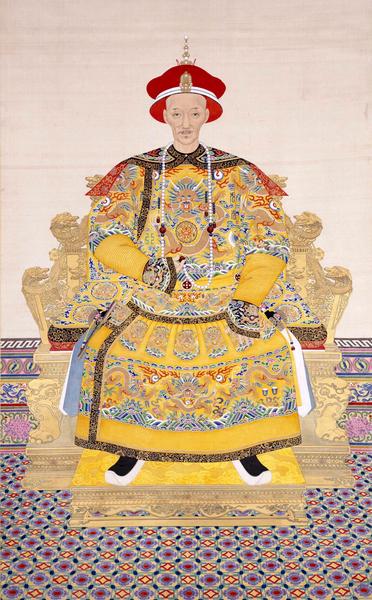
Daoguang Emperor
| Name | Daoguang Emperor |
| Title | Qing-dynasty Chinese emperor (1782–1850) |
| Gender | Male |
| Birthday | 1782-09-16 |
| nationality | Qing dynasty |
| Source | https://www.wikidata.org/wiki/Q334351 |
| pptrace | View Family Tree |
| LastUpdate | 2025-10-27T03:40:00.391Z |
Family Tree
Tap  to expand more relatives
Introduction
The Daoguang Emperor (16 September 1782 – 26 February 1850), also known by his temple name Emperor Xuanzong of Qing, was the seventh emperor of the Qing dynasty and the sixth Qing emperor to rule over China proper. His personal name was Minning; he was originally given the name Mianning. He was born in the Forbidden City, Beijing, in 1782.
He was the second son of Prince Yongyan, who was the 15th son and heir of the Qianlong Emperor. Although his elder brother was born to Yongyan's concubine, Mianning was first in line after Prince Yongyan due to his mother's status as primary spouse and the dishu system in place at the time. Mianning was favored by his grandfather, the Qianlong Emperor, and participated in hunting expeditions from a young age. Notably, at nine years old, he successfully hunted a deer during a trip, an event that amused the Qianlong Emperor. The Qianlong Emperor abdicated in 1796 when Mianning was 14, and his father, Prince Yongyan, became the Jiaqing Emperor. His mother was then honored as empress consort. The Qianlong Emperor died in 1799 when Mianning was 17.
During his early years, Mianning played a role in defending the Forbidden City from the Eight Trigrams invaders in 1813.
He ascended to the throne in September 1820 following the death of the Jiaqing Emperor. His reign was marked by internal and external crises, including the Khoja rebellion in Xinjiang and conflicts related to opium. In 1820, the exiled Khoja leader Jahangir Khoja attacked Xinjiang from Kokand, leading to the fall of several key cities by 1826. The rebellion was ultimately suppressed, and Jahangir Khoja was executed in 1828.
The Daoguang Emperor's government attempted to address the opium crisis through edicts banning the substance in the 1820s and 1830s. Lin Zexu was appointed as Imperial Commissioner to Canton to enforce these bans. Lin's efforts contributed to tensions with Britain, which culminated in the First Opium War (1839–1842). China was defeated in the war, resulting in the cession of Hong Kong to Britain, the payment of indemnities, and a recognition of British trade rights through the Treaty of Nanjing.
During his reign, the emperor also dealt with the Khoja rebellion in Xinjiang, where cities such as Kashgar and Yarkand fell to insurgents before being retaken by Qing forces. In 1811, a legal clause prescribing death for Europeans spreading Catholicism was added to Qing law; after Protestant missionaries distributed Christian texts in 1835 and 1836, the emperor demanded identification of those responsible in Guangzhou.
The Daoguang Emperor granted noble titles, including "Wujing Boshi" to descendants of Ran Qiu. He died on 26 February 1850 at the Old Summer Palace, near Beijing. His successor was his eldest surviving son, Yizhu, who became the Xianfeng Emperor.
His reign is characterized by increased economic difficulties, sectarian unrest, and intensified foreign pressures, which contributed to the decline of the Qing dynasty. He was interred at the Mu mausoleum complex, part of the Western Qing Tombs, approximately 120 km southwest of Beijing.
Family details include multiple consorts, empresses, noble consorts, and numerous children. His official consort include Empress Xiaomucheng of the Niohuru clan, Empress Xiaoshencheng of the Tunggiya clan, and Empress Xiaoquancheng of the Niohuru clan. His sons include the future Xianfeng Emperor, Yizhu, and Prince Gongzhong of the First Rank, Yixin.
The Daoguang Emperor’s reign saw significant challenges, including the First Opium War and internal rebellion, which highlighted the vulnerabilities of Qing China amidst increasing Western influence.
