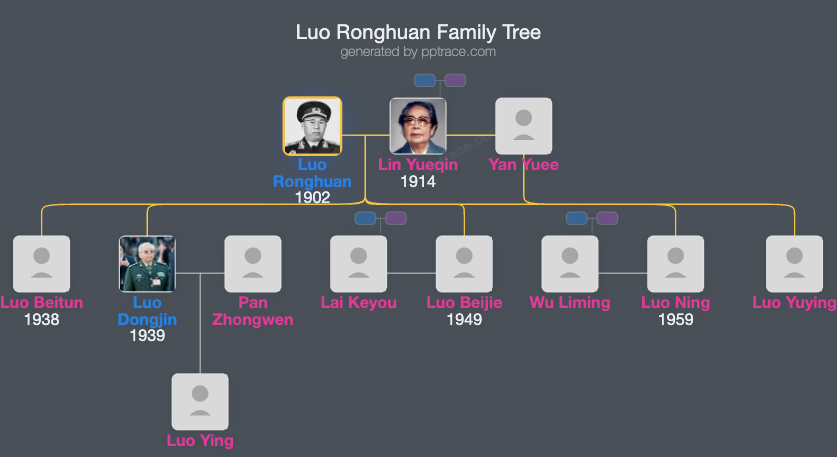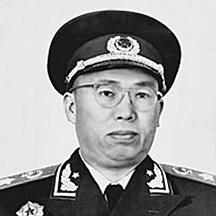
Luo Ronghuan
| Name | Luo Ronghuan |
| Title | Marshal of the People's Republic of China (1902-1963) |
| Gender | Male |
| Birthday | 1902-11-26 |
| nationality | Qing dynasty |
| Source | https://www.wikidata.org/wiki/Q709545 |
| pptrace | View Family Tree |
| LastUpdate | 2025-10-01T10:08:34.403Z |
Family Tree
Tap  to expand more relatives
Introduction
Luo Ronghuan, born on November 26, 1902, was a native of Hengshan County (now Hengdong County) in Hunan Province. In his early years, he received education and began participating in anti-warlord Zhang Jingyao's activities and resistance against Japanese goods at the end of 1919. In July 1923, he was admitted to the engineering preparatory department at Qingdao University, a private university in Shandong. Subsequently, in April 1927, he transferred to the College of Science at Zhongshan University in Wuhan. During this period, he joined the Chinese Communist Youth League, served as a league branch committee member and organization officer, and later became a member of the Chinese Communist Party.
In July 1927, he was dispatched to Tongcheng County in southern Hubei to carry out peasant movements, organize peasant self-defense armies, and on August 20, led the autumn harvest uprising in Tongcheng. At the same time, he participated in armed struggles with farmers along the borders of southern Jiangxi and western Fujian, and in January 1930, attended the Sanwan Village Conference in Xiushui, officially becoming a member of the Chinese Workers' and Peasants' Revolutionary Army. In June 1930, the Fourth Red Army was established, with Luo Ronghuan serving as the army's political commissar and political officer.
During the Long March, he briefly served as deputy director of the Political Department of the Eighth Army and accompanied the forces to northern Shaanxi to join the anti-Japanese campaign. Starting in 1937, he served as the director of the Political Department of the 115th Division of the Eighth Route Army, actively mobilizing the masses and establishing anti-Japanese bases. During the War of Resistance Against Japan, he commanded anti-Japanese forces in border regions such as Jin-Ji and Luliang Mountains, leading guerrilla warfare, and consolidating and expanding anti-Japanese bases. In 1941, he organized and commanded military operations in the central Shandong anti-Japanese base area, achieving multiple victories.
In March 1943, he was appointed commander and political commissar of the Shandong Military District, emphasizing party ideological training, leading the rectification movement, and advancing strategic counterattacks in the anti-Japanese base areas. By 1945, he commanded counteroffensive operations in Shandong, controlling most of the region and establishing the strongest Communist anti-Japanese base. After the war, he led forces in shandong Army regroupments, organized large-scale cross-sea troop transports to Northeast China, laying the foundation for the Northeast Liberation War.
From 1946 onward, he commanded operations in Northeast China, serving as deputy political commissar of the Northeast People's Liberation Army, participating in the Liaoshen Campaign, and playing a decisive role. After the conclusion of the Liberation War, he participated in the Pingjin Campaign, promoting the peaceful liberation of Beijing and Tianjin. Following the founding of the People's Republic of China, he held positions such as Chief Procurator of the Supreme People's Procuratorate, Director of the General Political Department of the People's Liberation Army, and Vice President of the State.
In 1955, he was awarded the rank of Marshal of the People's Republic of China and received multiple first-class medals. On December 16, 1963, he died in Beijing due to illness at the age of 61. Mao Zedong, upon mourning his death, commented that "your departure is a great loss for the people," highly praising his contributions to revolution and military development. Luo Ronghuan authored numerous articles and works on military and political matters, including "The Autumn Harvest Uprising and the Initial Formation of Our Army" and "Studying the Thought of Comrade Mao Zedong." His former residence and memorial hall are located in Nanwan Village, Hengdong County, and are commemorated as important revolutionary sites.