William Cavendish-Bentinck, 3rd Duke Of Portland
| Name | William Cavendish-Bentinck, 3rd Duke Of Portland |
| Title | British politician and prime minister (1738–1809) |
| Gender | Male |
| Birthday | 1738-04-14 |
| nationality | Great Britain |
| Source | https://www.wikidata.org/wiki/Q157208 |
| pptrace | View Family Tree |
| LastUpdate | 2025-11-26T23:22:15.308Z |
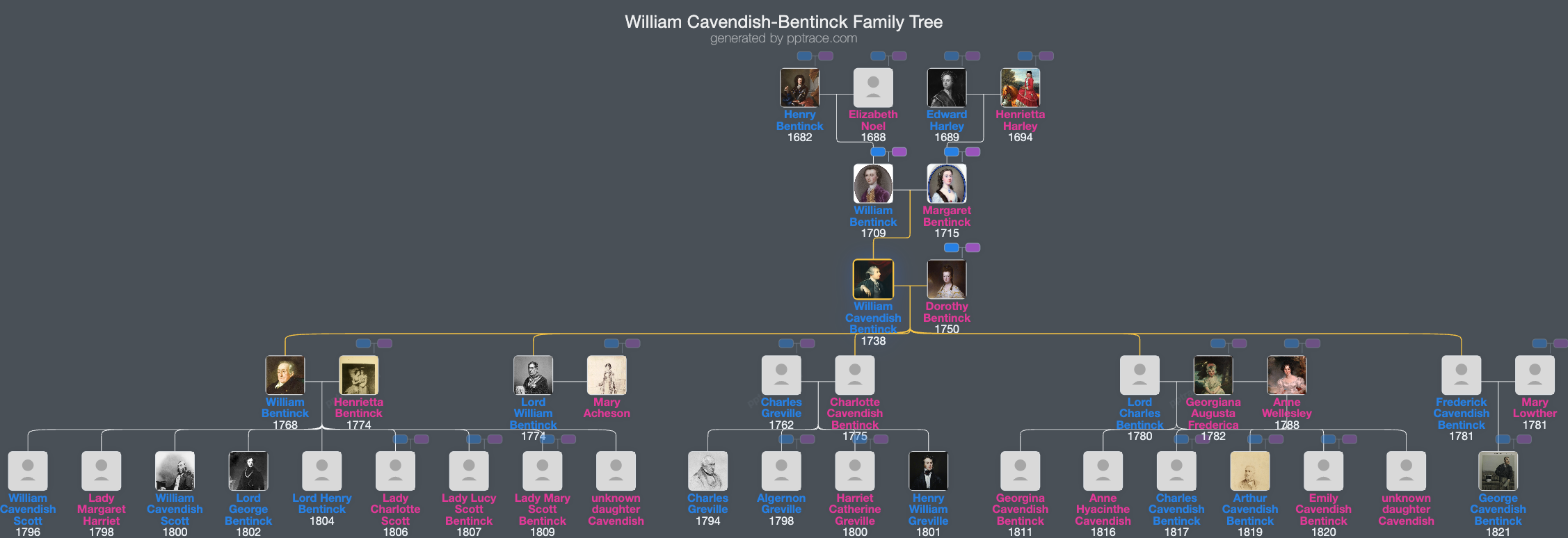
Family Tree
Tap  to expand more relatives
Introduction
William Henry Cavendish Cavendish-Bentinck, 3rd Duke of Portland (14 April 1738 – 30 October 1809), was a British politician during the late Georgian era. His political career included serving as Prime Minister of Great Britain in 1783 and subsequently as Prime Minister of the United Kingdom from 1807 to 1809. Between these terms, he held various governmental roles, including Secretay of State for the Home Department and Lord President of the Council.
Born at Bulstrode Park in Buckinghamshire, he was the eldest son of William Bentinck, 2nd Duke of Portland, and Lady Margaret Cavendish-Harley, known as "the richest woman in Great Britain." His maternal lineage included connections to John Holles, 1st Duke of Newcastle. He was educated at Westminster School and Christ Church, Oxford, where he earned a Master of Arts degree in 1757.
In December 1757, at the age of 19, he was sent to Warsaw to study under Lord Stormont, accompanied by Stormont’s secretary, Benjamin Langlois. His studies focused on ancient history, modern history, and general law. Subsequently, he traveled through Germany and Italy, spending time in Turin and Florence, and served as a secretary in the British embassy in Vienna when Stormont was ambassador.
He married Lady Dorothy Cavendish on 8 November 1766. She was the only daughter of William Cavendish, 4th Duke of Devonshire. They had nine children, six of whom survived to adulthood. Their notable offspring included William Henry Cavendish-Scott-Bentinck, 4th Duke of Portland, and other descendants who connected to various noble titles and the British royal family.
Portland entered Parliament representing Weobley in 1761 and succeeded his father as Duke of Portland the following year, thereby entering the House of Lords. Initially affiliated with the Whig Party, he was associated with the aristocratic Whig faction of Lord Rockingham and served as Lord Chamberlain of the Household during Rockingham’s first government (1765–1766). He briefly served as Lord Lieutenant of Ireland in 1782, where he attempted to implement conciliatory policies after years of coercion and taxation due to the American Revolutionary War.
In April 1783, Portland became the nominal head of a coalition government as Prime Minister. His administration, which was led in practice by Charles James Fox and Lord North, formulated and signed the Treaty of Paris to end the American Revolutionary War. The government lasted until December 1783, ending after losing a House of Lords vote on East India Company reforms.
Portland was also involved in charitable activities, serving as a vice president and later president of the Foundling Hospital, founded to care for abandoned children in London. His political stance evolved in response to the French Revolution; he distanced himself from Fox and joined William Pitt the Younger’s government as Secretary of State for the Home Department in 1794, a role he held during a period of political unrest and military conflict.
He continued to serve in various governmental capacities, including Lord President of the Council (1801–1805) and Minister without Portfolio before returning as Prime Minister in 1807, following Pitt’s death. His second term was characterized by Britain's diplomatic isolation during the Napoleonic Wars and the gradual onset of military engagement in the Peninsular War.
William Cavendish-Bentinck died at Burlington House in Piccadilly on 30 October 1809, after an operation for a kidney stone. He was buried at St Marylebone Parish Church, London. Despite his substantial income, he had accumulated debts of approximately £52,000 at his death, which were subsequently paid off by his heir through the sale of property.
His legacy includes the Portland Vase, a Roman glass piece named after him due to its ownership by his family, and various places and institutions bearing his name, such as Portland Parish in Jamaica, Portland Street and Great Portland Street in London, and Portland Bay in Australia. The Portland Collection holds a significant number of his personal and official papers, along with artworks associated with him.