
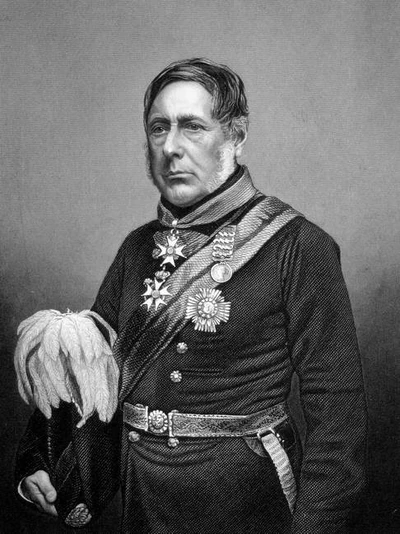
Lord William Bentinck
| Name | Lord William Bentinck |
| Title | First Governor General of India, British soldier and statesman (1774-1839) |
| Gender | Male |
| Birthday | 1774-09-14 |
| nationality | United Kingdom of Great Britain and Ireland |
| Source | https://www.wikidata.org/wiki/Q138559 |
| pptrace | View Family Tree |
| LastUpdate | 2025-11-26T23:22:14.422Z |
Family Tree
Tap  to expand more relatives
Introduction
Lieutenant-General Lord William Henry Cavendish-Bentinck (14 September 1774 – 17 June 1839), commonly referred to as Lord William Bentinck, was a British military officer and political figure who played a significant role in British India. He served as governor of the Bengal Presidency from 1828 to 1834 and subsequently as the first Governor-General of India from 1834 to 1835.
Born in Buckinghamshire, England, Lord William was the second son of William Bentinck, 3rd Duke of Portland, who was Prime Minister of Great Britain, and Lady Dorothy Cavendish, daughter of William Cavendish, 4th Duke of Devonshire. The family name was changed to Cavendish-Bentinck upon his parents' marriage. He received education at Westminster School in London.
At the age of nine, in 1783, Bentinck was appointed to the sinecure of Clerk of the Pipe. He joined the Coldstream Guards in January 1791 at age 16, purchasing an ensign's commission. Over the next few years, he gained promotions: to captain-lieutenant in 1792, to captain in April 1793, to major in March 1794, and to lieutenant-colonel in July 1794. He was promoted to colonel in January 1798.
In 1803, Bentinck was appointed Governor of Madras, a position that was considered surprisingly early in his career. He was promoted to major-general on 1 January 1805. His tenure in Madras was marked by the aftermath of the Vellore Mutiny in 1806, which was caused by orders that forbade native troops from wearing traditional attire. The mutiny was suppressed after violence, and the policy was rescinded, but Bentinck was recalled in 1807.
Bentinck served in the Peninsular War, notably participating as a brigade commander at the Battle of Corunna. Following his European military service, he was appointed commander of British forces in Sicily, where he was brevetted to lieutenant-general in March 1811. His political inclinations aligned with the Whig party; he sought to influence internal Sicilian affairs, advocating for constitutional reforms and constitutional government, which led to conflicts with local authorities, including Queen Maria Carolina.
In Sicily, Bentinck was instrumental in establishing a constitution on 20 July 1812, which provided for the separation of legislative and executive powers and abolished centuries-old feudal practices. This constitution symbolized a significant move toward Sicilian autonomy. However, the constitution was abolished in December 1816 following the return of Ferdinand IV to the throne of the Kingdom of the Two Sicilies, and Sicily was reintegrated with Naples. The constitutional experiment is viewed as having had a lasting influence on the subsequent Sicilian revolutions.
In 1814, Bentinck participated in British efforts in Italy, including efforts to support the exile of Joachim Murat and to promote Italian independence. He commanded British forces in Naples and led military actions in northern Italy, including a landing at Livorno. His proclamation at Livorno called on Italians to rise against Napoleon, advocating for Italian liberation that aligned with British interests.
Throughout his career, Bentinck engaged in military campaigns, colonial administration, and political reforms, with notable involvement in social reform measures in India, such as the abolition of sati (widow immolation), the suppression of infanticide and human sacrifice, and the effort to eliminate thuggee, a notorious band of assassins active for over 450 years. He, along with Thomas Babington Macaulay, promoted the use of English as the medium of instruction in Indian education.
Bentinck’s career reflected active military service and colonial governance, characterized by attempts to implement reformist policies within the contexts of empire and diplomacy.
