Margaret Bentinck, Duchess Of Portland
| Name | Margaret Bentinck, Duchess Of Portland |
| Title | British aristocrat, naturalist, botanist, and collector (1715-1785) |
| Gender | Female |
| Birthday | 1715-02-11 |
| nationality | Great Britain |
| Source | https://www.wikidata.org/wiki/Q126219 |
| pptrace | View Family Tree |
| LastUpdate | 2025-11-26T23:22:29.662Z |
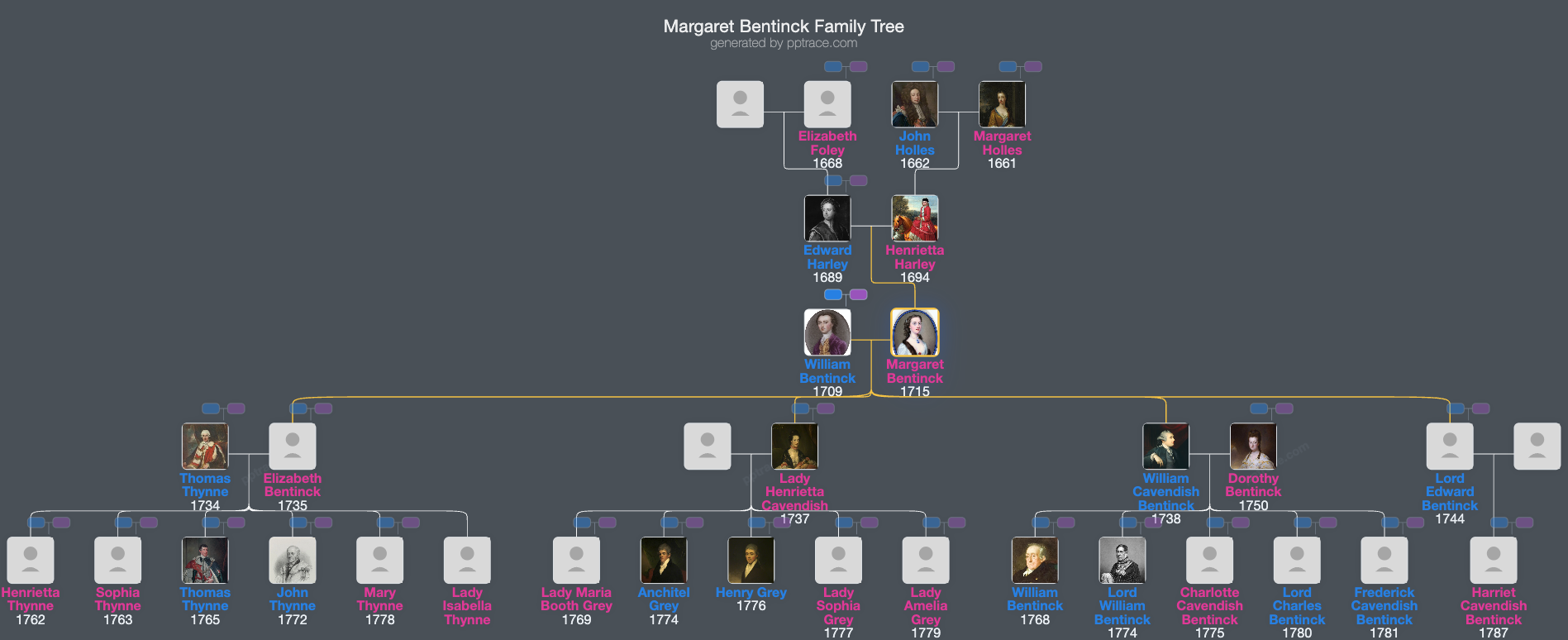
Family Tree
Tap  to expand more relatives
Introduction
Margaret Cavendish Bentinck, Duchess of Portland (11 February 1715 – 17 July 1785), was a British noblewoman known for her collection of natural history objects, artworks, and her involvement in intellectual societies. She was born in Great Britain and held titles including Lady Margaret Harley before 1734, and Duchess of Portland from 1734 until her husband's death in 1761. After his passing, she was styled as the Dowager Duchess of Portland until her death.
Her parents were the 2nd Earl of Oxford and Mortimer and Lady Henrietta Holles. Her father was a bibliophile, collector, and patron of the arts, while her mother was the daughter of the 1st Duke of Newcastle-upon-Tyne. Margaret was raised at Wimpole Hall in Cambridgeshire, where she was exposed to literature, art, and natural history from a young age, with associations including Alexander Pope, Jonathan Swift, and Matthew Prior. As a child, she collected pets and natural history specimens, notably seashells, encouraged by her family.
At the age of 19, she married the 2nd Duke of Portland on 11 July 1734 at Oxford Chapel, Marylebone. They had six children: Lady Elizabeth Bentinck, who married Thomas Thynne, 1st Marquess of Bath; Lady Henrietta Bentinck, who married George Grey, 5th Earl of Stamford; William Henry Cavendish-Bentinck, the 3rd Duke of Portland; Lady Margaret Bentinck; Lady Frances Bentinck; and Lord Edward Charles Cavendish-Bentinck. Elizabeth Elstob served as her tutor from 1738 to 1756.
Her interest in collecting expanded rapidly after her marriage, encompassing decorative arts and natural history. She resided at Bulstrode Hall in Buckinghamshire, which housed her extensive collections. She inherited additional estates upon her mother's death in 1755, including Welbeck in Nottinghamshire. Her collection was notable for its curation, inclusiveness of specimens from around the world—including Lapland and the South Seas—and its association with prominent scientists such as Daniel Solander and Reverend John Lightfoot. She also corresponded with the philosopher Jean-Jacques Rousseau, who admired her botanical knowledge. Rousseau offered to serve as her "herborist," though this did not materialize.
The collection included thousands of items and was open to visitors, attracting scholars, scientists, philosophers, and royalty. It featured specimens, art objects like the Portland Vase, and a botanic garden. Lightfoot described her ambitious goal to have every species of living organism described and published. The collection was well-documented, with her recording and illustrating specimens.
Following her death, her children were reportedly uninterested in her collection, and her financial circumstances prompted the sale of the collection at auction in 1786. Over 4,000 lots were sold at her Whitehall residence, with only a few items, such as the Portland Vase, retained within her family. The sale included natural history specimens, decorative arts, and parts of her collection's structural components.
Some of her personal papers and correspondence are preserved by the Manuscripts and Special Collections at the University of Nottingham, as part of the Portland (Welbeck) Collection. The Harley Gallery's Treasury Museum displays objects from her collection.
In addition to her interests in collecting, Margaret Cavendish Bentinck was a signatory to the Ladies' Petition supporting the establishment of the Foundling Hospital in 1735, advocating for orphaned and abandoned children. Her support helped garner signatures from the nobility and influential figures, contributing to the hospital's establishment via royal charter in 1739.
Margaret Street in London is named after her. Her legacy includes contributions to natural history collecting and her association with intellectual and charitable activities during the 18th century.