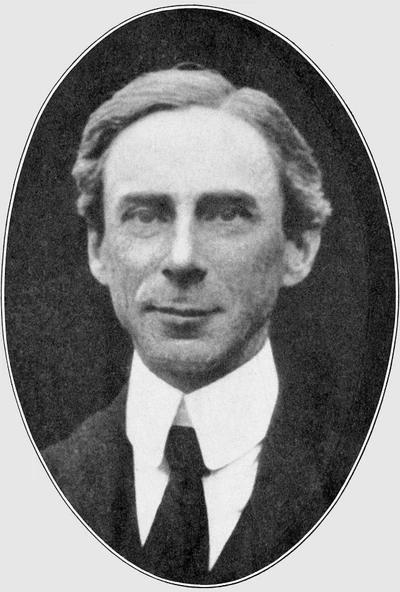
Bertrand Russell
| Name | Bertrand Russell |
| Title | British philosopher and logician (1872–1970) |
| Gender | Male |
| Birthday | 1872-05-18 |
| nationality | United Kingdom |
| Source | https://www.wikidata.org/wiki/Q33760 |
| pptrace | View Family Tree |
| LastUpdate | 2025-11-26T23:28:47.783Z |
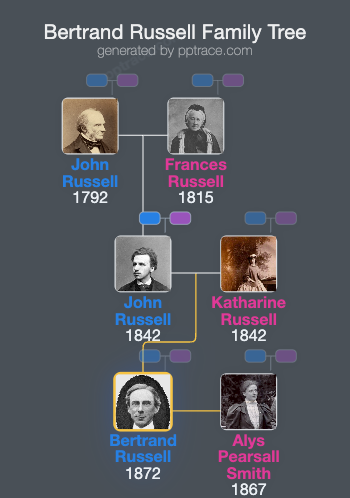
Family Tree
Tap  to expand more relatives
Introduction
Bertrand Arthur William Russell, 3rd Earl Russell, was born on 18 May 1872 at Ravenscroft in Trellech, Monmouthshire, Wales. He was a member of the British aristocracy and was part of an influential family with notable political and social prominence. His parents were Viscount and Viscountess Amberley. Both parents were advocates of birth control, which was considered controversial at the time. His father consented to his wife’s affair with their children’s tutor, Douglas Spalding, a biologist. Lord Amberley, a deist, requested the philosopher John Stuart Mill to serve as Russell's secular godfather. Mill died in 1873, a year after Russell's birth. Russell's paternal grandfather was Lord John Russell, who served twice as Prime Minister of the United Kingdom during the 19th century. The Russell family had been prominent in English politics and society since at least the 16th century, participating in events such as the dissolution of the monasteries, the Glorious Revolution, and the Great Reform Act of 1832. Lady Amberley, Russell’s maternal grandmother, was the daughter of Lord and Lady Stanley of Alderley.
Russell experienced a troubled childhood, losing his mother to diphtheria in June 1874 and his sister Rachel shortly afterward. His father died of bronchitis in January 1876, after a period of depression. Following these losses, Russell and his brother Frank were raised by their paternal grandparents at Pembroke Lodge in Richmond Park. His grandfather, the Earl Russell, died in 1878, leaving Russell’s grandmother, Lady Frances Elliot, as the primary caregiver. She held conservative religious views but supported progressive causes such as Darwinism and Irish Home Rule. Her influence was significant in shaping Russell's early outlook on social justice and principles.
During adolescence, Russell faced feelings of loneliness and contemplated suicide. He found solace in reading and developed interests in nature, books, and mathematics, which helped him through difficult times. At age eleven, he was introduced to Euclid's work by his brother Frank, an experience he regarded as profoundly influential. Russell also discovered the poetry of Percy Bysshe Shelley, whose works he learned by heart. By age fifteen, Russell began examining Christian religious dogma and concluded that there was no evidence supporting the existence of free will or an afterlife. At eighteen, after reading John Stuart Mill’s autobiography, he rejected the "First Cause" argument and adopted atheism.
Russell attended Trinity College at the University of Cambridge, winning a scholarship to study mathematics. He entered the college in 1890, where he was under the tutelage of Robert Rumsey Webb and became acquainted with G. E. Moore. Influenced by Alfred North Whitehead, Russell distinguished himself academically, graduating as seventh in his class in mathematics in 1893 and earning a fellowship in philosophy in 1895. His early academic work included exploring the foundations of mathematics and non-Euclidean geometry, culminating in the 1903 publication of "The Principles of Mathematics," which supported the philosophy of logicism—the idea that mathematics could be reduced to logic.
In 1896, Russell published his first work, "German Social Democracy," reflecting his interest in political and social theory. He engaged in teaching and research, including a study of set theory after encountering Bertrand's paradox at the 1900 International Congress of Philosophy in Paris. His pioneering work on the foundations of mathematics led to the publication of "The Principles of Mathematics" and later "Principia Mathematica," co-authored with Whitehead, between 1910 and 1913. These works significantly contributed to the development of formal logic and the attempt to ground all of mathematics in logical principles.
Russell's political activities included an unsuccessful bid as an Independent Liberal candidate for Wimbledon in 1907, and he was active in social reform circles, notably the Fabian Society. As a pacifist, he opposed World War I, leading to imprisonment for his anti-war stance. His views on international affairs evolved over time; initially supportive of appeasing Adolf Hitler's Nazi Germany, he later condemned totalitarian regimes, the U.S. involvement in Vietnam, and nuclear proliferation. Russell received the Nobel Prize in Literature in 1950 for his works promoting humanitarian ideals and freedom of thought. His other honors include the De Morgan Medal (1932), Sylvester Medal (1934), Kalinga Prize (1957), and Jerusalem Prize (1963).
He died on 2 February 1970 at the age of 97.