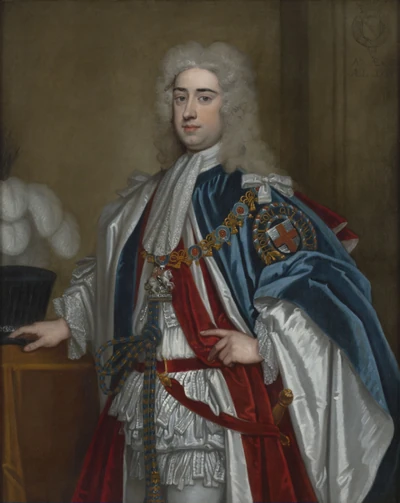
Lionel Sackville, 1st Duke Of Dorset
| Name | Lionel Sackville, 1st Duke Of Dorset |
| Title | British noble (1688-1765) |
| Gender | Male |
| Birthday | 1688-01-18 |
| nationality | Great Britain |
| Source | https://www.wikidata.org/wiki/Q337505 |
| pptrace | View Family Tree |
| LastUpdate | 2025-11-26T23:20:52.854Z |
Family Tree
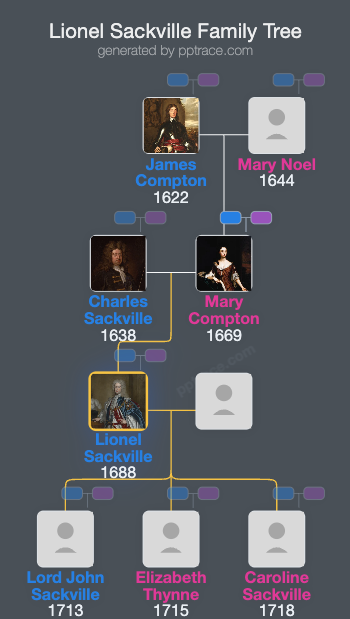
Tap  to expand more relatives
Introduction
Lionel Cranfield Sackville, 1st Duke of Dorset (born 18 January 1688, died 10 October 1765), was a British politician and nobleman. He held the office of Lord President of the Council from 1745 to 1751 and served as Lord Lieutenant of Ireland during two separate terms, from 1730 to 1737 and from 1750 to 1755.
Born into aristocracy, he was the son of Lionel Sackville, 6th Earl of Dorset and 1st Earl of Middlesex, and Lady Mary Compton, the daughter of the 3rd Earl of Northampton. He was styled Lord Buckhurst from birth. In 1706, upon the death of his father, he succeeded as the 7th Earl of Dorset and the 2nd Earl of Middlesex. He was elevated to the rank of Duke of Dorset in 1720.
In August 1714, Sackville was chosen to inform King George I of his accession to the throne, likely due to his previous diplomatic mission to Hanover. His initial relationship with George I was favorable; he received numerous appointments including Privy Councillor, Knight of the Garter, Groom of the Stole, Lord Steward, Governor of Dover Castle, and Warden of the Cinque Ports. During George I’s coronation, Sackville carried the sceptre, and at George II's coronation, he served as Lord High Steward, carrying St Edward’s Crown. He experienced a fall from favor in 1717 after clashing with the king, but was made a duke three years later.
Sackville’s first tenure as Lord Lieutenant of Ireland lasted from 1731 to 1737. His second term from 1751 to 1755 occurred amid serious political tensions in Ireland, involving factional conflicts between Henry Boyle, the Speaker of the Irish House of Commons, and George Stone, the Anglican Archbishop of Armagh. During this period, Sackville, influenced by his son George Sackville, openly supported the Archbishop over Boyle, which contributed to his unpopularity and eventual recall. The street in Dublin formerly named Sackville Street was renamed O’Connell Street in 1924.
In 1739, Sackville was among the original governors of the Foundling Hospital, a charity established to care for abandoned children. His later years saw limited activity, aside from a riot in 1757 related to the passage of the Militia Act for raising an army during the Seven Years’ War; Sackville narrowly avoided injury during this incident. He died at Knole house on 9 October 1765 and was buried in Withyham, Sussex.
Contemporaries reported on his character; Horace Walpole noted his appearance of dignity complemented a private penchant for humor and association with lower social circles. Jonathan Swift regarded him as an agreeable, intelligent man and an excellent conversationalist. Critics acknowledged his dignity and decorum, reminiscent of the manners of the Court of Queen Anne.
In January 1709, Sackville married Elizabeth Colyear, daughter of Lieutenant-General Walter Colyear, who was related to the Earl of Portmore. Elizabeth served as a Lady of the Bedchamber from 1714 to 1737 and as Mistress of the Robes for Caroline of Ansbach, wife of King George II. Their children included Charles, who succeeded as the 2nd Duke of Dorset; Lord John Sackville, the father of John Sackville, 3rd Duke of Dorset; Lord George Sackville, who became Lord George Germain and the 1st Viscount Sackville; and two daughters, Elizabeth, married to Thomas Thynne, 2nd Viscount Weymouth, and Caroline, married to Joseph Damer, 1st Earl of Dorchester.