Charles Sackville, 6th Earl Of Dorset
| Name | Charles Sackville, 6th Earl Of Dorset |
| Title | English noble and politician (1638-1706) |
| Gender | Male |
| Birthday | 1638-01-24 |
| nationality | Kingdom of England |
| Source | https://www.wikidata.org/wiki/Q337761 |
| pptrace | View Family Tree |
| LastUpdate | 2025-11-26T23:20:53.683Z |
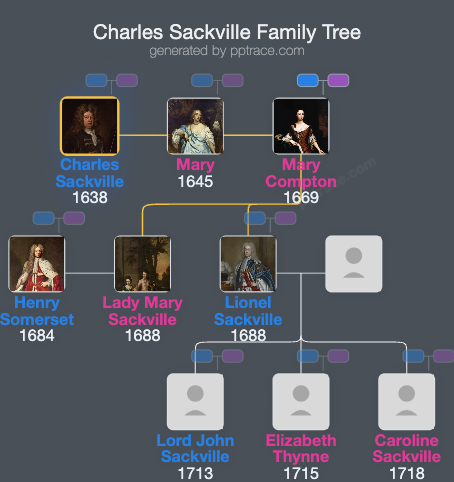
Family Tree
Tap  to expand more relatives
Introduction
Charles Sackville, 6th Earl of Dorset (24 January 1643 – 29 January 1706), was an English politician, courtier, and poet. He was born in 1643, the son of Richard Sackville, 5th Earl of Dorset (1622–1677), and Lady Frances Cranfield, sister and heiress of the 3rd Earl of Middlesex. Upon his mother's death, he inherited her estates and succeeded to the earldom in 1677, after the death of his father, in August of that year. His education was conducted privately, including time abroad with a private tutor, and he returned to England shortly before the Restoration of the monarchy.
In the early part of his career, Sackville sat as a Member of Parliament for East Grinstead during King Charles II's first Parliament. He is noted for his reputation as a courtier and wit, rather than for political ambitions. He was engaged in the Second Anglo-Dutch War in 1665, volunteering to serve under the Duke of York. It was during this period, specifically before the victory over foggy Opdam off Harwich on 3 June 1665, that he wrote his famous song, "To All You Ladies Now at Land."
In 1667, Samuel Pepys recorded his lament that Sackville had lured Nell Gwyn away from the theatre and that Sackville, along with Sedley, maintained a lively social life at Epsom. Sackville’s personal conduct in his youth included involvement in incidents of violence and misconduct. In 1662, he and his brother Edward, along with others, were indicted for the robbery and murder of a tanner named Hoppy but appear to have been acquitted, claiming they mistook Hoppy for a highwayman. The following year, Sackville was involved in a public breach of decency trial related to Sir Charles Sedley.
His social life was characterized by association with the "Merry Gang," a group of libertine courtiers and playwrights active from around 1665 for approximately fifteen years. Members included John Wilmot, 2nd Earl of Rochester; Henry Jermyn; John Sheffield, Earl of Mulgrave; Sir Charles Sedley; William Wycherley; George Etherege; and George Villiers, 2nd Duke of Buckingham. The gang was known for advocating libertinism, engaging in acts ranging from playful to violent, and often shocking public morality. Sackville's behavior was often aligned with this group's notorious reputation, including allegations of violence and public misconduct.
Sackville's personal life included three marriages. His first wife was Mary Bagot, widow of Charles Berkeley, Earl of Falmouth, whom he married in June 1674. His second wife was Mary Compton, daughter of James Compton, 3rd Earl of Northampton, married on 7 March 1685; they had two children: Lionel Cranfield Sackville, who became the 1st Duke of Dorset, and Mary Sackville (1689–1705). He also fathered two illegitimate daughters: one named Mary Sackville, who died in 1714, and another with actress Alice Lee, named Anne Lee Sackville (1667–1738). Sackville died in Bath in 1706.
His literary contributions include translation of the fourth act of "Pompey the Great," and a reputation as a poet, with some of his short lampoons noted by Pope. His influence extended to notable poets such as Dryden, who addressed him in his works. His patronage supported writers like John Dryden, who received a pension from Sackville after being dismissed from the laureateship. Matthew Prior acknowledged Sackville's role in the literary scene, citing his influence on poets including Waller, Butler, and Wycherley.
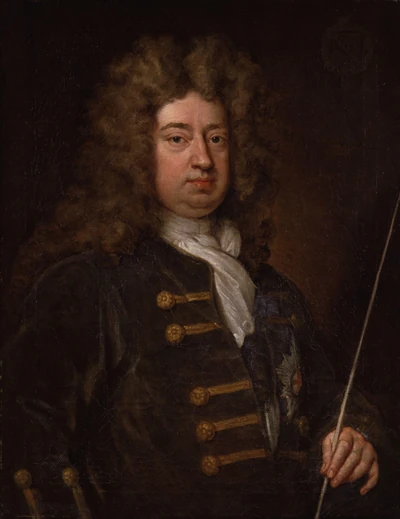
In popular culture, Sackville is portrayed by Johnny Vegas in the 2004 film "The Libertine," which depicts the Earl of Rochester and the social circle known as the "Merry Gang." His images and portraits are preserved in collections such as the National Portrait Gallery, London, and archival material related to him is held by the UK National Archives.