Lord John Sackville
| Name | Lord John Sackville |
| Title | English cricketer (1713–1765) |
| Gender | Male |
| Birthday | 1713-06-22 |
| nationality | Great Britain |
| Source | https://www.wikidata.org/wiki/Q6679456 |
| pptrace | View Family Tree |
| LastUpdate | 2025-11-26T12:19:33.124Z |
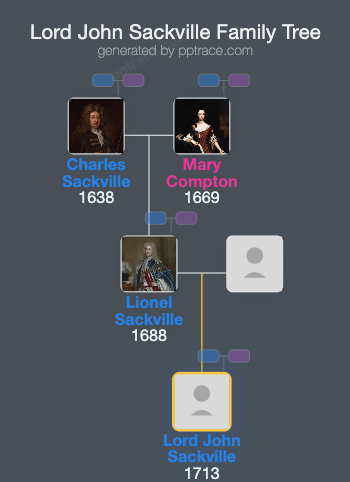
Family Tree
Tap  to expand more relatives
Introduction
Lord John Philip Sackville was born on 22 June 1713 and died on 3 December 1765. He was the second son of Lionel Sackville, 1st Duke of Dorset. His early life and background are documented through his familial connections and his education, although specific details about his upbringing are not provided in the available sources.
He held political office as a Member of Parliament for Tamworth from 1734 to 1747. During his parliamentary tenure, he was involved in the political landscape of the time, but there are no specific legislative achievements or political activities recorded in the provided information.
Sackville's involvement in cricket began in 1734, with his first recorded participation occurring at Sevenoaks Vine, where he and his brother, Lord Middlesex, played for a Kent team against Sussex. In August 1735, he captained the Kent team to victory against Sir William Gage's Sussex side at the same venue. Following this, he became the primary patron of the Kent cricket team and frequently served as its captain until 1745. He also played for the London Cricket Club in 1739. Notably, in 1744, Sackville challenged an England side to a match, which Kent won; he contributed by taking a catch to dismiss Richard Newland. This particular catch was highlighted in James Love's 1745 publication, "Cricket, An Heroic Poem." The details of this match are preserved in an early cricket scorecard, considered one of the oldest surviving records of the sport.
In his personal life, Sackville was known as a rake in his youth. He was compelled to marry Lady Frances Leveson-Gower in 1744 after she gave birth to his child at Woburn. Lady Frances was the daughter of John Leveson-Gower, 1st Earl Gower, and sister of the Duchess of Bedford. The marriage produced two sons and one daughter; among them was John Frederick Sackville, who later became the 3rd Duke of Dorset, born on 25 March 1745, and a daughter, Mary Sackville, born on 1 April 1746, who married Sackville Tufton, 8th Earl of Thanet, in 1767.
Sackville's family and social connections influenced his fortunes. His parents were displeased with his marriage, and the Prince of Wales compensated him financially for any potential loss, appointing him as a lord of his bedchamber in 1745 to secure his political allegiance. He also aspired to inherit substantial estates from Lord Wilmington, the late Prime Minister, but was disappointed when Wilmington declined to leave him the Sussex estates, valued between £3,000 and £4,000 annually. The reasons for Wilmington's decision remain unclear.
His military career commenced with a commission as a captain in the 37th Regiment of Foot in 1734. He was later promoted to captain and lieutenant-colonel in the 2nd Regiment of Foot Guards on 1 May 1740. However, his military career was marred by disgrace when he deserted from the Guards during foreign service in 1746, leading to his departure from the Army in September of that year. Subsequently, he faced personal difficulties; he was committed to a private lunatic asylum around 1746 and was later exiled abroad. In Lausanne, he lived on a limited allowance and was observed by Lord Shelburne in 1760, who noted his unkempt condition but remarked on his lucid conversation.
Later in life, Sackville reportedly became insane, and he died in Geneva, Switzerland, at the age of 52. Despite his personal struggles, his brother lived long enough to have his son inherit the family title, making him the next Duke of Dorset.