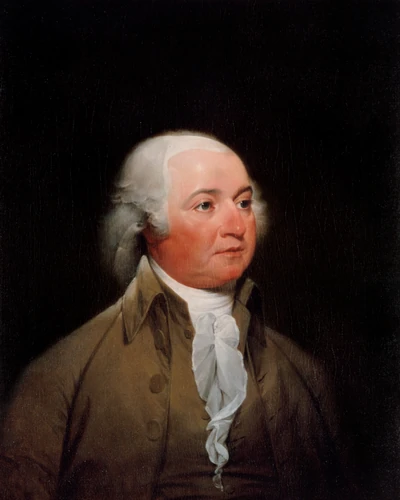
John Adams
| Name | John Adams |
| Title | president of the United States from 1797 to 1801 |
| Gender | Male |
| Birthday | 1735-10-30 |
| nationality | United States of America |
| Source | https://www.wikidata.org/wiki/Q11806 |
| pptrace | View Family Tree |
| LastUpdate | 2025-11-17T06:36:57.419Z |
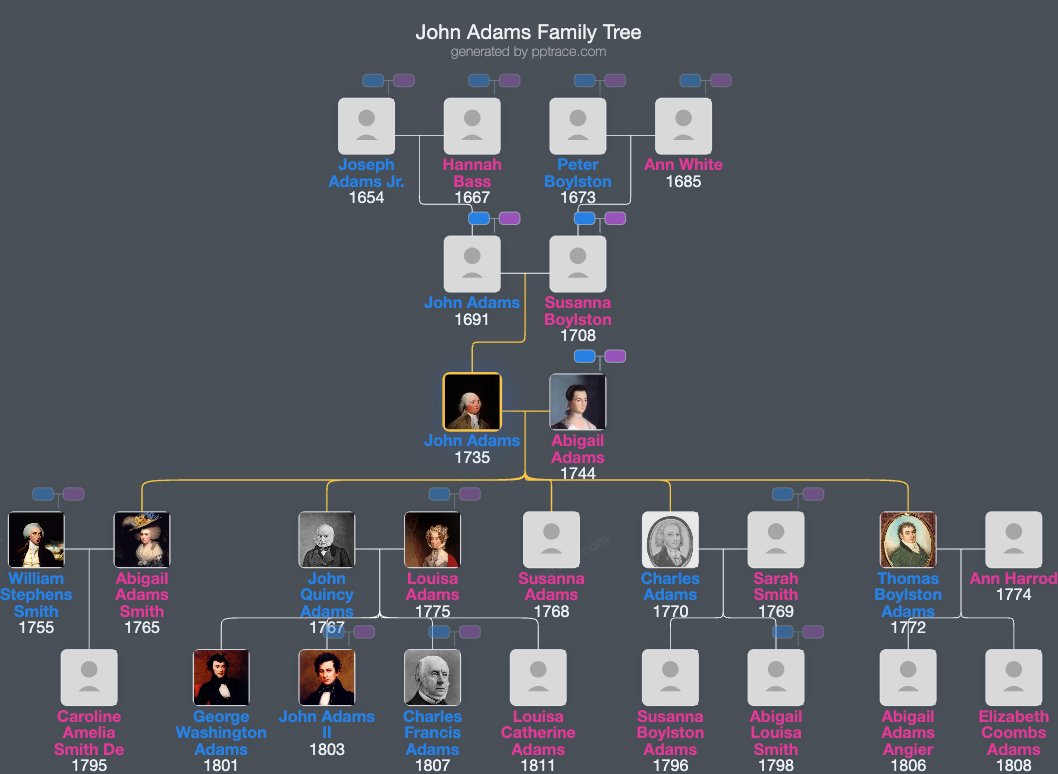
Family Tree
Tap  to expand more relatives
Introduction
John Adams (October 30, 1735 – July 4, 1826) was a prominent figure in the history of the United States, serving as a Founding Father and the second president of the country. His early life was situated in Braintree, Massachusetts, where he was born to John Adams Sr. and Susanna Boylston. His father was a deacon, farmer, and militia lieutenant, and his mother came from a distinguished medical family. Adams's upbringing was influence by a family with deep roots in Massachusetts; his great-great-grandfather, Henry Adams, immigrated from Braintree, Essex, England, around 1638.
Adams's education commenced at age six at a dame school and continued at Braintree Latin School, where he studied Latin, rhetoric, logic, and arithmetic. Subsequently, he enrolled at Harvard College in 1751 at age sixteen, earning an A.B. degree in 1755. During his studies, Adams developed an interest in classical and political literature, studying works by Thucydides, Plato, Cicero, and Tacitus. After graduation, Adams taught temporarily in Worcester while contemplating his future vocation. Initially considering the ministry, he eventually decided to pursue law, beginning reading law under James Putnam in 1756. He was admitted to the bar in 1759 after receiving an A.M. from Harvard in 1758.
Adams married Abigail Smith on October 25, 1764. The couple had six children: Abigail ("Nabby"), John Quincy, Susanna, Charles, Thomas, and Elizabeth. Three of his sons—John Quincy, Charles, and Thomas—became lawyers, though Charles and Thomas struggled with alcoholism and died young. Susanna died in childhood, and Elizabeth was stillborn.
Before the American Revolution, Adams established himself as a lawyer and political activist. He gained recognition for defending British soldiers accused of murder in the Boston Massacre, citing principles of the right to counsel and presumption of innocence. He rose as a leader of colonial opposition to British policies, notably opposing the Stamp Act of 1765 through his writings and speeches. Adams authored the "Braintree Instructions," which defended colonial rights concerning taxation and trial by jury. His writings, often under the pen name "Humphrey Ploughjogger," contributed to articulating colonial grievances.
In 1761, Adams became involved in political theory debates, contributing essays to Boston newspapers criticizing colonial elites. He was less well known than his cousin Samuel Adams but gained influence through his legal work and dedication to republican principles. During this period, he also developed a close relationship with Hannah Quincy, which was ultimately unfulfilled; he later married Abigail Smith.
Adams's patriotism led to his involvement in drafting the Declaration of Independence, for which he served as a leading advocate in the Continental Congress alongside Thomas Jefferson. He also served as a diplomat during the Revolution, representing the United States in France and the Netherlands, facilitating key negotiations that led to the Treaty of Paris in 1783, which ended the war. Adams was the first U.S. ambassador to Great Britain and contributed to securing Dutch loans for the fledgling nation.
He played a vital role in shaping the Massachusetts Constitution in 1780, which influenced the federal constitution. Adams served as the first Vice President of the United States under George Washington from 1789 to 1797, and then as President from 1797 to 1801, representing the Federalist Party. His presidency was marked by issues arising from the French Revolutionary Wars, including a stance of neutrality and the passage of the Alien and Sedition Acts. He increased the military forces amid an undeclared naval conflict with France, and was the first president to reside in the White House.
In 1800, Adams was defeated in his bid for re-election by Thomas Jefferson, his former friend and vice president. After leaving office, he retired to Massachusetts but resumed correspondence with Jefferson, with whom he maintained a notable friendship. Adams and his wife, Abigail, established the Adams political family, which included their son, John Quincy Adams, who became the sixth president of the United States. John Adams died on July 4, 1826, the fiftieth anniversary of the Declaration of Independence. Historically, he and his son are distinguished as the only presidents of the first twelve without ownership of slaves.