John Adams, Sr.
| Name | John Adams, Sr. |
| Title | British colonial farmer, minister, father of the U.S. President, John Adams (1690-1761) |
| Gender | Male |
| Birthday | 1691-02-08 |
| nationality | Q258532 |
| Source | https://www.wikidata.org/wiki/Q6218165 |
| pptrace | View Family Tree |
| LastUpdate | 2025-11-16T10:00:39.331Z |
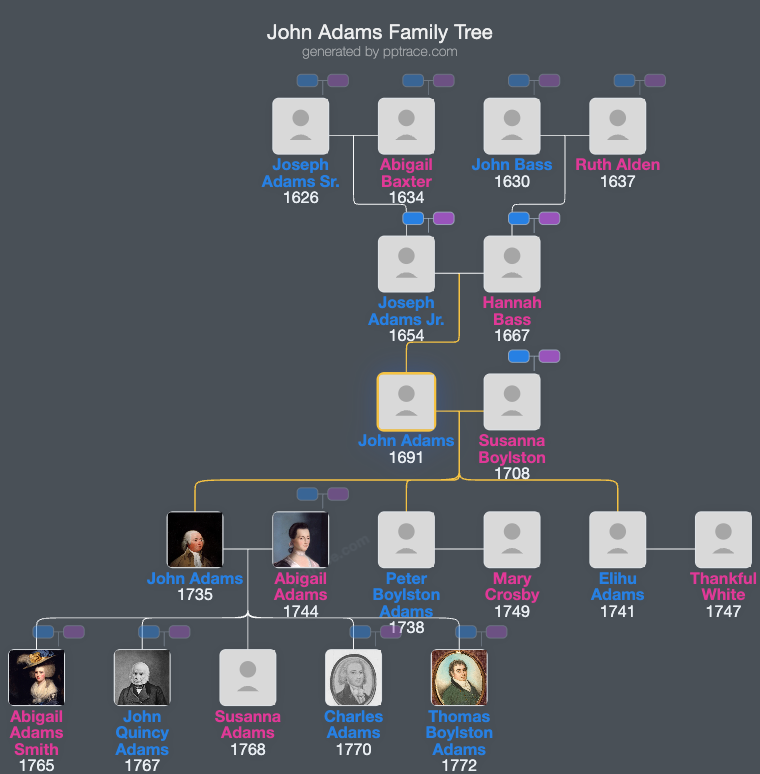
Family Tree
Tap  to expand more relatives
Introduction
John Adams Sr. (February 8, 1691 – May 25, 1761), also known as Deacon John, was an American colonial farmer and a church deacon. He was the father of John Adams Jr., who became the second President of the United States, and the paternal grandfather of John Quincy Adams, the sixth President of the United States.
Adams was descended from a family rooted in early English emigrants to Massachusetts. His ancestors included Henry Adams, who emigrated from Braintree, Essex, England, to the Massachusetts Bay Colony around 1638. His lineage also includes John and Priscilla Alden, and he was a first cousin once removed of Samuel Adams. His father was Joseph Adams Jr., and his grandfather was Joseph Adams.
In 1720, Adams purchased a farm in the area now known as Quincy, Massachusetts, then called the "north precinct" of Braintree. The farm's location and the birthplace of Adams' children are part of the Adams National Historical Park. The residence is a saltbox house, characterized by its sloping roof, which is operated by the National Park Service as the John Adams Birthplace. The site was designated a National Historic Landmark on December 19, 1960. Adams lived in this house with his family until 1764, when he married Abigail Smith.
Throughout his life, Adams engaged in various occupations and civic duties. He primarily worked as a farmer during the growing season and supplemented his income with shoemaking during the winters. He was a landowner, owning rather than renting his property, and regarded landownership as a valuable investment. Adams sold only ten acres to fund his son John Adams’ Harvard education. Besides farming, Adams served as a deacon in the Congregationalist church, a lieutenant in the Massachusetts colonial militia, a tax collector, and a town selectman for twenty years. His role as a selectman involved supervising the poor house, schools, and roads. His wife reportedly compelled him to resign from this position after a family dispute over his assistance to a destitute young woman.
His community was interested in religious and civic affairs, and Adams’ home was a place where local leaders, including Indian chiefs from Punkapaug and Neponset, would visit. Adams attended Harvard College, and he intended for his son John to follow the same path toward becoming a minister rather than a farmer.
Adams married Susanna Boylston in October 1734. She came from a prominent family of scientists and medical doctors, associated with the Boylston family of Brookline, Massachusetts. Their marriage connected Adams to a family of higher social standing. The couple had three sons: John, Peter Boylston, and Elihu. Peter served as a militia captain, while Elihu was a company commander during the American Revolution but died from dysentery in 1775. Adams was a strict father who emphasized the values of equality and fairness, and he raised his sons with an expectation that they would participate in the militia and uphold Puritan ethics. The family primarily lived a modest life, and Adams is believed to have homeschooled his children before sending John to a private school run by Joseph Marsh.
John Adams Sr. died of influenza on May 25, 1761, at the age of 70. He was buried in Braintree, Massachusetts. After his death, his widow, Susanna, remarried John Hall. His household and farm were later inherited by his son, John Adams Jr.