Thomas Boylston Adams
| Name | Thomas Boylston Adams |
| Title | son of John Adams (1772-1832) |
| Gender | Male |
| Birthday | 1772-09-15 |
| nationality | United States of America |
| Source | https://www.wikidata.org/wiki/Q7787805 |
| pptrace | View Family Tree |
| LastUpdate | 2025-11-17T06:36:59.885Z |
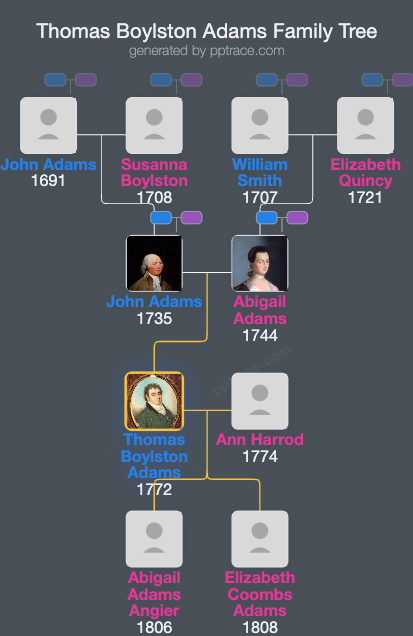
Family Tree
Tap  to expand more relatives
Introduction
Thomas Boylston Adams was born on September 15, 1772, in Braintree, Massachusetts. He was the youngest child of John Adams, who would become the second President of the United States, and Abigail (Smith) Adams. His siblings included Abigail (Nabby), John Quincy Adams, and Charles Adams. His paternal great-great-grandfather was physician Thomas Boylston, after whom he was named.
During his childhood, Adams was primarily raised on the family farm amid the upheaval of the American Revolution. His father's frequent absences due to participation in the Continental Congress caused emotional distress for him, with reports indicating that he often expressed a desire to see his father and believed his father did not love him as much as his brothers. In 1776, Abigail Adams arranged for inoculation against smallpox for her children. At age four, Adams expressed a desire to become a soldier, leading his father to suggest he consider a career in medicine instead.
Adams received education at home and was expected to attend Harvard University along with his older brothers. When he was eleven, his mother and sister traveled to Europe to join John Adams, then serving as a U.S. foreign minister. Adams and his brother Charles stayed behind with their aunt Elizabeth Smith Shaw and her husband. During this period, Adams studied Latin and cared for pet doves, experiencing emotional difficulty due to his parents' absence. He returned to his family at age fifteen.
He enrolled at Harvard University in the fall of 1786, supported by his family’s expectations and despite concerns about his young age. During his time at Harvard, he was known for diligence and participation in academic activities, graduating in 1790.
After graduating, Adams studied law under Jared Ingersoll in Philadelphia, where he became an apprentice lawyer. He obtained his bar certification in late 1793 and began practicing law in Philadelphia. During the yellow fever epidemic of 1793, he documented his experiences and evacuated the city for New Jersey to escape the outbreak. He returned to Philadelphia in late November of that year.
In 1793, John Quincy Adams was appointed as U.S. minister to the Netherlands, and Adams accompanied him as his secretary. Adams served in this capacity throughout John Quincy's diplomatic postings in the Netherlands and Prussia, gaining exposure to European political events, including Napoleon’s advances and the establishment of the Batavian Republic. He returned to the United States in 1798 to resume his law practice but struggled to establish himself professionally.
During the late presidency of John Adams, Thomas Adams authored essays under pseudonyms defending his father’s policies. He contributed to Joseph Dennie’s literary and political journal, the Port Folio, beginning with political articles and eventually managing its business operations. His contributions often included writings of his brother John Quincy, published anonymously. Due to disagreements with the journal's founder, the Adams brothers ceased contributing around 1805.
Adams was admitted to the Massachusetts bar in 1804. In 1806, he delivered the Phi Beta Kappa oration at Harvard, focusing on the topic of philosophy. He was elected a member of the American Academy of Arts and Sciences in 1810, an organization in which his brother John Quincy served as the corresponding secretary.