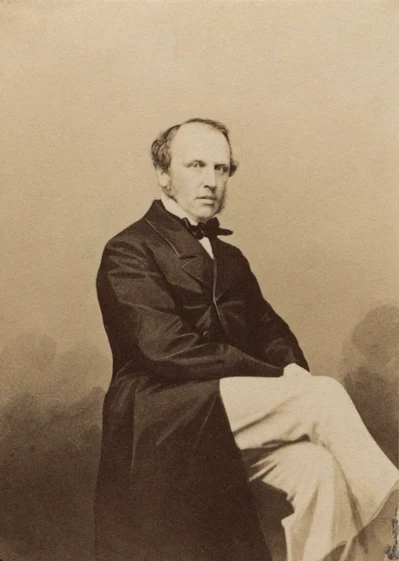
Charles Canning, 1st Earl Canning
| Name | Charles Canning, 1st Earl Canning |
| Title | British politician (1812-1862) |
| Gender | Male |
| Birthday | 1812-12-14 |
| nationality | United Kingdom of Great Britain and Ireland |
| Source | https://www.wikidata.org/wiki/Q335786 |
| pptrace | View Family Tree |
| LastUpdate | 2025-11-26T23:26:39.076Z |
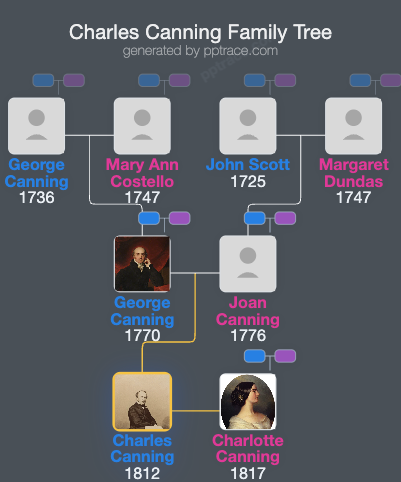
Family Tree
Tap  to expand more relatives
Introduction
Charles John Canning, 1st Earl Canning (14 December 1812 – 17 June 1862), was a British politician and administrative official known for his role during the Indian Rebellion of 1857 and subsequent governance of India. He was born at Gloucester Lodge, Brompton, near London. His parents were George Canning and Joan Scott; his mother was the daughter of Major-General John Scott. His father, George Canning, served as a Tory Member of Parliament, Foreign Secretary, and briefly as Prime Minister, before dying in 1827. Following his father’s death, his mother was granted the viscountcy of Canning, becoming the 1st Viscountess Canning.
Charles Canning attended Christ Church, Oxford, where he graduated with a Bachelor of Arts in 1833, achieving first-class honors in classics and second-class in mathematics. In 1836, he was elected as a Member of Parliament for Warwick representing the Conservative interest. Upon his mother’s death in 1837, he succeeded to the peerage, entering the House of Lords.
His early governmental roles included being the Parliamentary Under-Secretary of State for Foreign Affairs under Sir Robert Peel's administration from 1841 to 1846, and from January to July 1846, serving as First Commissioner of Woods and Forests. Between 1847 and 1849, he was a member of the Royal Commission on the British Museum. In 1853, he was appointed Postmaster General in the coalition ministry under the Earl of Aberdeen, a position he held until July 1855.
In December 1855, Lord Palmerston selected Canning to succeed Lord Dalhousie as Governor-General of India. Canning arrived in India in February 1856. His tenure coincided with the Indian Rebellion of 1857, a widespread uprising against British rule. During the rebellion, Canning was recognized for his calm judgment and effective leadership, maintaining functionality across government departments and managing critical decisions amidst the crisis. His approach earned him the nickname "Clemency Canning," notably after issuing a resolution on 31 July 1857 that distinguished between mutinous and disbanded Indian soldiers, a measure that, while humane, was unpopular among certain British factions.
Canning’s administration took significant steps during this period, including the passing of the Hindu Widows' Remarriage Act of 1856, drafted by his predecessor Lord Dalhousie, and the General Service Enlistment Act of 1856. He also oversaw the establishment of three major Indian universities—Calcutta, Madras, and Bombay—based on the recommendations of Wood’s despatch. The Indian Penal Code was drafted in 1860, largely based on earlier proposals by Lord Macaulay, and enacted in 1862.
Following the suppression of the rebellion, Canning managed the transfer of authority from the East India Company to the British Crown. He facilitated the reorganization of the Indian administration during this transition. In April 1859, he received the thanks of both Houses of Parliament and was elevated to the peerage as Earl Canning. Additionally, he was invested as a Knight of the Garter shortly before his death. Due to health issues exacerbated by the strain of his duties and the death of his wife, Charlotte, Canning returned to England in April 1862. He died in London on 17 June 1862. His titles became extinct as he died unmarried and without issue.
Canning’s interests outside governance included a project with his wife to produce a photographic survey of Indian peoples, which was transformed into an official publication, "The People of India," published between 1868 and 1875. Several places, including Canning Road in Croydon, Canning Town in London, Fort Canning Hill in Singapore, and Canning Street in Kolkata, are named after him.