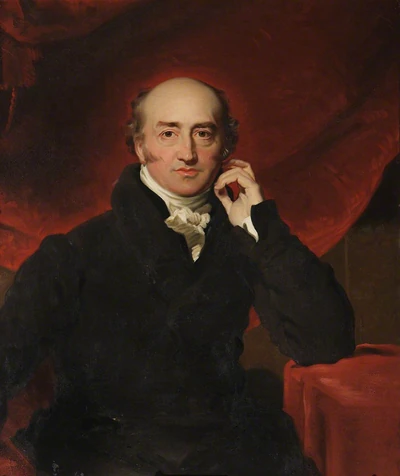
George Canning
| Name | George Canning |
| Title | British Prime Minister, statesman, and politician (1770-1827) |
| Gender | Male |
| Birthday | 1770-04-11 |
| nationality | United Kingdom of Great Britain and Ireland |
| Source | https://www.wikidata.org/wiki/Q219731 |
| pptrace | View Family Tree |
| LastUpdate | 2025-11-26T23:26:38.049Z |
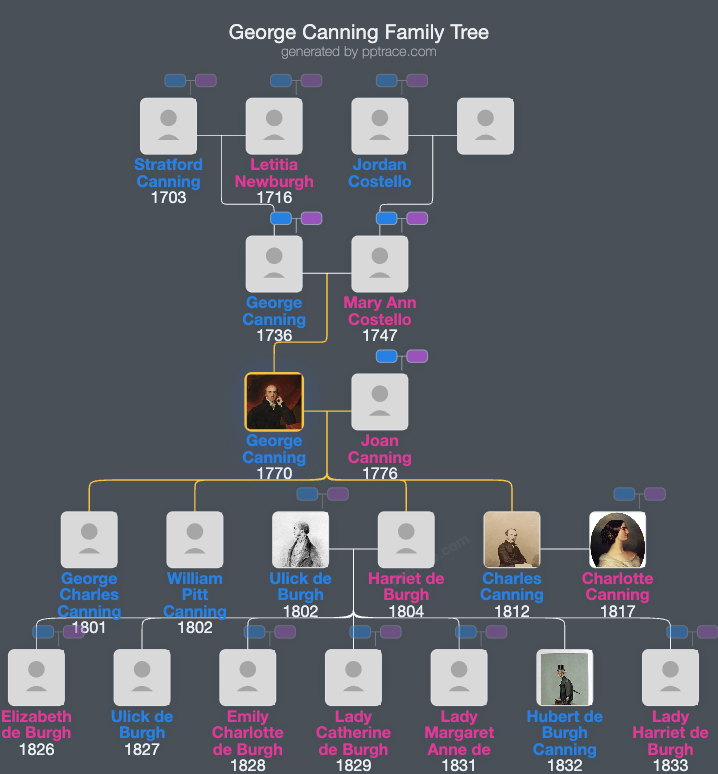
Family Tree
Tap  to expand more relatives
Introduction
George Canning (11 April 1770 – 8 August 1827) was a British statesman affiliated with the Tory party. His political career included holding various significant cabinet positions, such as the roles of Paymaster of the Forces (1800–1801), Treasurer of the Navy (1804–1806), and Foreign Secretary (1807–1809, 1822–1827). Canning served as Prime Minister of the United Kingdom from 22 April 1827 until his death on 8 August 1827, a tenure of 119 days.
Born in London, England, Canning was the son of an actress and a businessman and lawyer who faced financial difficulties. His father, George Canning of Garvagh, County Londonderry, was a wine merchant and lawyer who abandoned his family and died impoverished in 1771, when Canning was less than a year old. His mother, Mary Ann Costello, was Irish and worked as a stage actress. Due to his family's limited resources, Canning was supported financially by his uncle, Stratford Canning, enabling him to receive an education at Hyde Abbey School, Eton College, and Christ Church, Oxford. He excelled academically, particularly as a classicist at Eton College, and left Oxford after earning his Bachelor of Arts degree in 1791.
Canning’s early life was marked by connections to prominent Whig figures through his uncle, but as he matured, he adopted a more conservative stance, influenced by the radicalism of the French Revolution. Despite his impoverished background, he entered politics with the support of William Pitt the Younger, first becoming a Member of Parliament in 1793 representing Newtown, Isle of Wight, initially through a rotten borough. He later represented other constituencies, including Wendover.
Canning distinguished himself through his oratorical skills and writing, gaining influence within Pitt’s faction and earning a reputation for effective communication and leadership. His early ministerial appointments included serving as Under Secretary of State for Foreign Affairs in 1795. During this period, he demonstrated strong support for British foreign policy, including the seizure of the Danish fleet at the Battle of Copenhagen in 1807.
In 1809, Canning was wounded in a duel with Lord Castlereagh and was subsequently overlooked for succession to the Premiership in favor of Spencer Perceval. After the assassination of Perceval in 1812, Canning returned to prominent government roles, serving as the British Ambassador to Portugal (1814–1816), President of the Board of Control (1816–1821), and Foreign Secretary again (1822–1827). His diplomatic efforts included actions that strengthened Britain's relations with Spain and Portugal, contributing to the preservation of independence for Portuguese and Spanish American colonies, and supporting the Monroe Doctrine.
Canning was known for his diplomatic acumen and his efforts to secure advantageous trade arrangements for Britain. He earned praise from historians such as G. M. Trevelyan for his combining "brilliancy and wisdom" in service of the nation, and from Paul Hayes for his notable diplomatic achievements.
In April 1827, following the resignation of Lord Liverpool, Canning was appointed Prime Minister, a position he held until his death in August of the same year. His brief tenure was characterized by attempts to form a government inclusive of Whigs and other factions, though his health declined rapidly due to pneumonia. Canning died at Chiswick House while still in office, making his the second shortest tenure of a UK Prime Minister in history.