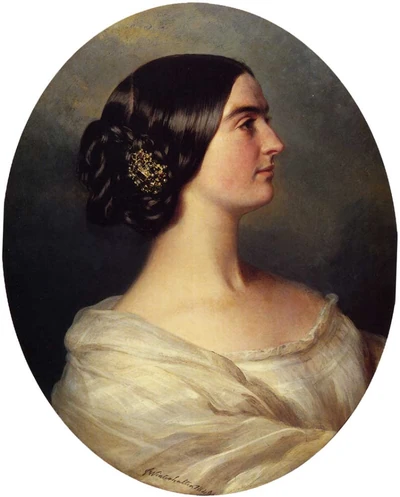
Charlotte Canning, Countess Canning
| Name | Charlotte Canning, Countess Canning |
| Title | British artist and the first vicereine of India (1817-1861) |
| Gender | Female |
| Birthday | 1817-03-31 |
| nationality | United Kingdom of Great Britain and Ireland |
| Source | https://www.wikidata.org/wiki/Q275145 |
| pptrace | View Family Tree |
| LastUpdate | 2025-11-26T23:23:04.982Z |
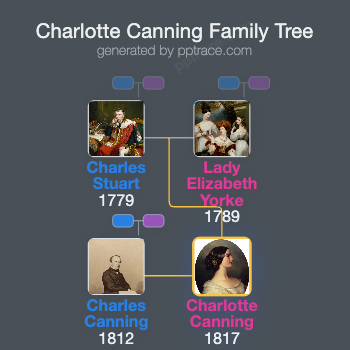
Family Tree
Tap  to expand more relatives
Introduction
Charlotte Canning, Countess Canning (née Stuart), was born on 31 March 1817 in Paris, France, and died on 18 November 1861 in Calcutta, India. She was a British aristocrat, artist, and the first Vicereine of India. Her father was Sir Charles Stuart, who served as the British ambassador to France, later becoming Baron Stuart de Rothesay. Her mother was Lady Elizabeth Yorke, daughter of Philip Yorke, 3rd Earl of Hardwicke. Charlotte's grandmother, the Countess of Hardwicke, was present at her birth and remarked on her striking resemblance to her father. She was named after Queen Charlotte, her godmother.
Charlotte was raised in Paris, acquiring fluency in French. In 1831, her family returned to London, residing in Carlton House Terrace. She entered society in 1834 and shortly afterward met Hon. Charles Canning, the only son of former Prime Minister George Canning. Despite initial familial opposition to their marriage due to political disagreements, Charlotte married Charles Canning on 5 September 1835 at St Martin-in-the-Fields, London.
Her husband became a Member of Parliament in 1836 and succeeded to his mother's title as Viscount Canning in 1837. In 1859, he was elevated to Earl Canning, and she became Countess Canning. From 1842 to 1855, Charlotte served as a Lady of the Bedchamber to Queen Victoria, a role she accepted promptly, characterized by discretion, intelligence, social acumen, and fluency in French. She was a favorite of Queen Victoria and her husband, Prince Albert, although her Anglican high church religious views differed from the monarch's preferences.
In 1856, upon her husband's appointment as Governor-General of India, the Cannings moved to Calcutta, residing at Government House. She disliked the formality and routine of the residence but enjoyed the natural environment at Barrackpore, particularly its lush vegetation. During the Indian Rebellion of 1857–1859, her husband faced criticism for perceived clemency toward rebels, but both maintained Queen Victoria's support. When the British government assumed direct rule of India, Lord Canning became the first Viceroy, making Charlotte the Vicereine.
As an accomplished botanist and artist, Charlotte collected and illustrated flora and natural scenes during her travels across India. Her watercolour portfolios, totaling approximately 350 works, are preserved mainly at the Victoria and Albert Museum. She was also among India's earliest photographers. She documented her experiences through detailed journals and maintained correspondence with Queen Victoria, providing insights into Indian life and nature. Samples of flora were sent to Victoria's children, with ongoing communication between the two.
Charlotte developed health issues in late 1861, contracting malaria during a final journey to the Darjeeling region. She died at Government House in Calcutta and was buried in a garden at Barrackpore, which her husband described as a "beautiful spot." Her death was widely mourned in England, where she was regarded as a symbol of Victorian feminine virtue. Following her death, her husband, Lord Canning, was deeply affected; he died in 1862 of liver disease, shortly after her.
Her legacy includes more than 350 watercolour artworks held at the Victoria and Albert Museum, and her contributions to botanical illustration and photography in India are recognized historically. The Indian sweet dessert ledikeni, also known as "Lady Kenny," is named after her and is made from chhana and flour, soaked in syrup.