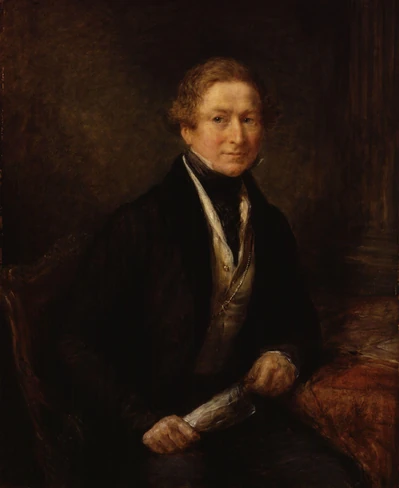
Robert Peel
| Name | Robert Peel |
| Title | Prime Minister of the United Kingdom (1834–1835; 1841–1846) |
| Gender | Male |
| Birthday | 1788-02-05 |
| nationality | United Kingdom of Great Britain and Ireland |
| Source | https://www.wikidata.org/wiki/Q181875 |
| pptrace | View Family Tree |
| LastUpdate | 2025-11-26T23:28:24.229Z |
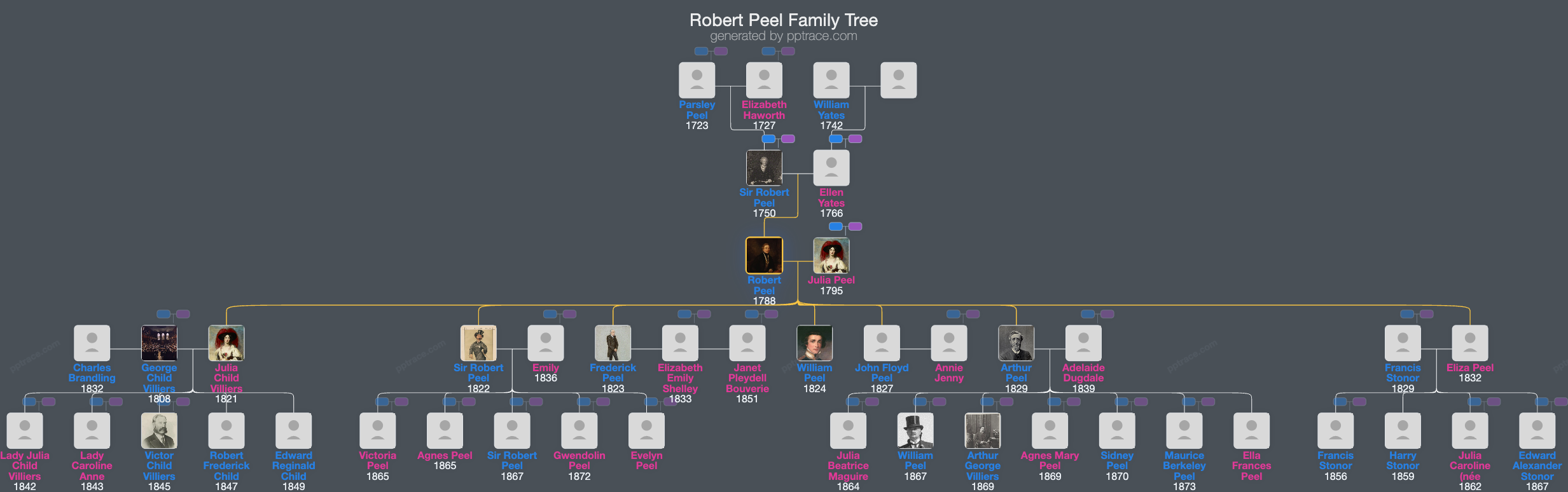
Family Tree
Tap  to expand more relatives
Introduction
Sir Robert Peel, 2nd Baronet (born 5 February 1788, deceased 2 July 1850), was a British Conservative politician who served as Prime Minister of the United Kingdom on two separate occasions, from 1834 to 1835 and from 1841 to 1846. During his second term, he concurrently held the position of Chancellor of the Exchequer from 1834 to 1835. Peel also notably held the office of Home Secretary twice, from 1822 to 1827 and from 1828 to 1830.
Peel is recognized for establishing the foundations of modern British policing, primarily through the creation of the Metropolitan Police while serving as Home Secretary. He was a founding figure of the modern Conservative Party, shaping its principles and identity. He was born into a wealthy family; his father was Sir Robert Peel, 1st Baronet, a prominent textile industrialist and politician. The Peel family has historical roots dating back to the 17th century in Lancashire, originally descending from yeomen. The family name was originally spelled "Peele" before being changed to "Peel" by his father.
Robert Peel received an education at Harrow School beginning in 1800 and later attended Christ Church, Oxford, where he graduated in 1808 with a double first in classics and mathematics. He also studied law at Lincoln's Inn in 1809. Peel held military commissions as a captain in the Manchester Regiment of Militia in 1808 and as a lieutenant in the Staffordshire Yeomanry Cavalry in 1820.
Peel entered parliamentary politics at the age of 21, representing the Irish rotten borough of Cashel in County Tipperary in 1809, with the support of Sir Arthur Wellesley, the future Duke of Wellington. He later represented Chippenham (from 1812) and Oxford University (from 1817). In his early political career, Peel served as Under-Secretary of State for War and the Colonies in 1810 and was appointed Chief Secretary for Ireland in 1812, a position he held until 1818. During his tenure in Ireland, Peel was involved in legislative efforts affecting public order and security, including the development of the Royal Irish Constabulary.
Peel consistently supported legislation and reforms concerning law and order, economic policy, and civil rights. Initially opposed to Catholic emancipation, Peel later supported the Roman Catholic Relief Act of 1829 and the repeal of the Test Act in 1828, citing concerns about civil strife and national stability. His political evolution involved a shift from traditional Tory positions toward more liberal policies.
As Prime Minister, Peel issued the Tamworth Manifesto in December 1834, outlining the principles upon which the modern Conservative Party was founded. His first ministry was a minority government, dependent on Whig support, and lasted four months before collapsing. He then served as Leader of the Opposition until his second rise to the premiership in 1841, which lasted until 1846. During his second term, Peel pursued policies aimed at economic reform, including tariff reductions to stimulate trade and the implementation of a modern banking system. His government passed significant legislation such as the Mines and Collieries Act 1842, the Income Tax Act 1842, the Factories Act 1844, and the Railway Regulation Act 1844.
Peel's tenure was challenged by political opposition and public sentiment, notably after increasing tensions over the Maynooth Grant in 1845 and the reversal of the Corn Laws during the Irish Famine. His decision to support the repeal of the Corn Laws, in alliance with Whigs and Radicals, led to his resignation as Prime Minister in 1846. Despite his resignation, he continued to serve as a Member of Parliament and remained the leader of the Peelite faction until his death.
Throughout his career, Peel was known for his willingness to reform traditional Tory positions, supporting measures such as Catholic emancipation, the Reform Act, income tax, and the repeal of the Corn Laws. Historians, including A. J. P. Taylor, have recognized Peel as one of the foremost statesmen of the 19th century.