Arthur Peel
| Name | Arthur Peel |
| Title | British politician (1829-1912) |
| Gender | Male |
| Birthday | 1829-08-03 |
| nationality | United Kingdom of Great Britain and Ireland |
| Source | https://www.wikidata.org/wiki/Q334165 |
| pptrace | View Family Tree |
| LastUpdate | 2025-11-26T23:28:29.781Z |
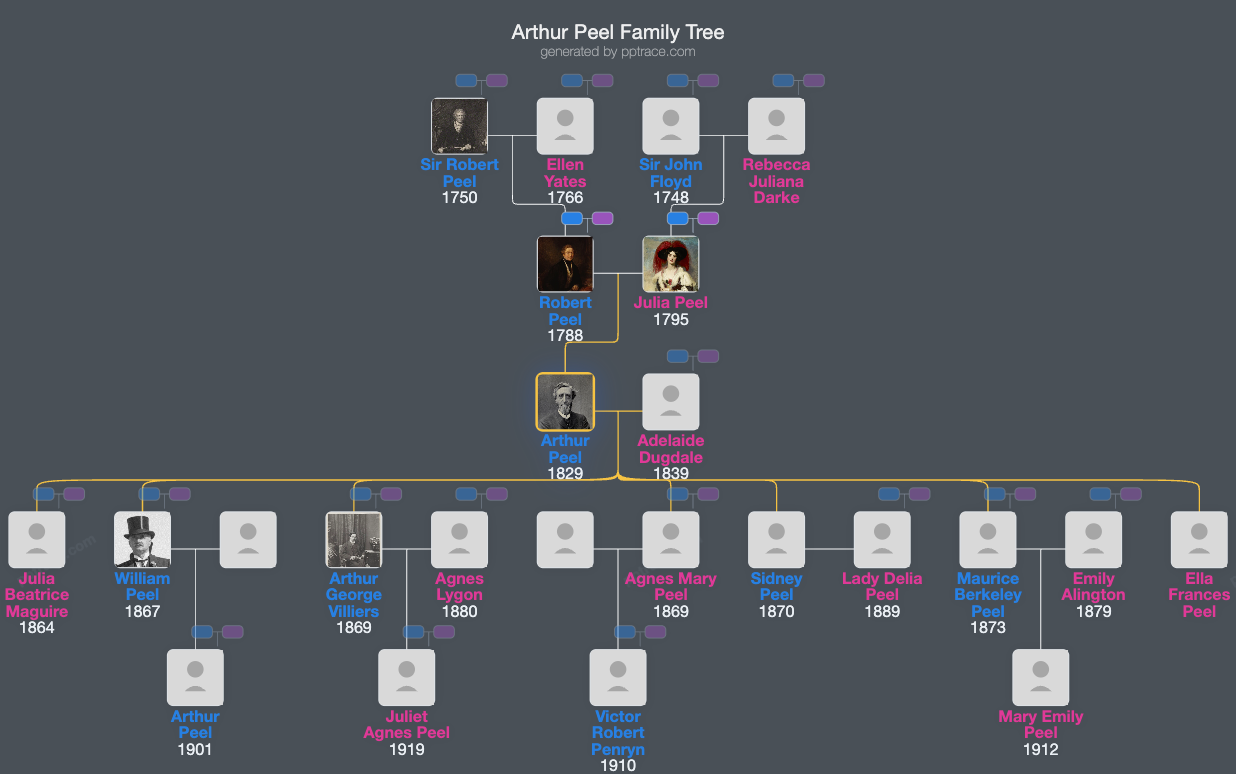
Family Tree
Tap  to expand more relatives
Introduction
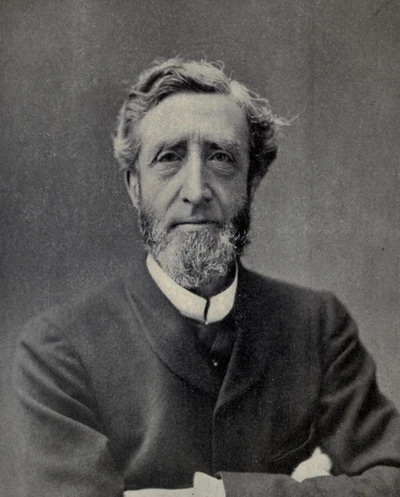
Arthur Wellesley Peel, 1st Viscount Peel, was born on 3 August 1829 and died on 24 October 1912. He was a British politician associated with the Liberal Party and served in the House of Commons from 1865 to 1895. Subsequently, he held the position of Speaker of the House of Commons from 1884 until 1895, upon which he was elevated to the peerage.
Early Life:
Peel was the youngest son of Sir Robert Peel, who served as Prime Minister of the United Kingdom and was a member of the Conservative Party. His mother was Julia Floyd, the daughter of General Sir John Floyd, 1st Baronet. Arthur Wellesley Peel was named after the Duke of Wellington. He received his education at Eton College and later at Balliol College, Oxford.
Political Career:
Peel was first elected as the Liberal Member of Parliament (MP) for Warwick in the 1865 general election. He maintained this seat until 1885, when it was abolished under the Redistribution of Seats Act 1885. During his early parliamentary career, he served as Parliamentary Secretary to the Poor Law Board from 1868 to 1871, then as Parliamentary Secretary to the Board of Trade. Between 1873 and 1874, he held the position of Patronage Secretary to the Treasury. In 1880, he was appointed Under-Secretary of State for Home Affairs in William Ewart Gladstone's second government.
On 26 February 1884, Peel was elected as the Speaker of the House of Commons, succeeding Sir Henry Brand. His tenure as Speaker was noted for its impartiality, a comprehensive understanding of parliamentary traditions, sound judgment, and the ability to make prompt decisions. Although officially non-partisan, Peel left the Liberal Party over the issue of Home Rule and aligned himself with the Liberal Unionists. He was also an advocate of Charles Bradlaugh's campaign to amend the oath of allegiance, which eventually allowed non-Christians, including atheists and agnostics, to serve as Members of Parliament.
Peel retired from the House of Commons prior to the 1895 general election due to health reasons. He was created Viscount Peel, of Sandy in the County of Bedford, through the Mr. Speaker's Retirement Act 1895 (58 & 59 Vict. c. 10). That year, he was awarded the Freedom of the City of London in July. In 1896, Peel served as chairman of a royal commission tasked with examining licensing laws. Disagreements among commission members led Peel to resign his chair, although his report—published under his name—recommended significant reductions in licensed premises and influenced reform efforts.
Honors and Legacy:
A street named Peel Road in Warwick bears his name.
Family:
In 1862, Peel married Adelaide Dugdale, daughter of William Stratford Dugdale. She was born on 14 November 1839 and died on 5 December 1890. Following her death, Peel remained widowed until his own death in October 1912 at the age of 83.
Together, they had seven children:
- Julia Beatrice Peel (1864–1949), who married James Rochfort Maguire, a Member of Parliament representing the Irish Parliamentary Party.
- William Wellesley Peel (1867–1937), who succeeded as the 2nd Viscount Peel and was created Earl Peel in 1929.
- Arthur George Villiers Peel (1868–1956), a politician and author.
- Sidney Cornwallis Peel (1870–1938), a colonel and former MP, who was created a baronet in 1936.
- Agnes Mary Peel (circa 1869/71–1959), who married Conservative MP Sydney Goldman.
- Ella Frances Peel (1872–1900).
- Maurice Berkeley Peel (1873–1917), a Church of England vicar and military chaplain, who was killed in action during the First World War.