William Peel
| Name | William Peel |
| Title | British Royal Navy officer (1824-1858) |
| Gender | Male |
| Birthday | 1824-11-02 |
| nationality | United Kingdom of Great Britain and Ireland |
| Source | https://www.wikidata.org/wiki/Q6039520 |
| pptrace | View Family Tree |
| LastUpdate | 2025-11-26T23:28:26.014Z |
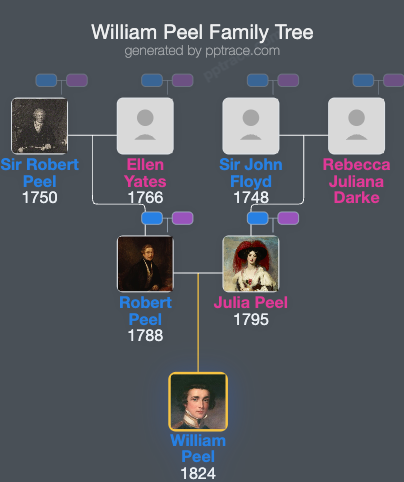
Family Tree
Tap  to expand more relatives
Introduction
William Peel was born on 2 November 1824 and died on 27 April 1858. He was a British naval officer and the recipient of the Victoria Cross, the highest award for gallantry in the face of the enemy awarded to British and Commonwealth forces. Peel was the third son of Sir Robert Peel, who served as Prime Minister of the United Kingdom, and his wife Julia.
He received his education at Harrow School, following a tradition shared with his father. In recognition of his service, Peel was made a Knight Commander of the Order of the Bath, assuming the title Sir William Peel.
Peel served as a captain in the Royal Navy. During the Crimean War, he served with the Naval Brigade. Notably, on 18 October 1854, during the Siege of Sevastopol, Peel displayed conspicuous bravery. He picked up a live shell with the fuse still burning, among several powder cases, and threw it over the parapet. The shell exploded after leaving his hands. For this act, Peel was awarded the Victoria Cross. His medal is currently displayed at the National Maritime Museum in Greenwich, England.
On 5 November, during the Battle of Inkerman, Peel participated alongside officers of the Grenadier Guards and helped defend the regiment's Colours when they were under significant pressure. On 18 June 1855, he led the first scaling party during the assault on the Redan fortification and was severely wounded in the process. During these campaigns, he was often accompanied by a young midshipman named Edward St. John Daniel, serving as his Aide-de-camp.
Beyond the Crimean War, Peel also served during the Indian Mutiny. He was wounded at the Relief of Lucknow. He died at the age of 33, from smallpox, in Cawnpore, India, in 1858.
In addition to his military service, Peel was an author. He wrote "A Ride through the Nubian Desert" in 1852, which detailed his travels undertaken in the previous year.
There are several memorials commemorating William Peel. A memorial dedicated to him and the Naval Brigade from HMS Shannon is located on the seafront at Southsea, England. A statue of Peel, sculpted by William Theed, is situated in the south transept of Saint Swithun's Church in Sandy, Bedfordshire. Two copies of this statue exist: one is housed in the National Maritime Museum in Greenwich, and another was erected in Eden Gardens, Calcutta. In 1977, the statue in Calcutta was moved to Barrackpore. There was some confusion in 2004 about its identity, with beliefs it belonged to Peel’s father, Robert Peel.
A public house called the Sir William Peel pub is located opposite Sandy church across the High Street. A plaque at The Lodge, the headquarters of the Royal Society for the Protection of Birds (RSPB) in Sandy, commemorates the 150th anniversary of Captain Peel's death. This plaque is near the Swiss Cottage he built in the 1850s, which now serves as the gatehouse to The Lodge. The Swiss Cottage was constructed by Peel and is adjacent to his brother Arthur Wellesley Peel's residence. Another plaque commemorating Peel’s life is mounted on a bench on Sandy High Street.
Additionally, a statue of Peel by William Theed is installed within the Greenwich Maritime Museum.
References include an entry from William Richard O'Byrne’s "A Naval Biographical Dictionary" and the "Dictionary of National Biography," published by Smith, Elder & Co. between 1885 and 1900.