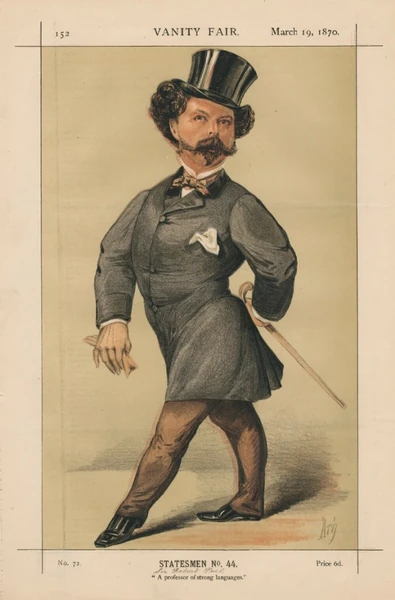
Sir Robert Peel, 3rd Baronet
| Name | Sir Robert Peel, 3rd Baronet |
| Title | British politician (1822-1895), sold father's art collection to the National Gallery |
| Gender | Male |
| Birthday | 1822-05-04 |
| nationality | United Kingdom of Great Britain and Ireland |
| Source | https://www.wikidata.org/wiki/Q4685934 |
| pptrace | View Family Tree |
| LastUpdate | 2025-11-26T23:28:26.909Z |
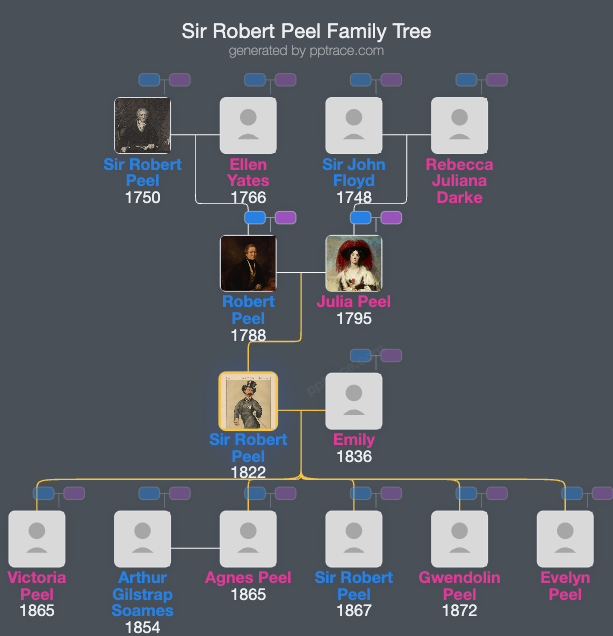
Family Tree
Tap  to expand more relatives
Introduction
Sir Robert Peel, 3rd Baronet, PC (4 May 1822 – 9 May 1895), was a British politician associated with multiple political parties during his career, including the Peelite, Liberal, and Conservative parties. He was the eldest son of the prominent statesman and former Prime Minister Sir Robert Peel, 2nd Baronet, and Julia Floyd, daughter of Sir John Floyd, 1st Baronet.
Born in London on 4 May 1822, Peel attended Harrow School beginning in February 1835. He matriculated at Christ Church, Oxford on 26 May 1841 but did not complete a degree. He entered the Diplomatic Service in 1844, serving as an attaché at the British legation in Madrid. In May 1846, he was promoted to secretary of legation in Switzerland and became chargé d'affaires there in November of the same year. Upon the death of his father on 2 July 1850, Peel succeeded to the baronetcy and resigned from his diplomatic position.
In his political career, Peel was elected as a Member of Parliament (MP) for Tamworth, his father's former constituency, on 19 July 1850. He represented Tamworth as a "liberal-conservative," associated with the Peelites, until 1880. He subsequently served as MP for Huntingdon from 1884 and for Blackburn from 1885 to 1886. His political affiliations shifted over time, and he was associated with Liberals and later Conservative parties. He also contested Gravesend in 1880 unsuccessfully and ran as a Liberal candidate for Brighton in 1889.
Peel held several governmental appointments. In March 1855, Lord Palmerston appointed him as a junior Civil Lord of the Admiralty, marking his transition towards the Liberal side. He served as secretary to Lord Granville’s mission to Russia in July 1856. In January 1857, Peel delivered a lecture at Adderley Park, Westminster, during which he made remarks about the Russian court that drew criticism from the Russian and French press.
In July 1861, Peel was appointed Chief Secretary for Ireland and was sworn into the Privy Council. His tenure in Ireland was considered unsuccessful, marked by debates over Fenianism and Irish affairs. His speeches and actions often lacked discretion and did not resolve ongoing tensions. In 1866, Peel was appointed Knight Grand Cross of the Order of the Bath (GCB).
Throughout his career, Peel was an active critic of policies he disagreed with, often expressing his opinions on international conflicts and domestic issues. He was known for his oratorical skills and contributed to debates on the Franco-Prussian War and other topics. His political stance shifted over time, and he sometimes supported Home Rule for Ireland, particularly after 1886, despite previous opposition.
Aside from politics, Peel was involved in horse racing under the pseudonym Mr. F. Robinson, breeding horses in Staffordshire. He was also present in the British Yeomanry, serving as a captain from 1854 to 1859. On 13 January 1856, he married Lady Emily Hay, daughter of George Hay, 8th Marquess of Tweeddale. They had a son and four daughters. His children included Gwendolin Cecilia, Agnes Helen, Victoria Alexandrina Julia, Robert (who succeeded to the baronetcy), and Evelyn Emily.
In 1871, Peel sold his father’s art collection to the National Gallery for £75,000. He owned approximately 9,923 acres of land across Staffordshire, Warwickshire, and Lancashire, generating substantial rental income. His private circumstances later in life deteriorated due to financial recklessness and personal issues, including a rift with his wife, resulting in his ceasing to reside at Drayton Manor. Peel died on 9 May 1895.