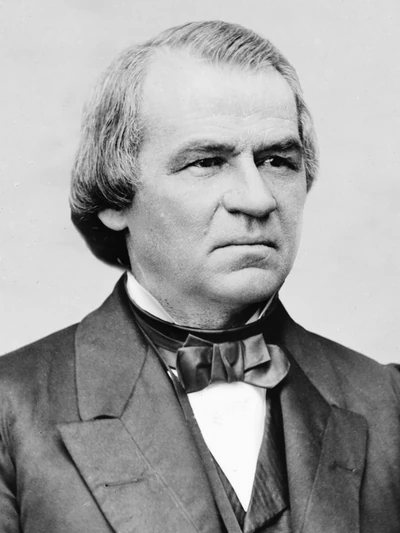
Andrew Johnson
| Name | Andrew Johnson |
| Title | President of the United States from 1865 to 1869 |
| Gender | Male |
| Birthday | 1808-12-29 |
| nationality | United States of America |
| Source | https://www.wikidata.org/wiki/Q8612 |
| pptrace | View Family Tree |
| LastUpdate | 2025-11-17T06:40:21.901Z |
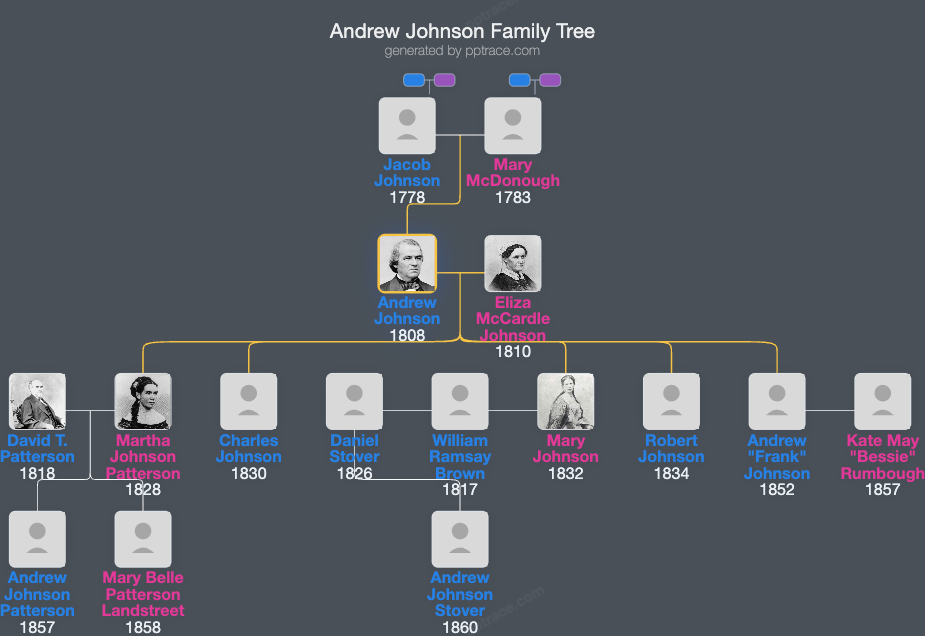
Family Tree
Tap  to expand more relatives
Introduction
Andrew Johnson was born in Raleigh, North Carolina, on December 29, 1808. His parents were Jacob Johnson and Mary ("Polly") McDonough, both of whom were illiterate. Johnson's father worked as a porter for the State Bank of North Carolina and served as town constable, while his mother worked as a washerwoman. Johnson was raised in poverty in a small two-room shack and was apprenticed as a tailor from a young age. He did not attend formal school but learned literacy skills from individuals who visited the tailor shop where he worked. His early life included living in Raleigh and later moving to Carthage, North Carolina, as well as Laurens, South Carolina, before relocating to Tennessee.
In his youth, Johnson traveled mostly on foot, working as a tailor in various towns before settling in Greeneville, Tennessee. He married Eliza McCardle in 1827; she was then 16 years old, and he was 18. Their marriage lasted nearly 50 years, and they had five children: Martha, Charles, Mary, Robert, and Andrew Jr. Eliza provided support for Johnson's endeavors and helped improve his skills in mathematics and writing.
Johnson established a tailoring business in Greeneville, which prospered and allowed him to invest in real estate. He was an avid reader and engaged in political debates, developing an interest in public speaking. Politically, Johnson entered local government as an alderman and mayor before being elected to the Tennessee House of Representatives in 1835. He also served briefly in the Tennessee Senate and was elected to the U.S. House of Representatives in 1843, serving five two-year terms.
In 1857, Johnson was elected to the U.S. Senate by the Tennessee legislature and served there until 1862. During his congressional career, he supported the passage of the Homestead Bill. His state, Tennessee, was a slave state that seceded from the Union to form the Confederate States of America. Johnson remained loyal to the Union, being the only sitting senator from a Southern state who did not resign after his state's secession. In 1862, Abraham Lincoln appointed him Military Governor of Tennessee.
Johnson was chosen as Lincoln’s running mate in the 1864 election on the National Union Party ticket to symbolize national unity. Following Lincoln’s assassination in 1865, Johnson became the 17th president of the United States, serving from 1865 to 1869. His presidency was marked by efforts at Presidential Reconstruction, which aimed to rapidly restore the seceded states to the Union, often without protections for newly freed enslaved people. His policies led to conflicts with Congressional Republicans, who sought to implement more comprehensive Reconstruction measures.
Johnson vetoed several pieces of legislation aimed at protecting African Americans’ rights, including statutes that mandated civil rights and voting protections, leading to clashes with Congress. He opposed the Fourteenth Amendment, which granted citizenship rights to former slaves. In 1866, Johnson traveled nationally to promote his policies, defying opposition from Congress.
His attempts to remove Secretary of War Edwin Stanton without congressional approval led to his impeachment by the House of Representatives in 1868. The Senate narrowly acquitted him, falling one vote short of conviction. Johnson did not secure the Democratic nomination for president in 1868 and left office in March 1869. After his presidency, he returned to Tennessee, where he was elected to the U.S. Senate in 1875, becoming the only former president to serve in the Senate. He died on July 31, 1875, five months into his term.
Johnson’s stance on civil rights and his resistance to federally protected rights for African Americans have been widely criticized. Historians generally rank him among the less effective U.S. presidents due to his policies and opposition to Reconstruction efforts.