Jacob Johnson
| Name | Jacob Johnson |
| Title | father of U.S. president Andrew Johnson |
| Gender | Male |
| Birthday | 1778-01-01 |
| nationality | England |
| Source | https://www.wikidata.org/wiki/Q6118810 |
| pptrace | View Family Tree |
| LastUpdate | 2025-11-16T10:13:47.215Z |
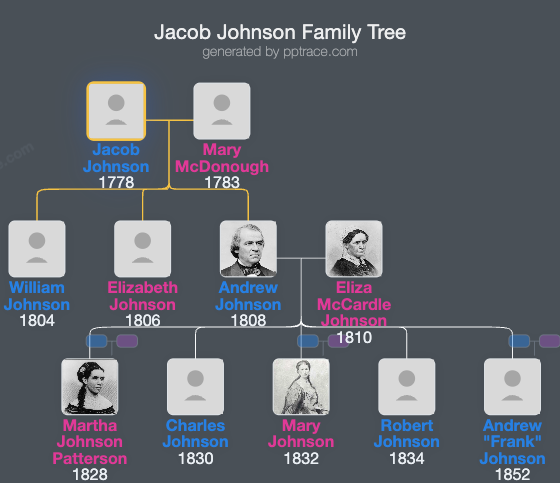
Family Tree
Tap  to expand more relatives
Introduction
Andrew Johnson (December 29, 1808 – July 31, 1875) was the 17th President of the United States, serving from 1865 to 1869. He assumed the presidency following the assassination of Abraham Lincoln, who was the 16th president. Johnson was the vice president under Lincoln after being elected in 1864 on the National Union Party ticket. His term as president began at the end of the American Civil War.
Born in Raleigh, North Carolina, Johnson was raised in poverty. His parents, Jacob Johnson and Mary ("Polly") McDonough, were illiterate and worked as tavern servants and washerwomen. Jacob Johnson died of a heart attack when Andrew was three years old. Johnson did not attend formal school but was apprenticed as a tailor at age ten, working in Raleigh and later in other towns such as Carthage and Laurens. He learned basic literacy skills from acquaintances and developed a love for reading, which influenced his skills as a public speaker.
In the late 1820s, Johnson moved to Tennessee, traveling primarily on foot through the Blue Ridge Mountains. He settled in Greeneville, Tennessee, where he established a successful tailoring business. In 1827, at age 18, he married Eliza McCardle, with whom he had five children. Eliza supported Johnson's career by teaching him mathematics and improving his writing skills.
Johnson's early political career included serving as an alderman and mayor of Greeneville. He was elected to the Tennessee House of Representatives in 1835 and subsequently served briefly in the Tennessee Senate. In 1843, Johnson was elected to the U.S. House of Representatives, where he served five two-year terms. He also served as the governor of Tennessee for four years and was elected to the U.S. Senate in 1857. He remained committed to the Union during the Civil War, despite Tennessee's secession, and was appointed Military Governor of Tennessee in 1862 by President Lincoln.
In the 1864 presidential election, Lincoln chose Johnson as his running mate to promote national unity. As vice president, Johnson supported a swift restoration of the seceded states into the Union and advocated for pardon and leniency toward former Confederates. His approach to Reconstruction, which included the return of old leadership in Southern states and the passage of Black Codes that limited the rights of freedmen, clashed with Congressional Republicans, leading to significant conflict during his presidency.
Johnson opposed the Fourteenth Amendment, which granted citizenship to former slaves, and vetoed several bills opposed by Congress. In 1866, he embarked on a nationwide tour to promote his policies. Congress responded by passing the Tenure of Office Act in 1867, restricting his ability to dismiss certain Cabinet members. Johnson's attempt to dismiss Secretary of War Edwin Stanton resulted in his impeachment by the House of Representatives in 1868. He was narrowly acquitted by the Senate and completed his term in 1869.
Following his presidency, Johnson returned to Tennessee and was elected to the U.S. Senate in 1875, becoming the only former president to serve in that chamber. He died five months into his Senate term on July 31, 1875.
Throughout his political career, Johnson's views on civil rights and race relations have been widely criticized. Historians have consistently ranked him among the least effective and most controversial U.S. presidents.
Early Life
Childhood
Andrew Johnson was born in Raleigh, North Carolina, on December 29, 1808, to Jacob Johnson and Mary ("Polly") McDonough. His ancestry included English, Scots-Irish, and Scottish roots. He had a brother, William, and an older sister, Elizabeth, who died in childhood. His birthplace was a two-room shack, a detail he often highlighted during his political career. His father, Jacob Johnson, was a poor man who worked as a porter for the State Bank of North Carolina and served briefly as a town constable. Both of his parents were illiterate, and his father died when Andrew was three. His mother, Polly, worked as a washerwoman. Johnson's early education was informal; he was apprenticed to a tailor at age ten and learned literacy skills from shop employees. He developed an early love of reading, which contributed to his later oratorical skills.
Migration and Early Work
Johnson and his brother William ran away from their apprenticeship when he was about fifteen. He moved to Carthage, North Carolina, and then to Laurens, South Carolina, before relocating to Tennessee. Traveling mainly on foot, he eventually settled in Greeneville, Tennessee, where he established a reputable tailoring business. In 1827, he married Eliza McCardle, and they had five children: Martha, Charles, Mary, Robert, and Andrew Jr.
Ownership of Slaves
In 1843, Johnson purchased Dolly, a 14-year-old slave, along with her children. He also acquired Dolly's half-brother Sam and his family. Sam Johnson later became a commissioner of the Freedmen's Bureau.