Robert Johnson
| Name | Robert Johnson |
| Title | (1834-1869) |
| Gender | Male |
| Birthday | 1834-02-22 |
| nationality | — |
| Source | https://www.wikidata.org/wiki/Q75766070 |
| pptrace | View Family Tree |
| LastUpdate | 2025-11-16T10:13:47.994Z |
Family Tree
Tap  to expand more relatives
Introduction
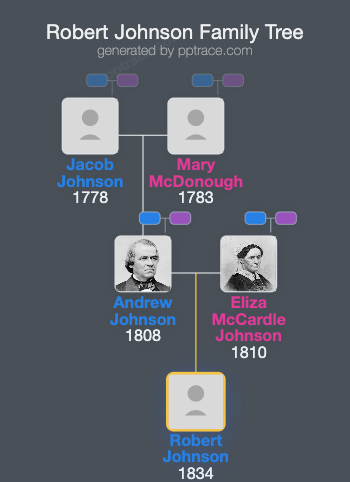
Robert Johnson was born on February 22, 1834, in Greeneville, Tennessee, in the family's Water Street house. He was the fourth child of Andrew Johnson and Eliza McCardle. His father, Andrew Johnson, was a lawyer, a one-term Tennessee state legislator, a Union Army cavalry officer during the American Civil War, and served as Secretary to the President of the United States. Robert Johnson is sometimes referred to as Bob Johnson.
In his early life, Robert Johnson briefly studied at Franklin College in Nashville during the winter of 1850–51 but soon returned home for reasons that are not well documented. During this period, he reportedly experienced some hemorrhaging of the lungs, which may have been related to tuberculosis. He was licensed as a lawyer in 1856 after studying under attorney Robert McFarland. Contemporary accounts suggest he was not particularly distinguished in his legal career. Along with his brother Charles Johnson, he managed their father's business affairs and real estate while Andrew Johnson was away from Tennessee.
Johnson attended the 1856 Democratic National Convention and served in the Tennessee state legislature's 33rd General Assembly from 1859 to 1861, representing Greene, Hancock, Hawkins, and Jefferson counties. There are claims that efforts were made to position him as a presidential candidate through his legislative role. He also participated in the 1860 Democratic National Convention in Charleston, South Carolina.
During the period leading up to the Civil War, Johnson was a Southern Unionist, remaining loyal to the federal government while Tennessee seceded. He made a notable speech defending the Union, the Constitution, and the Laws in Nashville shortly before Tennessee's secession ordinance. In June 1861, he was a delegate from Greene County to the pro-Union East Tennessee Convention. Due to his Unionist stance, Johnson faced threats of arrest and hanging in Tennessee, and during the early Civil War, he was hidden from Confederate forces on his family's farm and possibly sheltered with Union guerrilla bands.
In February 1862, Johnson joined the Union Army at Camp Dennison near Cincinnati, Ohio, for a three-year term, being commissioned as colonel of the 4th Tennessee Volunteer Regiment, which he organized. The regiment was later redesignated as the 1st Tennessee Cavalry Regiment. Johnson participated in various activities in the Western theater of the Civil War, including a journey to Union camps in Kentucky in early 1862, and was active in recruiting and administrative duties. On November 14, 1862, he addressed Union supporters in Cincinnati along with politicians and military officers, including his father’s political allies.
Johnson's role during the Civil War included the presentation of a regimental flag inscribed with the regiment's dedication to Tennessee. His older brother, Charles Johnson, an assistant surgeon with the 10th Tennessee Infantry, died in Nashville in April 1863 following a horse accident. Subsequently, Johnson's drinking habit reportedly worsened, as noted by General William S. Rosecrans. Johnson resigned his commission due to health reasons on May 31, 1863, after serving approximately a year and a half. Brigadier General James Patton Brownlow succeeded him as colonel.
Following his resignation, Robert Johnson was assigned to detached duty, which involved efforts to raise a brigade and other activities in Nashville. In November 1863, Andrew Johnson, then serving as military governor of Tennessee, demanded that Robert resign entirely from the Union Army, which he did. His subsequent resignation from military service was officially noted on May 31, 1864, citing reasons of a private nature and the solicitation to undertake civilian work. Despite his limited participation in combat, Johnson was later brevetted as a Brigadier General with rank from March 13, 1865.
Robert Johnson died on April 22, 1869, in Greeneville, Tennessee, at the family home. His death followed a period of chronic alcohol dependence, and it was caused by an overdose of alcohol and laudanum. His death occurred six weeks after the conclusion of President Andrew Johnson's term in office.