Charles Johnson
| Name | Charles Johnson |
| Title | (1830-1863) |
| Gender | Male |
| Birthday | 1830-02-19 |
| nationality | — |
| Source | https://www.wikidata.org/wiki/Q75766067 |
| pptrace | View Family Tree |
| LastUpdate | 2025-11-16T10:13:48.763Z |
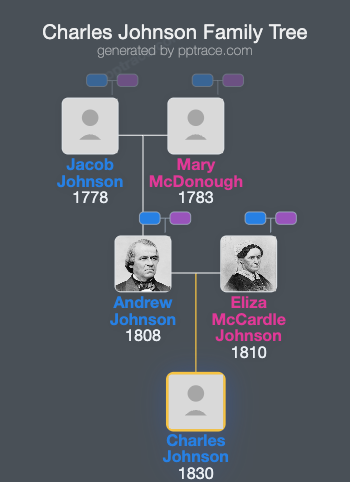
Family Tree
Tap  to expand more relatives
Introduction
Charles Johnson (February 19, 1830 – April 4, 1863) was the eldest son of Andrew Johnson, who served as the 17th President of the United States, and his wife Eliza McCardle Johnson. He was born in Greeneville, Tennessee, at the family's residence on Main Street. As of the 1850 census, at age 20, Johnson was employed as a printer in Greeneville. Around this time, he was a partner in the Greeneville Spy, a newspaper, for approximately one year, and circa 1857, he co-owned a drugstore where he worked as a druggist. He and his brother Robert also managed their father's business affairs and real estate holdings during Andrew Johnson's absences from Tennessee.
By the 1860 census, at age 30, Johnson was recorded as a physician and was residing in the Johnson family home. That year, he visited Charleston, South Carolina, for the Democratic National Convention, where he reportedly "gotten on a spree," a term indicating intoxication, which troubled his family. Earlier, in May–June 1861, he and his brother Robert served as delegates from Greene County to the pro-Union East Tennessee Convention. During this period, Tennessee aligned with the Confederacy, making the Johnson brothers Unionist targets; their brother-in-law, David T. Patterson, was imprisoned, and Daniel Stover, another brother-in-law and leader of the East Tennessee bridge burners, risked execution if captured by Confederate forces.
It is believed that Charles Johnson at some point took an oath of allegiance to the Confederacy, possibly in an effort to protect family property, although this was unsuccessful. Andrew Johnson was appointed military governor of Tennessee on March 5, 1862, by President Abraham Lincoln. In the fall of 1862, Charles traveled with his father to the national capital, where he enlisted in the Union Army as an assistant surgeon. He served in the 10th Tennessee Infantry Regiment, also known as the Middle Tennessee Infantry, under Rudolph Knaffl.
Charles Johnson died in Nashville on April 4, 1863, following a horse-riding accident. Reports suggest he was thrown from a horse, sustaining fatal head injuries; accounts of his death vary, with some indicating he died almost instantly, while others noted he lingered for several hours. The circumstances of his death were not entirely clear. A family record from 1869 reports that he was thrown from a mare after it reared suddenly, resulting in his death. An 1891 account mentions the "enemy that carried the illustrious father away—the bottle," implying alcoholism contributed to his death, which is supported by the fact that he had battled a serious drinking problem for years.
The family was notified of his death via telegram from Tennessee Secretary of State Edward H. East, and only Robert Johnson was able to attend the funeral, which took place on April 7, 1863. The funeral procession included a portion of the 1st Tennessee Cavalry, the regiment he served with. He was initially buried at Mount Olivet Cemetery in Nashville; however, his body was later reinterred in the family burial plot at the Andrew Johnson National Cemetery, where he shares a grave marker with his brother Robert.
Throughout his life, Charles Johnson was remembered as his mother Eliza's favorite. Her grief over his early death reportedly affected her deeply, and his passing is sometimes cited as a contributing factor to her subsequent periods of self-isolation during the family's time in the White House.