Charles Stuart, 1st Baron Stuart De Rothesay
| Name | Charles Stuart, 1st Baron Stuart De Rothesay |
| Title | British diplomat and bibliophile (1779-1845) |
| Gender | Male |
| Birthday | 1779-01-02 |
| nationality | United Kingdom of Great Britain and Ireland |
| Source | https://www.wikidata.org/wiki/Q275110 |
| pptrace | View Family Tree |
| LastUpdate | 2025-11-26T23:22:51.588Z |
Family Tree
Tap  to expand more relatives
Introduction
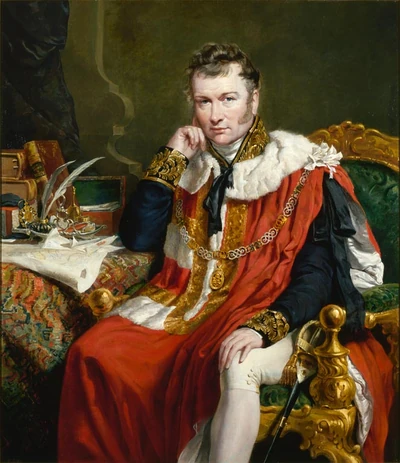
Charles Stuart, 1st Baron Stuart de Rothesay (2 January 1779 – 6 November 1845), was a British diplomat who served as twice Ambassador to France and as Ambassador to Russia from 1841 to 1844.
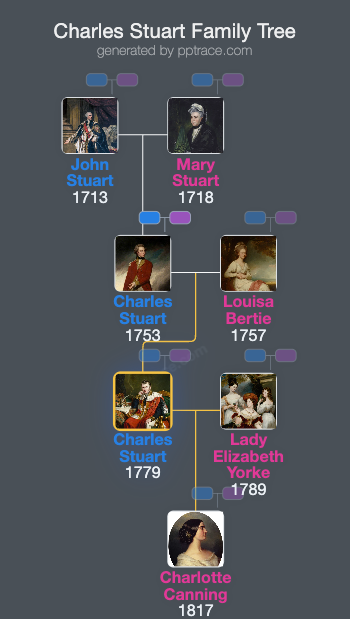
He was born in January 1779, the son of Lieutenant-General The Honourable Sir Charles Stuart and Louisa Bertie. His paternal grandfather was John Stuart, 3rd Earl of Bute, who served as Prime Minister of Great Britain. His maternal grandfather was Lord Vere Bertie, a younger son of Robert Bertie, 1st Duke of Ancaster and Kesteven.
Stuart was educated at Eton College and Christ Church, Oxford University. He entered the Diplomatic Service in 1801, initially serving as Secretary of Legation in Vienna until 1804. Subsequently, he was stationed in Saint Petersburg, Russia, and in 1808, he was posted to French-occupied Spain. Between 1810 and 1814, he served as Envoy Extraordinary and Minister Plenipotentiary to Portugal and Brazil.
In 1812, Stuart was appointed a Knight of the Most Honourable Order of the Bath (KB). He was sworn into the Privy Council in 1814. In December of that year, Henry Brougham described Stuart as a man of practical sense, honest, straightforward, and well-read, with a reputation for integrity and honor. During 1815, he briefly served as envoy to the Netherlands from February to May.
While stationed in Spain as ambassador, Stuart became an influential figure to the Duke of Wellington. He was appointed British ambassador to France during Napoleon's Hundred Days. At the start of the Waterloo Campaign, he was in Brussels and attended the Duchess of Richmond's Ball. After Napoleon's defeat, he accompanied King Louis XVIII back to Paris and remained as British ambassador there until 1824. In 1815, Stuart was elevated to Knight-Grand-Cross of the Order of the Bath (GCB).
From 1825 to 1826, he again served as Envoy Extraordinary and Minister Plenipotentiary to Portugal and Brazil. During this period, he was authorized by King John VI of Portugal to negotiate the recognition of Brazilian independence. He signed the treaty on 29 August 1825, which was ratified on 15 November 1825, and was subsequently created the 1st Count of o Machico by Portuguese decree. Shortly thereafter, he was also granted the title 1st Marquess of Angra. Additionally, he was awarded the Grand Cross of the Portuguese Order of the Tower and Sword.
In January 1828, Stuart was appointed ambassador to France once more, and he was raised to the peerage of Great Britain and Ireland as Baron Stuart de Rothesay, of the Isle of Bute. He held this post until November 1830. Later, he served as ambassador to Russia from 1841 to 1844.
Stuart married Lady Elizabeth Margaret, daughter of Philip Yorke, 3rd Earl of Hardwicke, on 6 February 1816. They had two daughters, Charlotte Stuart and Louisa Anne Stuart. Charlotte married Charles Canning, 1st Earl Canning, and Louisa married Henry Beresford, 3rd Marquess of Waterford.
In the early 1830s, Stuart retired from diplomatic service and commissioned the construction of Highcliffe Castle at Highcliffe, Dorset. He engaged architect William Donthorne to design the castle, which incorporated medieval stonework from French sites acquired following the French Revolution. The castle features an L-shaped layout, with notable architectural elements including an oriel window, stained glass, and carved stone from Norman and other historical structures.
After completing the castle, Stuart was appointed ambassador to Russia in 1841. Due to ill-health, he returned to England and died at Highcliffe in November 1845 at the age of 66. The barony became extinct upon his death. He was buried at St Mark's Church, Highcliffe, where his memorial remains. His wife, Lady Stuart de Rothesay, remained widowed until her death in June 1867.