John Ponsonby
| Name | John Ponsonby |
| Title | Irish politician (1713-1787) |
| Gender | Male |
| Birthday | 1713-03-29 |
| nationality | — |
| Source | https://www.wikidata.org/wiki/Q15521030 |
| pptrace | View Family Tree |
| LastUpdate | 2025-11-26T23:22:24.327Z |
Family Tree
Tap  to expand more relatives
Introduction
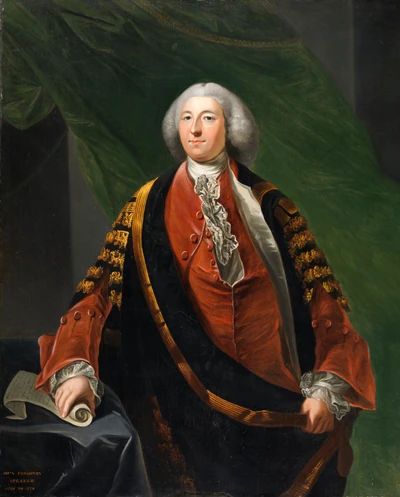
John Ponsonby, PC (Ire) (29 March 1713 – 16 August 1787), was an Irish politician of Anglo-Irish descent. He served as the Speaker of the Irish House of Commons from 1756 to 1771, a period marked by the assertion and testing of the legislative independence of the Kingdom of Ireland.
== Early life ==
John Ponsonby was born on 29 March 1713. He was the second son of Brabazon Ponsonby, who was created the Earl of Bessborough in 1739, and his first wife, Sarah Margetson Colvill. His grandfather was William Ponsonby, 1st Viscount Duncannon. Ponsonby was admitted to Trinity College Dublin on 6 April 1730; however, there is no record indicating that he graduated.
== Parliamentary career ==
In 1739, Ponsonby entered the Irish House of Commons representing Newtownards. He aligned himself with his father's faction, which aimed to diminish the influence of Henry Boyle. Following Boyle’s resignation as speaker in 1756, Ponsonby was elected unopposed as the new Speaker of the Irish House of Commons. He was re-elected to this position in 1761 and again in 1769.
Ponsonby also held the position of First Commissioner of the Revenue and became a member of the Privy Council of Ireland in 1746. In 1761, he was elected for both County Kilkenny and Armagh and chose to sit for County Kilkenny. He stood for election in Gowran and Newtownards in 1768, and for Carlow in 1776, but consistently chose to represent County Kilkenny until 1783. Afterwards, he was elected again for Newtownards, representing that constituency until his death in 1787.
As a member of a prominent family controlling significant influence over Irish governance, Ponsonby was among the "undertakers"—individuals who managed the government's operations in Ireland. In his role as speaker, he exerted influence over governmental affairs, employing patronage to sustain loyalty among his supporters, and used his office to bolster the Irish Patriot movement during the 1760s.
In 1767, the political landscape shifted with George Townshend, 1st Marquess Townshend, assuming the role of lord-lieutenant, leading to a power struggle between Ponsonby’s faction and the Dublin Castle administration aligned with Townshend. This struggle culminated in Ponsonby voting in favor of a patriot motion in November 1769, which opposed a privy council money bill, resulting in his dismissal from his role in the revenue by Townshend.
In 1770, Ponsonby did not respond to Lord Charlemont's proposal to coordinate opposition against Townshend. Following the Irish MPs’ endorsement of the king's decision to retain Townshend in office in 1771, Ponsonby resigned as speaker. Despite the departure of many allies from his faction, Ponsonby remained in opposition. He sought to regain the speakership in 1776 but was defeated by the incumbent, Edmund Sexton Pery.
John Ponsonby died while still serving as a member of parliament on 16 August 1787.
== Marriage and issue ==
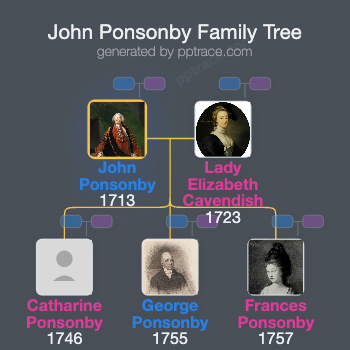
In 1743, Ponsonby married Lady Elizabeth Cavendish, daughter of the 3rd Duke of Devonshire. This marriage linked the Ponsonby family to the Dukes of Devonshire, a connection of significant social and political importance. His older brother, William Ponsonby, 2nd Earl of Bessborough, had married the eldest daughter of the 3rd Duke of Devonshire in 1739.
Ponsonby's children included William Ponsonby, 1st Baron Ponsonby of Imokilly, and George Ponsonby, both of whom became notable politicians. His daughter Catherine married Richard Boyle, 2nd Earl of Shannon, and was the mother of Henry Boyle, 3rd Earl of Shannon.