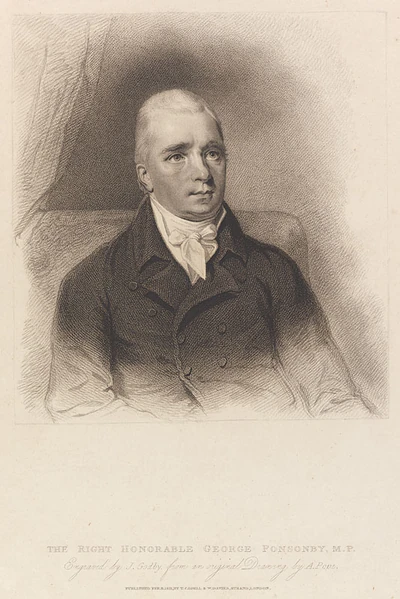
George Ponsonby
| Name | George Ponsonby |
| Title | British politician |
| Gender | Male |
| Birthday | 1755-03-05 |
| nationality | United Kingdom of Great Britain and Ireland |
| Source | https://www.wikidata.org/wiki/Q5543487 |
| pptrace | View Family Tree |
| LastUpdate | 2025-11-26T23:22:22.614Z |
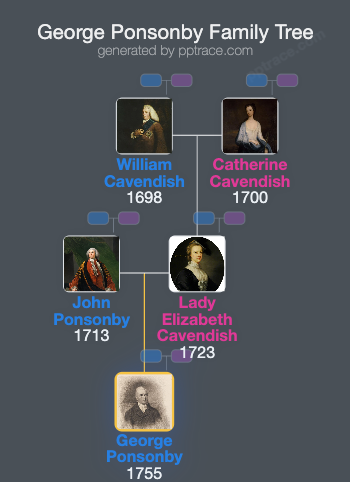
Family Tree
Tap  to expand more relatives
Introduction
George Ponsonby (5 March 1755 – 8 July 1817) was a British lawyer and politician affiliated with the Whig party. He held the office of Lord Chancellor of Ireland from 1806 to 1807 during the administration known as the Ministry of All the Talents.
Born in Dublin, Ponsonby was the second surviving son of Honourable John Ponsonby and Lady Elizabeth Cavendish. His father served as the speaker of the Irish House of Commons from 1756 to 1771. His mother was the daughter of William Cavendish, the 3rd Duke of Devonshire. His early education took place at Kilkenny College, followed by studies at Trinity College, Cambridge.
In 1776, Ponsonby became a member of the Irish House of Commons. He initially represented Wicklow from 1778 to 1783, then served as the member for Inistioge from 1783 to 1797. From 1798 until the Act of Union in 1801, he represented Galway Borough. Throughout this period, he was involved in significant debates, including those concerning Roman Catholic relief, and he served as Chancellor of the Irish Exchequer in 1782.
Following the union of the Irish and British parliaments in 1801, Ponsonby represented County Wicklow and later Tavistock in the Parliament of the United Kingdom. In 1806, he was appointed as Lord Chancellor of Ireland, a role he held until 1807. Subsequently, from 1808 until his death in 1817, he was recognized as the leader of the opposition in the British House of Commons.
Ponsonby was selected as the first recognized opposition leader in the House of Commons, proposed by leading Whig peers Lord Grenville and Earl Grey. Despite this position, he was often characterized as a moderate, and some descriptions considered him a "mediocrity," with Foorde noting that he was "a little-known mediocrity who was related to Lady Grey." His leadership was regarded as weak, and although he was reluctant to resign, he maintained the leadership until his death. Upon his death in London, he was succeeded by George Tierney as the leader of the Whig opposition.
In his personal life, Ponsonby was a member of Daly’s Club in Dublin. He married Lady Mary Butler, daughter of Brinsley Butler, the 2nd Earl of Lanesborough, and Lady Jane Rochfort. He left behind an only daughter, Elizabeth, who married Francis Aldborough Prittie, MP. Elizabeth and Prittie had six children.
George Ponsonby died in London on 8 July 1817.