Frank Robert Pierce
| Name | Frank Robert Pierce |
| Title | (1839-1843) |
| Gender | Male |
| Birthday | 1839-08-27 |
| nationality | — |
| Source | https://www.wikidata.org/wiki/Q75766619 |
| pptrace | View Family Tree |
| LastUpdate | 2025-11-16T10:11:17.797Z |
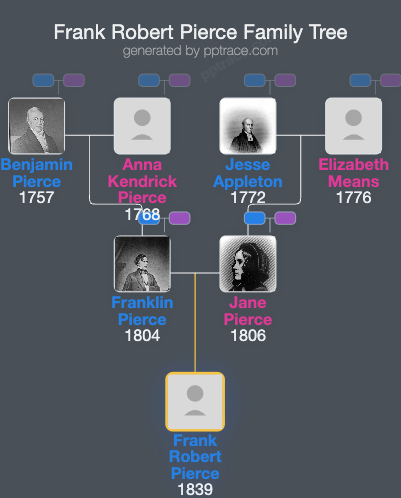
Family Tree
Tap  to expand more relatives
Introduction
Franklin Pierce (November 23, 1804 – October 8, 1869) was an American politician who served as the 14th president of the United States from 1853 to 1857. He was born in Hillsborough, New Hampshire, and was a sixth-generation descendant of Thomas Pierce, an immigrant from Norwich, Norfolk, England, who settled in the Massachusetts Bay Colony around 1634. His father, Benjamin Pierce, was a prominent Democratic-Republican politician and served as the governor of New Hampshire. Franklin Pierce was the fifth of eight children born to Benjamin Pierce and his second wife, Anna Kendrick.
Pierce's early education included attendance at Hillsborough Center and Hancock town schools, after which he transferred to Phillips Exeter Academy. He enrolled at Bowdoin College in Brunswick, Maine, in 1820, where he joined the Athenian Society and developed friendships with future notable figures such as Nathaniel Hawthorne and Jonathan Cilley. He graduated in 1824, placing fifth in a class of 14 students. Following graduation, Pierce briefly read law with Levi Woodbury in Portsmouth, New Hampshire, and then studied at Northampton Law School in Massachusetts and under Judge Edmund Parker in Amherst, New Hampshire. He was admitted to the New Hampshire bar in late 1827 and practiced law in Hillsborough.
In addition to his legal career, Pierce was involved in politics from an early age. He was elected to the Hillsborough town meeting and served several terms as town moderator. He also served in the New Hampshire House of Representatives, where he was chairman of the Education Committee and the Committee on Towns, and was elected Speaker of the House at age 27. His political activity aligned with the Democratic Party supporting Andrew Jackson, and he actively campaigned for Jackson in the 1828 presidential election.
Pierce served in the New Hampshire militia, starting as an aide de camp to the governor in 1831 and attaining the rank of colonel. During the Mexican-American War, he served as a brigadier general in the United States Army from 1847 to 1848. His military involvement and political career contributed to his rising prominence within the Democratic Party.
In 1845, Pierce was appointed as the U.S. attorney for New Hampshire. He was also a member of the U.S. Senate, serving from 1837 until his resignation in 1842. His legal practice was successful, and he gained national recognition as a compromise candidate for the Democratic nomination in the 1852 presidential election.
Pierce was nominated by the Democratic Party in 1852 and elected president alongside running mate William R. King after defeating the Whig ticket of Winfield Scott and William Alexander Graham. His presidency was characterized by efforts to enforce civil service standards, promote expansionist policies such as the Gadsden Purchase from Mexico, and pursue negotiations with Britain and Japan. He also signed the Kansas-Nebraska Act, which nullified the Missouri Compromise and led to violent conflicts over slavery's expansion, notably the "Bleeding Kansas." His administration was further damaged by the Ostend Manifesto, a secret diplomatic document advocating for the annexation of Cuba.
Pierce sought renomination in 1856 but was not re-nominated by the Democratic Party. His popularity declined domestically and internationally, and he became a critic of Abraham Lincoln during the Civil War. His personal life was marked by tragedy; he experienced the early death of his children and the illness and depression of his wife, Jane Pierce. Their last surviving son died in a train accident shortly before Pierce's inauguration. Pierce was known to be a heavy drinker throughout his life and died in 1869 of cirrhosis.
Historians generally rank Franklin Pierce as one of the less successful and less influential U.S. presidents, largely due to his support for Southern interests and his inability to effectively manage the sectional tensions leading up to the Civil War.