Franklin Pierce
| Name | Franklin Pierce |
| Title | president of the United States from 1853 to 1857 |
| Gender | Male |
| Birthday | 1804-11-23 |
| nationality | United States of America |
| Source | https://www.wikidata.org/wiki/Q12312 |
| pptrace | View Family Tree |
| LastUpdate | 2025-11-17T06:39:39.917Z |
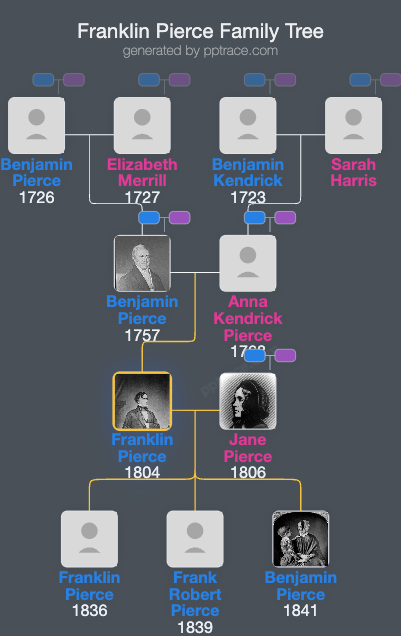
Family Tree
Tap  to expand more relatives
Introduction
Franklin Pierce (November 23, 1804 – October 8, 1869) was an American politician who served as the 14th president of the United States from 1853 to 1857. Born in Hillsborough, New Hampshire, Pierce was a descendant of Thomas Pierce, who migrated from Norwich, Norfolk, England, to the Massachusetts Bay Colony around 1634. His father, Benjamin Pierce, served as a lieutenant in the American Revolutionary War and later became a prominent Democratic-Republican politician, serving as governor of New Hampshire. Franklin Pierce was the fifth of eight children born to Benjamin Pierce and his second wife, Anna Kendrick. His early education included attendance at local schools in Hillsborough and Hancock, with a notable experience that he later considered a turning point: walking back home from school during a thunderstorm after being disciplined by his father. He subsequently transferred to Phillips Exeter Academy to prepare for college.
In 1820, Pierce enrolled at Bowdoin College in Brunswick, Maine, where he participated in literary societies and formed enduring friendships, including with Nathaniel Hawthorne. He graduated in 1824, ranking fifth in his class of 14. Following graduation, Pierce briefly taught at Hebron Academy and studied law under Levi Woodbury in Portsmouth, New Hampshire. He was admitted to the New Hampshire bar in 1827 and began practicing law in Hillsborough, developing a reputation for personal charm and good memory.
Pierce’s political career began with local involvement, serving as Hillsborough’s town meeting moderator and later as a member of the New Hampshire House of Representatives, where he was elected speaker in 1831 at the age of 27. His family remained active in state politics, with his father serving again as governor. Pierce’s interest in the state militia grew, and he was appointed aide de camp to the governor in 1831, later attaining the rank of colonel and serving as a brigadier general during the Mexican–American War.
In national politics, Pierce was aligned with the Democratic Party, which supported Andrew Jackson. He served in the U.S. House of Representatives from 1833 to 1837, then in the U.S. Senate from 1837 until his resignation in 1842. In 1845, he was appointed as the U.S. attorney for New Hampshire. During the Mexican–American War (1846–1848), he served as a brigadier general in the U.S. Army, gaining military experience.
Pierce was selected as the Democratic candidate for president in 1852, seen as a compromise candidate capable of uniting Northern and Southern interests. He and running mate William R. King defeated the Whig ticket of Winfield Scott and William Alexander Graham. As president, Pierce attempted to implement civil service reforms and was involved in expansionist policies, including the Gadsden Purchase and efforts to acquire Cuba from Spain. His administration signed trade treaties with Britain and Japan, and his cabinet aimed to improve departmental accountability. However, his tenure was overshadowed by political conflicts, notably the passage of the Kansas–Nebraska Act, which nullified the Missouri Compromise and led to violent conflicts over slavery expansion.
Pierce’s popularity declined in the Northern states after his support for the Kansas–Nebraska Act, though he retained support among many Southern whites. The Ostend Manifesto, calling for the annexation of Cuba, further damaged his reputation. He expected renomination in 1856 but was rejected by the Democratic Party. He opposed President Abraham Lincoln during the Civil War and became a vocal critic.
Pierce’s personal life was marked by tragedy; his three children died young, and his wife, Jane Pierce, suffered from illness and depression. Their last surviving son was killed in a train accident shortly before Pierce’s inauguration. A heavy drinker, Pierce died in 1869 from cirrhosis. His legacy is generally characterized by historians as among the least distinguished among U.S. presidents, largely due to his political actions and stances leading up to the Civil War.