John Strachey
| Name | John Strachey |
| Title | British politician and writer (1901-1963) |
| Gender | Male |
| Birthday | 1901-10-21 |
| nationality | United Kingdom |
| Source | https://www.wikidata.org/wiki/Q334116 |
| pptrace | View Family Tree |
| LastUpdate | 2025-11-17T06:41:22.756Z |
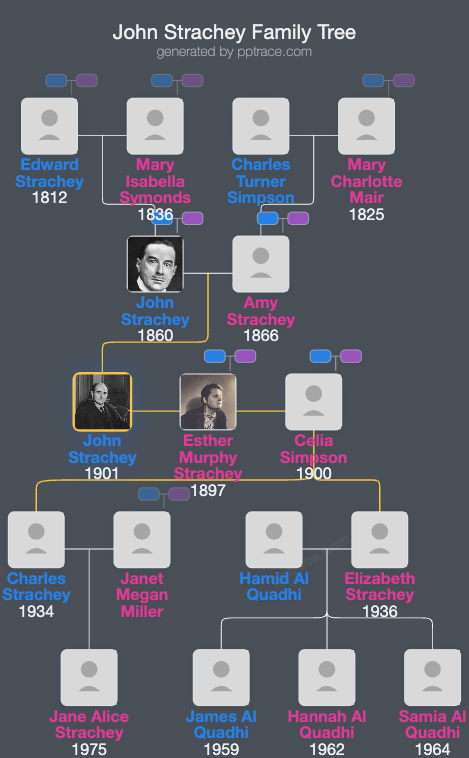
Family Tree
Tap  to expand more relatives
Introduction
Evelyn John St Loe Strachey was born on 21 October 1901 in Guildford, Surrey, and died on 15 July 1963. He was a British politician affiliated with the Labour Party and also engaged in writing as a journalist and author. His father was John St Loe Strachey (1860–1927), who served as the editor of The Spectator.
Strachey was educated at Eton College from 1915 to 1919, and he commenced studies at Magdalen College, Oxford, in 1920. His attendance was interrupted by ill health—peritonitis—and he left Oxford in 1922 after two years without obtaining a degree. That same year, he joined the staff of The Spectator journal.
His political career began with an affiliation to the Labour Party in 1923, and he initially aligned with Oswald Mosley, then a prominent Labour politician. During this period, Strachey contributed writings to the Independent Labour Party (ILP) publication New Leader. He was an unsuccessful Labour candidate in Birmingham Aston during the 1924 general election.
In 1929, he was elected as a Member of Parliament (MP) for Birmingham Aston, representing the Labour Party. That year, he married Esther Murphy, the daughter of a New York department store owner; Oswald Mosley served as best man at the wedding.
Strachey supported Mosley's activities in the early 1930s, including the founding of the New Party in 1931. However, he disassociated from Mosley's movement later that year when Mosley rejected socialism and veered towards fascism; Strachey did not follow him into fascism. He was defeated in the October 1931 general election, contesting as an independent pro-communist candidate. He sought to join the Communist Party of Great Britain (CPGB) but was rejected in 1932, citing unreliability as an intellectual.
Throughout the 1930s, Strachey aligned with Communist sympathies, serving as secretary of the Committee for Coordinating Anti-Fascist Activities, which opposed British fascist organizations such as Oswald Mosley's British Union of Fascists. He played a significant role in organizing counter-demonstrations against fascist rallies, including the large Hyde Park rally in 1934.
He was a prolific writer during this period, contributing to Marxist theory and socialist literature. Notably, he authored "The Coming Struggle for Power" (1932) and was considered one of the most influential Marxist–Leninist theorists in Britain during the 1930s. His works were among the most widely read popularizations of Marxism in English. Strachey also assisted in founding the Left Book Club in 1936.
In 1938, Strachey adopted Keynesian economic perspectives, and by 1940 he publicly supported the New Deal policies of U.S. President Franklin D. Roosevelt through his publication "A Programme for Progress." His stance toward the Communist movement shifted following the Molotov–Ribbentrop Pact and Soviet actions in Finland, leading to his break with the CPGB in April 1940.
During World War II, Strachey served as a volunteer air raid warden and later joined the Royal Air Force in a temporary commission, serving as a squadron leader with roles in aircraft operations and public relations. He was known for broadcasting official RAF messages on the BBC.
Post-war, Strachey re-entered Parliament as a Labour MP for Dundee, initially elected in 1945, and later for Dundee West in 1950, remaining in office until his death. He held government positions including Under-Secretary of State for Air, Minister of Food (appointed in May 1946), and Secretary of State for War. His tenure as Minister of Food was marked by the implementation of rationing measures, which faced public criticism.
Throughout his parliamentary career, Strachey generally supported the right wing of the Labour Party. His political views evolved from Marxist socialism to social democracy over the course of his life. He also supported Zionist efforts during the Palestine Emergency, sometimes controversially. Strachey was appointed to the Privy Council in 1946.
He was married twice, first to Esther Murphy and later to Celia Simpson, with whom he had two children. His death occurred in 1963 while still serving as an MP.