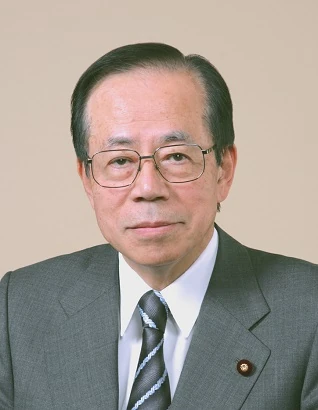
Yasuo Fukuda
| Name | Yasuo Fukuda |
| Title | Prime Minister of Japan from 2007 to 2008 |
| Gender | Male |
| Birthday | 1936-07-16 |
| nationality | Japan |
| Source | https://www.wikidata.org/wiki/Q101137 |
| pptrace | View Family Tree |
| LastUpdate | 2025-11-17T06:46:48.397Z |
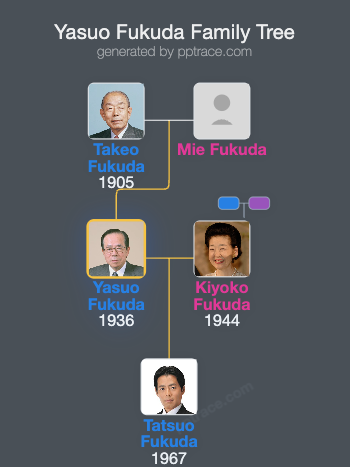
Family Tree
Tap  to expand more relatives
Introduction
Yasuo Fukuda (福田 康夫, Fukuda Yasuo) was born on 16 July 1936 in Takasaki, Gunma, Japan. He is the eldest son of Takeo Fukuda, who served as the 67th Prime Minister of Japan. Yasuo Fukuda spent his early years in Setagaya, Tokyo, where he attended Azabu High School. He graduated from Waseda University in 1959 with a degree in economics.
Following his university education, Fukuda joined Maruzen Petroleum (now part of Cosmo Oil Company). Over the next seventeen years, he worked within the company, ascending to the position of section chief. During this period, he was posted to the United States from 1962 to 1964.
From 1976 to 1978, Yasuo Fukuda served as a political secretary during his father Takeo Fukuda’s tenure as Prime Minister. Between 1978 and 1989, Fukuda was a director of the Kinzai Institute for Financial Affairs and became a trustee of the institute in 1986. He also served as president of the Japanese Canoe Federation before entering the national political stage.
Fukuda was first elected to the House of Representatives in 1990. He was appointed deputy director of the Liberal Democratic Party (LDP) in 1997. In October 2000, he became Chief Cabinet Secretary under Prime Minister Yoshirō Mori, a position he held until May 2004. He resigned from this role amid the fallout of a scandal related to Japan’s pension system.
Throughout his political career, Fukuda held various roles within the LDP. He was considered a potential candidate for party leadership in 2006 but declined to run, allowing Shinzo Abe to become the LDP leader and Prime Minister. Fukuda is known for advocating for a secular approach to the Yasukuni Shrine, proposing an alternative to the shrine’s memorial practices in June 2006 involving 134 other lawmakers.
Following Shinzo Abe’s resignation in September 2007, Fukuda announced his candidacy for the leadership of the LDP. He received endorsements from key factions, including the party’s largest faction led by Foreign Minister Nobutaka Machimura, and was supported by Finance Minister Fukushiro Nukaga. On 23 September 2007, Fukuda defeated Tarō Asō in the leadership election, receiving 330 votes to Aso's 197. He was formally appointed as Japan’s 91st Prime Minister on 25 September 2007, and his cabinet was sworn in by Emperor Akihito on 26 September.
During his tenure as Prime Minister, Fukuda experienced political challenges, including the passage of a non-binding censure motion by the opposition-controlled upper house on 11 June 2008, marking the first such motion against a Prime Minister under Japan's post-war constitution. The following day, a motion of confidence was passed by the lower house’s ruling coalition to counter the censure.
On 1 September 2008, Fukuda announced his resignation, citing the need to improve political processes hindered by deadlock between his party and the opposition-controlled upper house. His resignation was a surprise to the public and was followed by a leadership election in which Tarō Asō was elected to succeed him as LDP President. Fukuda and his cabinet resigned on 24 September 2008, and Aso was elected Prime Minister by the National Diet.
After leaving office, Fukuda did not participate in the 2012 general election and officially retired from politics. In June 2014, he engaged in secret diplomatic meetings in Beijing with Chinese officials, which contributed to groundwork for subsequent Japan-China summits. In the following years, he continued to be active in diplomatic and international forums, including addressing trade relations involving China and the United States.
Fukuda currently serves as President of the Japan-Indonesia Association. His career also includes controversy, notably comments made in 2003 regarding victims of rape by members of the Waseda University "Super Free" club, which he later stated had been distorted and reaffirmed that rape is a crime.
He has been involved in discussions on Japan's foreign policy, including the Indian Ocean refueling mission following the September 11 attacks.