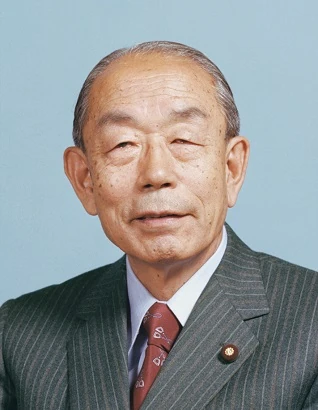
Takeo Fukuda
| Name | Takeo Fukuda |
| Title | Prime Minister of Japan from 1976 to 1978 |
| Gender | Male |
| Birthday | 1905-01-14 |
| nationality | Japan |
| Source | https://www.wikidata.org/wiki/Q315584 |
| pptrace | View Family Tree |
| LastUpdate | 2025-11-17T06:46:47.574Z |
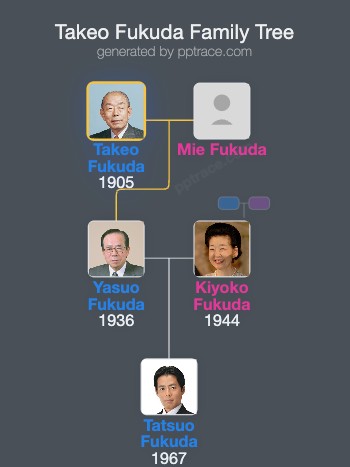
Family Tree
Tap  to expand more relatives
Introduction
Takeo Fukuda (福田 赳夫, Fukuda Takeo) was a Japanese politician born on January 14, 1905, in Kaneko village, Gunma Prefecture, Japan. He died on July 5, 1995. Fukuda was the second son of a family with a samurai lineage, whose ancestors held village headman positions during the Edo period. His father served as the mayor of Kaneko, and his grandfather and older brother also held mayoral positions.
He was educated at the First Higher School in Tokyo and later studied law at Tokyo Imperial University. After graduating in 1929, Fukuda achieved the highest score on the civil service examination and entered the Ministry of Finance. His early bureaucratic career included serving as a financial attaché at the Japanese embassy in London in 1930, followed by roles as head of a local tax office, chief of the Banking Bureau in 1946, and chief of the Budget Bureau in 1947. He married Mie Arai, granddaughter of a Supreme Court justice, and they had five children, including their eldest son, Yasuo Fukuda.
During the Pacific War, Fukuda served as an adviser on fiscal policy for the Wang Jingwei regime. At the end of World War II, he was chief secretary and head of the Minister's Secretariat, with subordinates including Masayoshi Ohira and Kiichi Miyazawa. In 1946, he became chief of the Banking Bureau, and in 1947 he was promoted to chief of the Budget Bureau. In 1948, Fukuda was arrested in connection with the Showa Denko scandal, a corruption case involving bureaucrats, businessmen, and politicians, but he was later acquitted. The incident prompted his resignation from the Ministry of Finance in 1950.
Fukuda was elected to the House of Representatives for the first time in 1952 as an independent representing Gunma’s third district. He later joined the Liberal Party in 1953, aligning with Nobusuke Kishi. When Kishi was expelled from the party in 1954, Fukuda left with him and helped form the Democratic Party. These parties merged in 1955 to establish the Liberal Democratic Party (LDP). Fukuda held various party roles, including chairman of the Policy Research Council in 1958 and secretary-general in 1959.
In government, Fukuda served as Minister of Agriculture, Forestry, and Fisheries from 1959 to 1960 under Prime Minister Nobusuke Kishi. Following Kishi’s resignation amid the 1960 Anpo protests against the U.S.-Japan Security Treaty, Fukuda continued his political ascent, supporting political factions within the LDP. He was involved in factional struggles between Kishi, Ikeda, and Sato, and in 1962, he formed the "Party Spirit Renovation League," which became a platform for opposition within the party.
He served as Minister of Finance from 1965 to 1966 and again from 1968 to 1971, and as Minister of Foreign Affairs from 1971 to 1972 under Prime Minister Eisaku Sato. In the 1972 leadership election, Fukuda ran to succeed Sato but was defeated by Kakuei Tanaka. During Tanaka’s administration, Fukuda served as Minister of Finance from 1973 to 1974, and later as Director of the Economic Planning Agency in 1974.
Fukuda’s tenure as Prime Minister commenced in 1976 following the resignation of Takeo Miki. His government lasted until 1978. During this period, Fukuda was involved in formalizing the Japanese posture toward China, culminating in the Treaty of Peace and Friendship with China in 1978. He also delivered the "Fukuda Doctrine" at the ASEAN summit in Manila in 1977, emphasizing Japan’s commitment to peace, mutual confidence, and partnership with Southeast Asian nations.
His administration faced challenges stemming from factional politics within the LDP. In 1978, Fukuda was defeated in the party primary by Masayoshi Ōhira, leading to his resignation as Prime Minister.