Edward Harley, 2nd Earl Of Oxford And Earl Mortimer
| Name | Edward Harley, 2nd Earl Of Oxford And Earl Mortimer |
| Title | British politician, bibliophile, collector and patron of the arts (1689-1741) |
| Gender | Male |
| Birthday | 1689-06-02 |
| nationality | Great Britain |
| Source | https://www.wikidata.org/wiki/Q5343313 |
| pptrace | View Family Tree |
| LastUpdate | 2025-11-26T23:25:33.543Z |
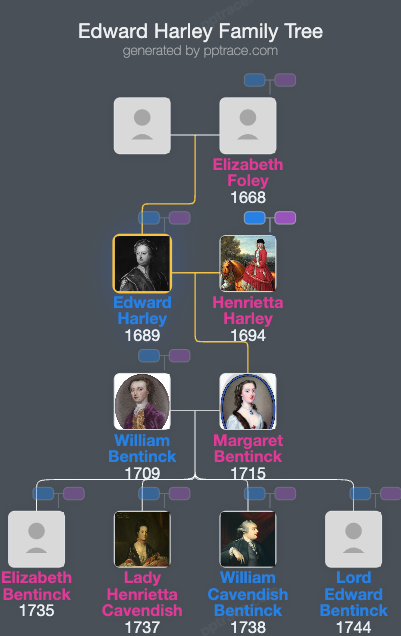
Family Tree
Tap  to expand more relatives
Introduction
Edward Harley, 2nd Earl of Oxford and Earl Mortimer, was born on 2 June 1689. He was the only son of Robert Harley, 1st Earl of Oxford and Earl Mortimer, and his first wife Elizabeth Foley. His family held hereditary titles and a history of political involvement, with previous generations serving as Members of Parliament for Radnor.
Harley's political career commenced when he was elected as Member of Parliament for Radnor in 1711. He served in this capacity until 1714. Later, he represented Cambridgeshire in Parliament from 1722 until 1724. In 1724, upon the death of his father, he succeeded to the family titles and entered the House of Lords. There is no record of significant political activity or government roles beyond his parliamentary service and subsequent accession to the peerage.
He was known for his interests in collecting arts and literature. Harley amassed a notable collection of coins and medals totaling 520 lots, which was auctioned over six days starting 18 March 1742, at Christopher Cock’s house in Covent Garden. He expanded his family library, including the Harleian Collection, which is now housed in the British Library. A significant portion of his personal book collection was acquired by Otto Thott, a Danish count, and upon Thott’s death in 1785, many volumes were transferred to the Royal Library in Copenhagen. The University of Nottingham’s Manuscripts and Special Collections hold papers relating to Harley and the management of his estates, including the Harley family papers as part of the Portland (Welbeck) Collection.
Through marriage, Harley inherited estate holdings including Welbeck Abbey in Nottinghamshire and Wimpole Hall in Cambridgeshire. Wimpole Hall became the family’s primary residence until 1740, when it was sold to settle debts. Harley also acquired substantial landholdings in London’s West End, which he developed during his lifetime. Many streets in London derive their names from Harley’s properties or connections, notably Harley Street and Oxford Street, alongside Wigmore Street and Wimpole Street.
Harley married Lady Henrietta Cavendish Holles on 31 August 1713. She was the only daughter and heir of the 1st Duke of Newcastle and Lady Margaret Cavendish. They had two children: Lady Margaret Cavendish Harley (1715–1785), who married William Bentinck, 2nd Duke of Portland, in 1734, and Henry Cavendish Harley, Lord Harley, who was born on 18 October 1725 and died shortly after birth on 22 October 1725.
Edward Harley died in London in 1741 and was buried in the vault of the Duke of Newcastle in Westminster Abbey. Upon his death, the earldom was inherited by his cousin, Edward Harley, who became the 3rd Earl of Oxford and Earl Mortimer.