Ludwig Von Wallmoden-Gimborn
| Name | Ludwig Von Wallmoden-Gimborn |
| Title | Austrian general |
| Gender | Male |
| Birthday | 1769-02-06 |
| nationality | Austrian Empire |
| Source | https://www.wikidata.org/wiki/Q79135 |
| pptrace | View Family Tree |
| LastUpdate | 2025-11-12T01:15:38.004Z |
Family Tree
Tap  to expand more relatives
Introduction
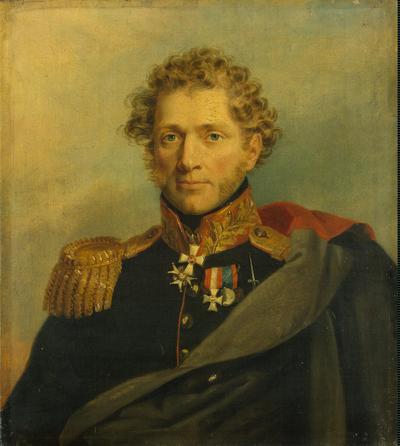
Ludwig Georg Thedel Graf von Wallmoden was born on 6 February 1769 and died on 22 March 1862. He was an Austrian general who served in various states and was notably involved in the training of light infantry and the development of the Tirailleur system.
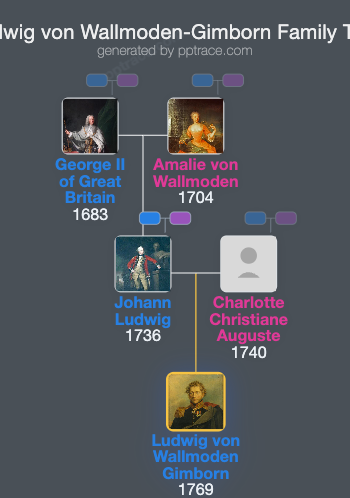
Wallmoden was a member of the House of Wallmoden and was the second son of Johann Ludwig Reichsgraf von Wallmoden-Gimborn (1736–1811) and Charlotte Christiane Auguste Wilhelmine von Wangenheim (1740–1783). His father was serving as the British ambassador in Austria at the time of his birth. Johann Ludwig was an illegitimate son of King George II of Great Britain through his mistress Amalie von Wallmoden, who was married to Adam Gottlieb, Count Wallmoden. The count was willing to accept payment to relinquish his claims on Amalie von Wallmoden, leading to her separation from her husband in 1740.
Wallmoden initially joined the Hanoverian Army before transitioning to the Prussian Army in 1790. While serving as a captain in Wolfradt's Hussars, he distinguished himself at the Battle of Kaiserslautern, receiving the Pour le Mérite award, though he was bayoneted in the chest during the engagement. Following the Peace of Basel in 1795, Wallmoden joined the Austrian army as a second captain in Vecsey's Hussars. He was promoted to first captain on 1 January 1797 and subsequently transferred to Karaczay-Chevaulegers. Over the next years, his ranks advanced: to major on 16 April 1797, to lieutenant colonel in Ulanenregimente No. 1 on 3 August 1798, and to colonel in the same regiment on 16 August 1800.
In 1809, Wallmoden negotiated the Subsidienvertrag between Austria and Great Britain in London. He then participated in the Battle of Wagram as a brigadier-general, where he commanded the left flank of the III Corps on 6 July. He ordered an attack involving the Liechtenstein Hussars on the enemy's right flank, which resulted in disrupting the enemy lines and capturing nine guns. During the Austrian retreat to Moravia, he led the Liechtenstein and Blankenstein Hussars in a delaying action at Hollabrunn on 9 July 1809, among other engagements. For his conduct at Wagram and during the delaying actions, he received the Knight's Cross of the Order of Maria Theresia and was promoted to army commander on 13 July 1809.
Following the Treaty of Vienna, Wallmoden was promoted to Feldmarschallleutnant on 21 August 1809 and resided in Prague. In 1812, he received permission from the Austrian emperor to transfer first to the British Army, and then at the request of the British, he joined the Russian Imperial Army. In Russia, he commanded light troops in the Russian-German Legion, which he amalgamated into the Allied "army of the north." During the Battle of the Göhrde, he and his corps resisted French forces under Davout and Pécheux, and later participated in operations in Schleswig, contributing to Danish peace efforts.
After the fall of Paris in 1814, the corps was disbanded. Wallmoden rejoined the Austrian army on 24 May 1815, during the Hundred Days, leading a column of the Austrian III Corps at Seltz against French forces and participating in the Battle of La Suffel and the siege of Strasbourg. In August 1816, he was appointed as the supreme commander of Austrian troops sent to Naples for the Neapolitan War. He remained in control of Austrian forces in Naples until 1821, after which he occupied Sicily from 1821 to 1823.
When Austria evacuated Naples in 1827, Wallmoden became the military commander of Milan on 21 March 1827 and was appointed to a secret council on 20 January 1831. He was promoted to General of the Cavalry on 18 September 1838. On 1 March 1848, he served as deputy to Field Marshal Count Radetzky, and on 19 October 1848, he received the Grand Cross of the Austrian Order of Leopold. He lived in Vienna during his retirement. After breaking his leg, he died in Vienna on 20 March 1862 at the age of 93, leaving no legitimate heirs.