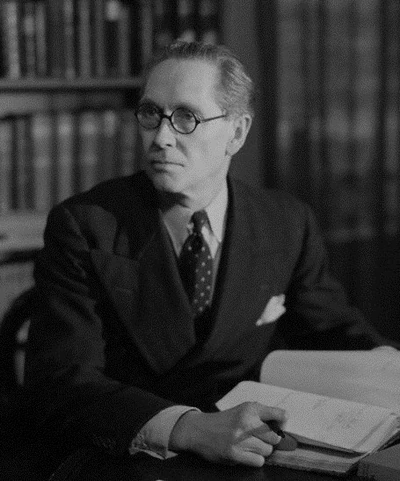
Philip Noel-Baker, Baron Noel-Baker
| Name | Philip Noel-Baker, Baron Noel-Baker |
| Title | British athlete, politician, Cabinet minister, life peer and Nobel Peace Prize winner (1889-1982) |
| Gender | Male |
| Birthday | 1889-11-01 |
| nationality | United Kingdom |
| Source | https://www.wikidata.org/wiki/Q211856 |
| pptrace | View Family Tree |
| LastUpdate | 2025-11-26T23:31:50.063Z |
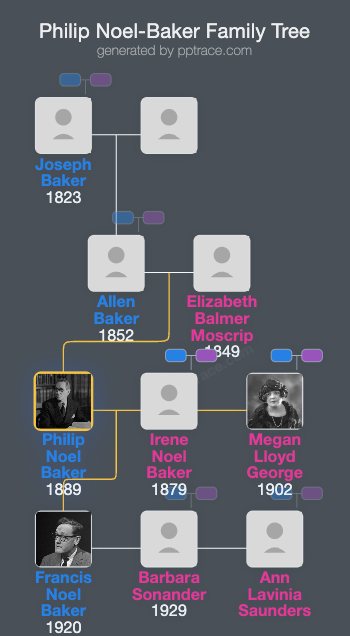
Family Tree
Tap  to expand more relatives
Introduction
Philip John Noel-Baker, Baron Noel-Baker (originally Philip John Baker), was born on November 1, 1889, in Brondesbury Park, London, England. He was the sixth of seven children of Allen Baker, a Canadian-born Quaker who moved to England in 1876 to establish a manufacturing business and later served as a Progressive member of the London County Council from 1895 to 1906 and as a Liberal Member of Parliament for East Finsbury from 1905 to 1918. His mother was Elizabeth Balmer Moscrip, born in Scotland.
Educationally, Noel-Baker attended Ackworth School in the West Riding of Yorkshire and Bootham School in York, both Quaker independent schools. He studied in the United States at Haverford College in Pennsylvania, a Quaker-affiliated institution. He subsequently attended King's College, Cambridge, from 1908 to 1912, earning a second-class degree in Part I of the history tripos and a first-class degree in Part II Economics. At Cambridge, he served as President of the Cambridge Union Society in 1912 and as President of the Cambridge University Athletic Club from 1910 to 1912.
In athletics, Noel-Baker competed as a middle-distance runner in the Olympic Games. He represented Great Britain in the 1912 Stockholm Olympics, reaching the final of the 1500 metres event. He participated again in the 1920 Summer Olympics in Antwerp, serving as captain of the British track team and carrying the British flag. There, he won a silver medal in the 1500 metres, finishing behind teammate Albert Hill. He also qualified for the 800 metres race in the first round but did not compete further. He served as captain again in the 1924 Paris Olympics but did not participate in the events.
Following his graduation in 1912, Noel-Baker received the Whewell Scholarship in international law. In 1914, he was appointed vice-principal of Ruskin College in Oxford, an adult education institution serving working-class men. In 1915, he was elected a fellow of King's College, Cambridge. During World War I, he organized and led the Friends' Ambulance Unit attached to the front in France (1914–1915). From 1915 to 1918, he served as adjutant of the First British Ambulance Unit for Italy, associated with the British Red Cross, as a conscientious objector, for which he received military medals from the UK, France, and Italy.
In the period immediately following World War I, Noel-Baker was actively involved in the formation of the League of Nations. He served as an assistant to Lord Robert Cecil and subsequently to Sir Eric Drummond, the League’s first secretary-general. He contributed significantly to the development of the mandates system and held the position of the first Sir Ernest Cassel Professor of International Relations at the London School of Economics from 1924 to 1929 and lectured at Yale University from 1933 to 1934.
His political career with the Labour Party began unsuccessfully in 1924 when he contested Birmingham Handsworth. He was elected as the Member of Parliament for Coventry in 1929 and served as parliamentary private secretary to the Foreign Secretary Arthur Henderson. He lost his seat in 1931 but remained politically active, assisting Henderson during the World Disarmament Conference (1932–1933). In 1935, he unsuccessfully contested Coventry again and, in July 1936, was elected as MP for Derby after J. H. Thomas resigned. When Derby was divided, he transferred to Derby South in 1950.
Throughout his parliamentary career, Noel-Baker served on various government bodies. He opposed aerial bombing on moral grounds in 1938. During World War II, he was a parliamentary secretary at the Ministry of War Transport and later served as Minister of State for Foreign Affairs. Subsequently, he held positions as Secretary of State for Air (1946) and Secretary of State for Commonwealth Relations (1947), joining the cabinet. He organized the 1948 Olympic Games in London. Later, he served at the Ministry of Fuel and Power from 1950.
Noel-Baker played a role in the British delegation to the United Nations in the mid-1940s, contributing to drafting its charter. He served as Chairman of the Labour Party from 1946 to 1947 but lost his place on the National Executive Committee in 1948. An advocate for multilateral nuclear disarmament, he received the Nobel Peace Prize in 1959 for his efforts.
He was a founding co-chair of the World Disarmament Campaign in 1979 and remained active in disarmament advocacy into the 1980s. Noel-Baker retired from Parliament in 1970 and was granted a life peerage as Baron Noel-Baker of the City of Derby in 1977. He declined an appointment as a Companion of Honour in 1965. As a peer, he continued contributing to debates in the House of Lords until his death.
He was married in June 1915 to Irene Noel, a nurse in East Grinstead. They adopted the hyphenated surname Noel-Baker in 1921. They had one son, Francis, who also became a Labour MP. The marriage was reportedly unsuccessful, and his relationship with Megan Lloyd George, daughter of David Lloyd George, ended with Irene's death in 1956.
Philip Noel-Baker died on October 8, 1982, in Westminster, London. A memorial garden dedicated to him, the Philip Noel-Baker Peace Garden, is located within Elthorne Park in the London Borough of Islington.