George Finch, 9th Earl Of Winchilsea
| Name | George Finch, 9th Earl Of Winchilsea |
| Title | Patron of cricket (1752-1826) |
| Gender | Male |
| Birthday | 1752-11-04 |
| nationality | United Kingdom of Great Britain and Ireland |
| Source | https://www.wikidata.org/wiki/Q1507342 |
| pptrace | View Family Tree |
| LastUpdate | 2025-11-26T23:23:55.482Z |
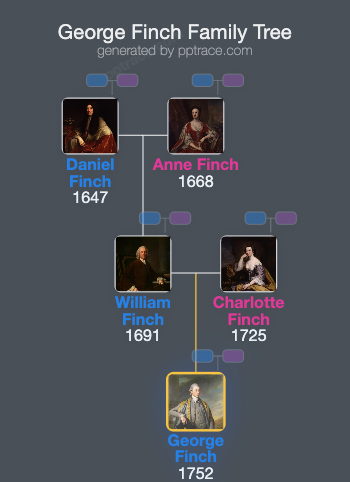
Family Tree
Tap  to expand more relatives
Introduction
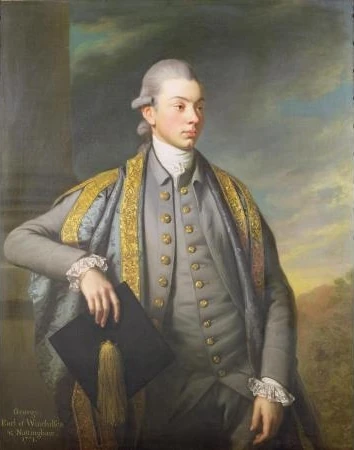
George Finch, 9th Earl of Winchilsea (4 November 1752 – 2 August 1826), was an English peer and army officer, as well as an influential figure in the history of cricket during the late 18th and early 19th centuries. His primary contributions to the sport were in the realms of patronage and organization, although he also participated actively as a player.
Born in 1752, Finch was the son of Hon. William Finch and Charlotte Fermor. His paternal grandfather was Daniel Finch, 2nd Earl of Nottingham. His sister was Sophia Finch. During the 1770s, Finch resided in Florence and is depicted in Johann Zoffany's painting "The Tribuna of the Uffizi" as one of the recognizable figures on the right side. He inherited the titles of Earl of Winchilsea and associated estates in 1769 upon the death of his uncle, Daniel Finch, 8th Earl of Winchilsea, who left no male heirs. Along with the titles, Finch inherited the estate of Burley House located at Burley-on-the-Hill, Rutland.
In his military career, Finch served with the 87th Foot from its formation in 1779 until its disbandment in 1783, attaining the ranks of major and lieutenant-colonel temporarily. His service coincided with the American Revolutionary War.
In addition to his peerage and military pursuits, Finch became the first president of the Royal Institution, where he influenced its recognition by King George III.
Regarding his involvement in cricket, Finch was a dedicated amateur athlete who played in at least 128 recorded top-class matches between 1786 and 1804. His on-field record indicates a batting average of less than one. Despite his modest playing ability, Finch was prolific in his participation, second only to contemporaries Billy Beldham and Tom Walker in the number of appearances. He used a bat that weighed approximately 4 pounds 2 ounces.
Finch was a key figure in the foundation of the White Conduit Club around 1784, which played at White Conduit Fields. The club was intended for gentlemen only but employed professional players, including Thomas Lord, a noted bowler and businessman. In 1785, White Conduit Club's matches appeared in first-class records. Due to the noisy and accessible nature of White Conduit Fields, the club sought a more private venue. Finch, alongside Colonel Charles Lennox, commissioned Lord to find a new ground, leading to the establishment of Lord's Ground in 1787. Located at Dorset Fields in Marylebone, Lord's became the home of the club, which renamed itself the Marylebone Cricket Club (MCC). Lord Winchilsea was among MCC's early significant members.
He never married and died in 1826. His peerages were succeeded by his first cousin's son, George William Finch-Hatton, 10th Earl of Winchilsea. Finch left Burley House to his illegitimate son, George Finch, a politician.
References and sources include works by G. B. Buckley, Arthur Haygarth, Ashley Mote, and H. T. Waghorn, among others.