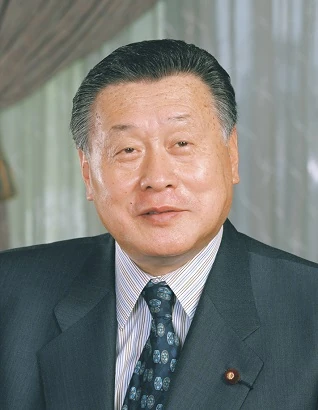
Yoshirō Mori
| Name | Yoshirō Mori |
| Title | 86th Prime Minister of Japan |
| Gender | Male |
| Birthday | 1937-07-14 |
| nationality | Japan |
| Source | https://www.wikidata.org/wiki/Q233499 |
| pptrace | View Family Tree |
| LastUpdate | 2025-11-17T06:48:22.773Z |
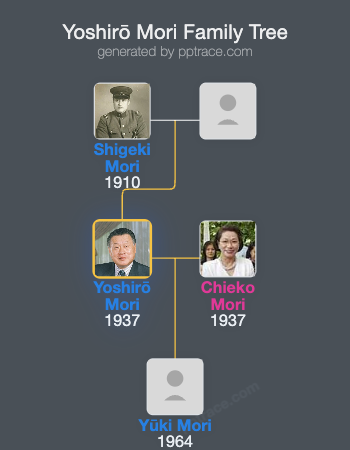
Family Tree
Tap  to expand more relatives
Introduction
Yoshirō Mori (Japanese: 森 喜朗, Hepburn: Mori Yoshirō) was born on July 14, 1937, in present-day Nomi, Ishikawa, Japan. He is a Japanese politician who served as the Prime Minister of Japan and as President of the Liberal Democratic Party (LDP) from 2000 to 2001.
Early Life and Education:
Yoshirō Mori was the son of Shigeki and Kaoru Mori, who were wealthy rice farmers with a history of political involvement. Both his father and grandfather served as the mayor of Neagari in Ishikawa Prefecture. Mori's mother passed away when he was seven years old. He attended Waseda University in Tokyo, where he joined the rugby union club. After completing his education, he worked as a journalist for the Sankei Shimbun, a conservative newspaper in Japan.
Family and Personal Background:
Mori's family background includes significant involvement in politics through his father and grandfather, both of whom held mayoral positions. Mori's connection to rugby was developed during his university years, though he was not a high-level athlete.
Political Career:
Mori entered politics in 1962 as a secretary to a Diet member. He was first elected to Japan's lower house in the 1969 general election for the Ishikawa 2nd district at age 32. He was re-elected ten consecutive times. His political career included serving as education minister in 1983 and 1984; international trade and industry minister in 1992 and 1993; and construction minister in 1995 and 1996. In 1980, Mori was involved in the Recruit scandal involving the receipt and sale of unlisted shares of the Recruit company.
He began to assume control of the Mitsuzuka faction of the LDP in 1999, succeeding the Hiroshi Mitsuzuka faction (formerly the Abe faction).
Prime Ministership:
Following the health crisis of then-Prime Minister Keizō Obuchi, who suffered a stroke and cerebral hemorrhage on April 2, 2000, Mori was elected as President of the LDP and subsequently became Prime Minister days before Obuchi's death. His appointment was supported by the LDP, New Komeito, and the New Conservative Party. Mori announced his intention to retain Obuchi's cabinet in place.
During his tenure as Prime Minister, Mori's administration was characterized by numerous public gaffes and controversial statements. Prior to his election, he was known in media reports for comments such as comparing his campaign experience to having "the heart of a flea and the brain of a shark," and making inappropriate jokes. In January 2000, he made a controversial remark about his 1969 election campaign, stating, "When I was greeting farmers from my car, they all went into their homes. I felt like I had AIDS." Other statements included comments on the Year 2000 problem in the United States, and he failed to perform proper ceremonial acts at Obuchi's funeral.
In May 2000, Mori described Japan as "a divine nation (kami no kuni) with the Emperor at its center," which stirred controversy due to its invocation of Japan's imperial divinity. He also made remarks questioning Japan Communist Party's ability to ensure national security and defend the kokutai, a term associated with Japan's unity and divine imperial authority.
Political Challenges and Gaffes:
Mori's administration faced multiple challenges, including cabinet resignations related to fundraising scandals. His approval ratings plummeted from above 60% to below 30%, then to single digits. Opposition parties attempted a vote of no confidence in November 2000, which was blocked after threats of expulsion from the LDP. By early 2001, his approval ratings were critically low, prompting him to plan resignation.
Resignation and Aftermath:
Yoshirō Mori announced his resignation on April 6, 2001, and Junichiro Koizumi succeeded him as Prime Minister on April 26, 2001. Mori remained a member of the House of Representatives until July 2012, when he announced he would not run in the upcoming general election.
Post-Premiership Activities:
Following his departure from the premiership, Mori maintained involvement in international relations, notably with Russia, due to his close relationship with Vladimir Putin. He also served as President of the Japan Rugby Football Union and chaired the Japan-Korea Parliamentarians' Union.
In 2014, Mori was appointed head of the organizing committee for the 2020 Summer Olympics and Paralympics. However, he resigned in 2021 after making comments perceived as sexist during a committee meeting.
Honors:
In 2003, Mori received the Golden Pheasant Award, the highest distinction of the Scout Association of Japan.
Note:
Yoshirō Mori's political career was marked by multiple controversies, both during his tenure as Prime Minister and afterward, including various statements that attracted public and media scrutiny.