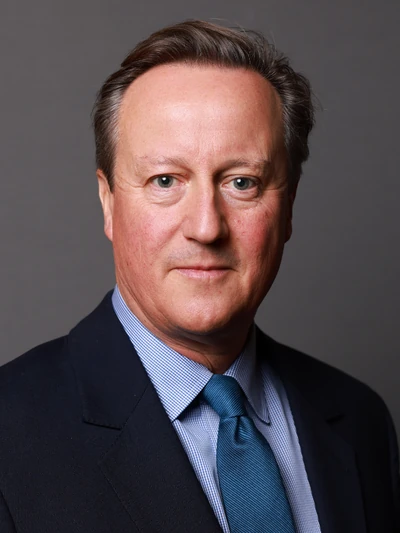
David Cameron
| Name | David Cameron |
| Title | British politician (born 1966) |
| Gender | Male |
| Birthday | 1966-10-09 |
| nationality | United Kingdom |
| Source | https://www.wikidata.org/wiki/Q192 |
| pptrace | View Family Tree |
| LastUpdate | 2025-11-26T23:33:54.144Z |
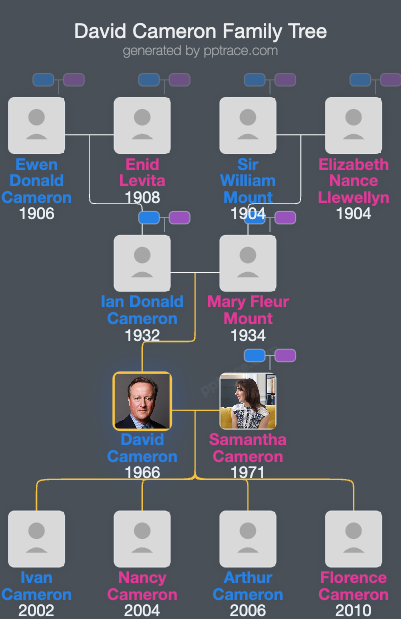
Family Tree
Tap  to expand more relatives
Introduction
David William Donald Cameron, known as Baron Cameron of Chipping Norton, was born on October 9, 1966, at the London Clinic in Marylebone, London. He was raised in Peasemore, Berkshire. Cameron is the son of Ian Donald Cameron, a stockbroker, and Mary Fleur, a retired Justice of the Peace and daughter of Sir William Mount, 2nd Baronet. He has two sisters and an elder brother named Alexander Cameron. Cameron's paternal family hails from Blairmore House near Huntly, Aberdeenshire; Blairmore was built by his great-great-grandfather, Alexander Geddes, who amassed wealth in the grain trade in Chicago before returning to Scotland in the 1880s. Cameron has indicated Welsh, Scottish, and English ancestry from his mother's side and has referenced German Jewish heritage through a great-grandfather, Arthur Levita.
Cameron was educated at Heatherdown School in Winkfield, Berkshire, starting from age seven, where he excelled academically. At age 13, he moved to Eton College in Berkshire, following his father and brother. During his time at Eton, he developed an interest in art. Cameron entered Eton with twelve O-levels and three A-levels in History of Art, History, Economics with Politics, achieving high grades, including three 'A's and a '1' in A-levels. In autumn 1984, he passed the entrance exam for the University of Oxford and received an exhibition at Brasenose College.
After completing secondary education in 1984, Cameron took a nine-month gap year, working as a researcher for his godfather, Conservative MP Tim Rathbone, and visiting the Soviet Union, where he was approached by individuals speaking fluent English. He also briefly worked in Hong Kong for Jardine Matheson as a 'ship jumper.'
In October 1985, Cameron began studies at Oxford University in the PPE (Philosophy, Politics, and Economics) program at Brasenose College. His tutor, Vernon Bogdanor, described him as an exceptionally able student with moderate and sensible Conservative views. Fellow student Guy Spier remembered him as an outstanding student, particularly in economics and British political systems. Cameron was a member of the Bullingdon Club, an elite and controversial all-male dining society known for boisterous behavior.
Cameron graduated in 1988 with a first-class BA degree, later promoted to an MA by seniority. Post-graduation, he joined the Conservative Research Department, where he worked from September 1988 to 1993, initially focusing on Trade and Industry, Energy, and Privatisation portfolios. During this period, Cameron formed connections with colleagues such as Edward Llewellyn, Ed Vaizey, and Rachel Whetstone, and was part of a group called the "Smith Square set," sometimes referred to as the "Brat Pack."
Cameron entered elected politics in 2001 when he became the Member of Parliament for Witney, a seat he held until 2016. He quickly rose through party ranks, serving in the opposition Shadow Cabinet under Michael Howard, and succeeded Howard as leader of the Conservative Party in 2005. As party leader, Cameron emphasized modernizing efforts and positioning the Tories as a One-Nation Conservative party.
In the 2010 general election, Cameron's Conservative Party secured a coalition government with the Liberal Democrats. Cameron served as Prime Minister from 2010 until 2016. His government faced challenges stemming from the 2008 financial crisis, implementing austerity measures and passing significant legislation such as the Health and Social Care Act, Welfare Reform Act, and the Equality Act. His tenure included reforms to healthcare and welfare systems, stricter immigration policies, and the legalization of same-sex marriage in England and Wales.
Cameron's government also responded to international conflicts, notably participating in Operation Ellamy during the Libyan Civil War and authorizing actions against Islamic State targets. Constitutional referendums held during his tenure included the 2011 UK Alternative Vote referendum and the Scottish independence referendum, both of which resulted in maintaining the status quo. Cameron's government also organized the 2012 London Olympics.
Following the 2015 general election, Cameron's Conservative Party achieved an unexpected majority, allowing him to form a majority government. In 2016, he initiated the Brexit referendum, supporting the "Remain" campaign. The referendum resulted in a vote to leave the European Union, leading to Cameron's resignation as Prime Minister, succeeded by Theresa May.
After stepping down as Prime Minister, Cameron resigned his seat in Parliament on September 12, 2016. He maintained a relatively low profile afterward but served as president of Alzheimer's Research UK from 2017 to 2023 and was involved in discussions related to the Greensill scandal. He published a memoir, "For the Record," in 2019. In 2023, Cameron was appointed Foreign Secretary by Prime Minister Rishi Sunak and was granted a life peerage as Baron Cameron of Chipping Norton. Following the Conservative defeat in the 2024 general election, Cameron retired from his role as Foreign Secretary but remains a member of the House of Lords.
Throughout his career, Cameron has been recognized for efforts to modernize the Conservative Party and for fiscal policies aimed at reducing the UK’s national deficit. He received various rankings in historical assessments of UK Prime Ministers, generally placing in the third or fourth quintiles.