Charles Phelps Taft II
| Name | Charles Phelps Taft II |
| Title | Mayor of Cincinnati, Ohio |
| Gender | Male |
| Birthday | 1897-09-20 |
| nationality | United States of America |
| Source | https://www.wikidata.org/wiki/Q5081626 |
| pptrace | View Family Tree |
| LastUpdate | 2025-11-17T06:42:38.236Z |
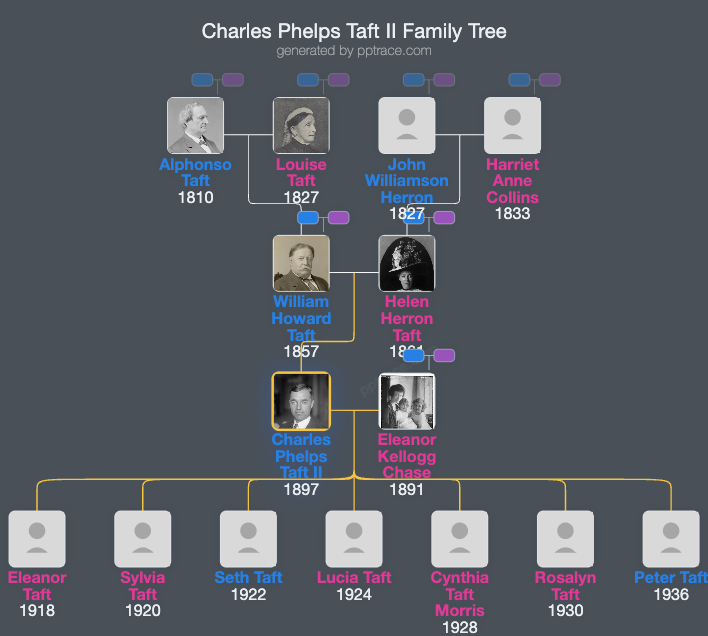
Family Tree
Tap  to expand more relatives
Introduction
Charles Phelps Taft II was born on September 20, 1897, in Cincinnati, Ohio. He was the youngest of three children of William Howard Taft, who served as President of the United States from 1909 to 1913, and Helen Herron Taft. His siblings included Robert A. Taft, a United States Senator, and Helen Taft Manning, a professor at Bryn Mawr College. His paternal uncle was Charles Phelps Taft, a U.S. Congressman, after whom he was named.
In 1909, at the age of 11, Taft moved to the White House following his father’s election as President. During his father's tenure as Secretary of War, he frequently interacted with President Theodore Roosevelt's children. On May 17, 1909, the same day his mother experienced a severe stroke, he underwent a "bloody adenoid operation."
Taft began his higher education at Yale University but dropped out to serve in the United States Army during World War I. He later returned to complete his studies, graduating in 1918, and received a law degree from Yale Law School in 1921. During his time at Yale, he was a member of Beta Theta Pi and was initiated into the Skull and Bones society in 1918.
On October 6, 1917, Taft married Eleanor Kellogg Chase in Waterbury, Connecticut. Eleanor’s father was associated with the Waterbury Clock Company. The couple had seven children: Eleanor Kellogg Hall (1918–2004), Sylvia Howard Lotspeich (1920–2008), Seth Taft (1922–2013), Lucia Chase Taft (1924–1955), Cynthia Herron Taft Morris (1928–2013), Rosalyn Rawson Taft (1930–1941), and Peter Rawson Taft III (born 1936). Rosalyn died from polio, and Lucia committed suicide in 1955.
Professionally, after completing law school, Taft practiced law and became active in Cincinnati politics. In 1925, he contributed to the adoption of Cincinnati’s home-rule charter, establishing the city’s first city manager form of government. That year, he also became the youngest president of the International YMCA. In 1926, he and his brother Robert A. Taft co-founded the law firm Taft Stettinius & Hollister.
He served as Hamilton County Prosecutor from 1927 to 1928. Taft was elected to Cincinnati City Council three times, serving terms from 1938 to 1942, 1948 to 1951, and 1955 to 1977. During World War II, he served as Director of U.S. Community War Service at the Federal Security Agency and as Director of Economic Affairs at the U.S. State Department under President Franklin D. Roosevelt. From 1947 to 1948, he was the first layman president of the Federal Council of the Churches of Christ in America.
In the 1952 Ohio gubernatorial election, Taft was an unsuccessful candidate, losing to incumbent Frank Lausche. As mayor of Cincinnati from 1955 to 1957, he was instrumental in city administration, and during his tenure, Fortune magazine ranked Cincinnati as the best managed large city in the U.S. He was known as "Mr. Cincinnati."
Taft had personal interests in baseball and fishing. He was an avid Cincinnati Reds fan and would sometimes listen to games with an earplug during city council meetings. He also enjoyed fishing, often traveling in a canoe tied to his car, and his gravesite includes the inscription “Gone fishing.”
He served on the vestry of Christ Church Cathedral in Cincinnati from 1928 to 1977, holding positions such as Junior Warden and Senior Warden. A sculpture at the cathedral’s southwest corner commemorates him. In addition, the Taft Lecture Series, funded by the Charles P. and Eleanor Taft Memorial Fund, features speakers in various social, religious, and cultural fields.
Later in life, Taft dedicated efforts to preserving his father’s childhood home, now the William Howard Taft National Historic Site. In 1952, while serving as Senior Warden at Christ Church, he was accused by Cincinnati Councilman Jesse D. Locker of inserting racial restrictive clauses into property deeds. Taft justified the practices by citing financial hardships during the wartime housing projects, noting that such clauses were necessary for his housing developments, despite their legal invalidity following Supreme Court rulings.
Charles Phelps Taft II died on June 24, 1983, in Cincinnati.