Makiko Hitotsuyanagi
| Name | Makiko Hitotsuyanagi |
| Title | (1884-1969) |
| Gender | Female |
| Birthday | 1884-03-18 |
| nationality | Japan |
| Source | https://www.wikidata.org/wiki/Q11352863 |
| pptrace | View Family Tree |
| LastUpdate | 2025-11-17T09:47:12.218Z |
Family Tree
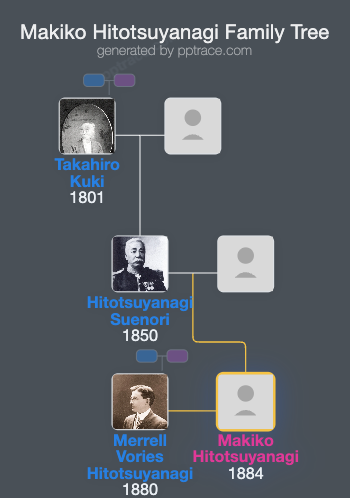
Tap  to expand more relatives
Introduction
Makiko Hitotsuyanagi (March 18, 1884 – September 7, 1969) was a Japanese Christian educator. She was known as the principal of the Omi Sisters’ School and also as the wife of William Merrell Vories.
Her origins trace back to Ono Town in Kato District, Hyogo Prefecture (now Ono City, Hyogo). She was born as the third daughter of Sue Tokushige Hitotsuyanagi, a former daimyo of the Harima Ono Domain. Her father, Sue Tokushige, became a member of the House of Peers after the Meiji Restoration. Her mother, Eiko, passed away during her childhood, and she was influenced by her parents, received education at the Tsukiji Mission-affiliated Sakuraijogakkou (now Joshi Gakuin), and was guided by Yoshiko Yajima and various missionaries.
After graduating from Kobe Girl's College of Music, she traveled alone to the United States, utilizing a scholarship system established by Tsuda Umeko, Japan's first female international student, to attend Bryn Mawr College in Pennsylvania. While studying there in 1910, she was baptized in the Presbyterian Church. She later participated in Alice B. Bacon’s educational practices. Her experiences studying abroad and her educational activities influenced her pedagogical philosophy, emphasizing the development of self-control through faith centered on God.
In 1919 (Taisho 8), she married William Merrell Vories, an architect involved in designing her brother Keizo Hirooka’s residence. She then joined the Omi Mission. After marriage, she continued her activities mainly in Omihachiman, developing a “Playground” for preschool children in the area into what is now Omi Brothers’ School, including “Seiyu-en Kindergarten.”
She studied Western educational theories and implemented her own educational practices. She also engaged with overseas missionary organizations. After World War II, her work gained recognition; her book “Bridge of Love,” written by American woman writer Grace Nee Fletcher, was widely read in the U.S. Her connections included Mrs. Elizabeth Whyning, who served as a tutor to imperial family members upon Emperor Showa's request.
In her later years, she passed away in 1969 (Showa 44), five years after her husband Vories’ death. The couple had no children. Their funeral was held at Eikōen in Kitano-Shō Town, where both are also buried.
Her works include "Educational Essays" (1959). Her life and activities are also introduced in works such as Kaoru Tamaoka’s "Don’t Lose, Vories Makiko’s Days of Planting," published by Shinchosha in 2011.
Related persons include her husband William Merrell Vories, her father Sue Tokushige Hitotsuyanagi, her brother Keizo Hirooka, her sister-in-law Kameko Hirooka, and her mother Asako Hirooka.