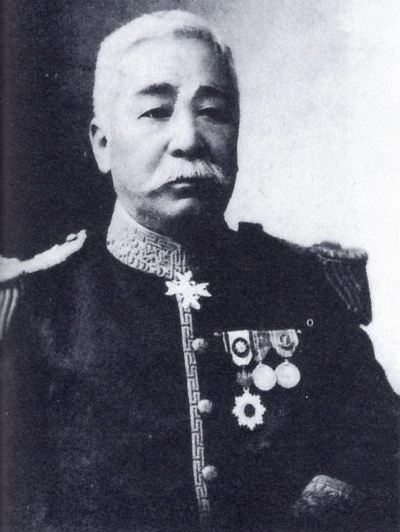
Hitotsuyanagi Suenori
| Name | Hitotsuyanagi Suenori |
| Title | Japanese politician |
| Gender | Male |
| Birthday | 1850-08-26 |
| nationality | Japan |
| Source | https://www.wikidata.org/wiki/Q11352856 |
| pptrace | View Family Tree |
| LastUpdate | 2025-11-17T10:07:42.600Z |
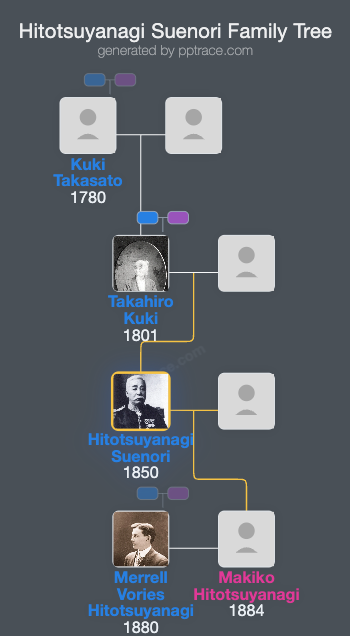
Family Tree
Tap  to expand more relatives
Introduction
Ichiyanagi Suetoku (Hitosuyanagi Suetoku, April 1843 – March 21, 1922) was a feudal lord of the late Edo period, serving as the 11th and last daimyo of the Ono Domain in Harima Province. After the Meiji Restoration, he was elevated to the peerage as a Viscount (shishaku) and served as a member of the House of Peers.
Life
He was born as the fifth son of Takatoshi Kuki of the Anebako Domain in Tanba Province (1801–1882). His childhood name was Hokarō. He became the adopted heir of his predecessor, the daimyo Ichiyanagi Suhiko (1843–1881), and on June 9, Keiō 3 (1863), following Suhiko’s retirement, he succeeded the family headship.
During the Boshin War (Keiō 4, 1868), he promptly pledged allegiance to the new government and was dispatched to the North and East Campaign. In 1869 (Meiji 2), with the abolition of the han system and return of domain territories to the imperial government, he became a governor of the domain. Subsequently, in 1871 (Meiji 4), he moved to Tokyo. After moving to the capital, he enrolled at Keio University, studying English.
In 1879 (Meiji 12), he became the chairman of the Tokyo Ward Council. In 1884 (Meiji 17), with the promulgation of the peerage law, he was awarded the title of Viscount (shishaku), and later served as a member of the Imperial Museum.
Obligations and Social Roles
On July 10, 1890 (Meiji 23), he was appointed as a member of the House of Peers, serving approximately four terms. He was awarded the ranks of the Third Court Rank (Shōsanmi) and the Third Class of the Order of the Sacred Treasure, and on June 18, 1914 (Taishō 3), he received the Third Class of the Order of the Sacred Treasure (zuihō-shō). He resigned from the House of Peers on January 17, 1920 (Taishō 9). He was promoted to Junior Second Rank (Juni-ni-i) on March 20, 1922, and died on March 21 at his family residence in Okuraya, Akashi City, Hyogo Prefecture, at age 73.
Family and Lineage
His father was Takatoshi Kuki; details about his mother are not recorded. His adoptive father was Ichiyanagi Suhiko. His formal wife was Eiko (1854–1893), daughter of Ichiyanagi Yorizuke. His second wife was Shino; his concubine was Yōko.
His children included his eldest son, Ichiyanagi Jōji (1873–1949); second son, Hirooka Keizō (1876–1953), who worked at Kajima Bank, Dowa Life Insurance, and Osaka Electric Tramway; and his third son, Ichiyanagi Tsuyoshi (1879–1919), who inherited the family estate. Tsuyoshi’s eldest son, Sueyuki, succeeded the family headship. His eldest daughter was Chikako (1871–1920); second daughter, Kikuko (1880–1920); third daughter, Mankiko (1884–1969); and fourth daughter, Chieko (1888–1966).
Following Tsuyoshi’s death, his eldest son Sueyuki inherited the family estate and was granted the title of Viscount. Before inheriting the family headship, Jōji and Keizō were adopted into other families.
Honors and Awards
- June 18, 1914 – Awarded the Third Class of the Order of the Sacred Treasure.
- Also received the ranks of Third Rank (Shōsanmi) and Third Class of the Order of the Sacred Treasure.
Archaeology, Academic, and Social Activities
As a member of the peerage, he promoted higher education, especially encouraging both men and women to study abroad and pursue higher education.
References
His works include "Ichiyanagi Ie Shiki Yō" written by Sadakichi Ichiyanagi (1933) and the "Imperial Diet and House of Councilors: 100-Year History of the Parliamentary System – Directory of Peers and Senators" (1990).
External Links
- Digital version of the Nihon Jinmei Daijiten Plus: "Ichiyanagi Suetoku" – Kotobank