Merrell Vories Hitotsuyanagi
| Name | Merrell Vories Hitotsuyanagi |
| Title | American architect |
| Gender | Male |
| Birthday | 1880-10-28 |
| nationality | United States of America |
| Source | https://www.wikidata.org/wiki/Q8015576 |
| pptrace | View Family Tree |
| LastUpdate | 2025-11-17T10:07:45.808Z |
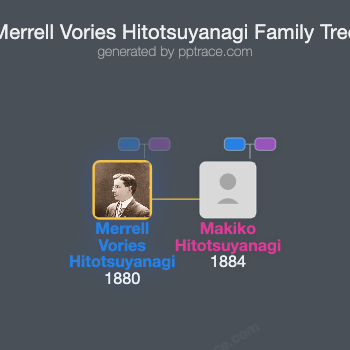
Family Tree
Tap  to expand more relatives
Introduction
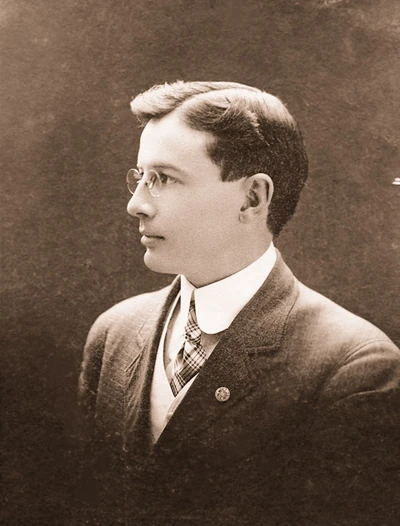
William Merrell Vories, also known in Japan as Mereru Hitotsuyanagi (一柳 米来留, Hitotsuyanagi Mereru), was born on October 28, 1880, in Leavenworth, Kansas, United States. He died on May 7, 1964. Vories was an educator, architect, entrepreneur, Christian lay missionary, and founder of the Omi Mission. He was a naturalized Japanese citizen who primarily lived and worked in Shiga Prefecture, Japan.
Vories graduated from Colorado College in 1904. Originally aspiring to become an architect, he traveled to Japan in 1905 intending to serve as an English-language teacher and engage in Christian missionary activities. During his tenure as a teacher in Omihachiman, Shiga Prefecture, in 1908, he was dismissed from his teaching position due to the controversy surrounding his Bible classes, which attracted over one-third of his students and drew the attention of local Buddhist temples.
In 1907, Vories was asked to inspect the construction of an Omihachiman YMCA office building, which marked his first architectural work in Japan. He established an architectural office in 1908, initially in Kyoto, and in 1909, co-founded "Vories & Co." with architect Lester Chapin and Etsuzō Yoshida, a student from his English class. The firm later relocated to Omihachiman. Through YMCA activities and commissions, Vories designed over 1,600 buildings, including residential, commercial, church, hospital, and educational structures across Japan and Korea prior to World War II.
In 1918, Vories founded the Omi Mission, dedicating his efforts to Christian missionary work and education. The following year, he married Makiko Hitotsuyanagi (1884–1969), daughter of Viscount Suenori Hitotsuyanagi. In 1920, he established the Omi Sales Company to promote Mentholatum ointment, generating funds to sustain his missionary endeavors. The Omi Mission was renamed the Omi Brotherhood (近江兄弟社, Ōmi Kyōdaisha) in 1934.
Vories was also instrumental in introducing music to Japan, notably bringing the Hammond Organ into the country. The schools founded by the Omi Brotherhood, collectively known as Vories Gakuen, continue to utilize Hammond organs supplied by Vories.
In 1941, shortly before the attack on Pearl Harbor, Vories formally naturalized as a Japanese citizen, adopting the name Mereru Hitotsuyanagi in accordance with Japanese law. He pledged allegiance to Japan and Emperor Hirohito. In September 1945, Fumimaro Konoe, the former Prime Minister, asked Vories to communicate a message to the Supreme Commander for the Allied Powers (SCAP) on behalf of the Emperor, advocating for the Emperor to renounce claims of divinity and declare his humanity. Vories subsequently met the Emperor four times.
In 1957, Vories suffered a stroke while at his summer residence in Karuizawa, Nagano Prefecture. He was transported back to Omihachiman for treatment and remained bedridden for seven years until his death on May 7, 1964, at the age of 83. In 1958, he was honored as the first Honorary Citizen of Omihachiman. The Japanese government posthumously awarded him the Order of the Sacred Treasure, 3rd class.
Vories's residence in Omihachiman has been preserved as the Vories Commemorative Museum.