Anna Kendrick Pierce
| Name | Anna Kendrick Pierce |
| Title | American political wife, mother of president Franklin Pierce |
| Gender | Female |
| Birthday | 1768-10-30 |
| nationality | United States of America |
| Source | https://www.wikidata.org/wiki/Q44129005 |
| pptrace | View Family Tree |
| LastUpdate | 2025-11-16T10:11:15.423Z |
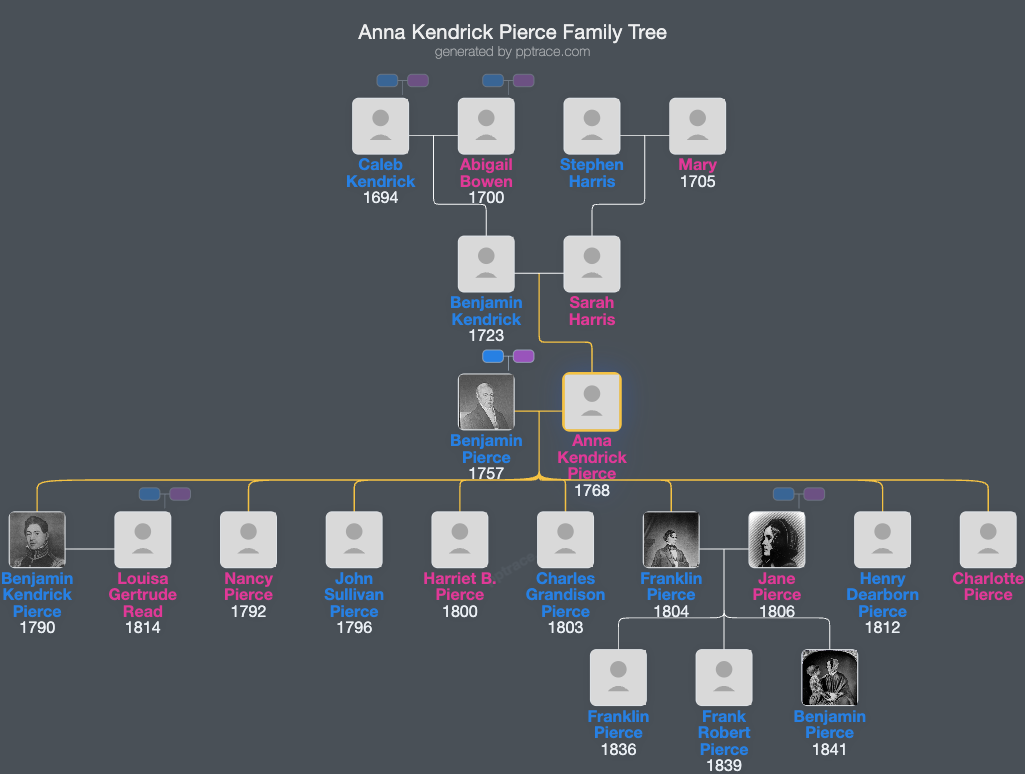
Family Tree
Tap  to expand more relatives
Introduction
Franklin Pierce (November 23, 1804 – October 8, 1869) was an American politician who served as the 14th president of the United States from 1853 to 1857. He was born in Hillsborough, New Hampshire, and was a descendant of Thomas Pierce, who emigrated from Norwich, Norfolk, England, around 1634. His father, Benjamin Pierce, was a prominent Democratic-Republican state legislator, farmer, tavern-keeper, and served as governor of New Hampshire. Franklin Pierce was the fifth of eight children in the family, and his early life was influenced by his father's political involvement and family military service; two of his older brothers fought in the War of 1812.
Pierce received early education at Hillsborough Center and Hancock, ultimately transferring to Phillips Exeter Academy. In 1820, he enrolled at Bowdoin College in Brunswick, Maine, where he joined the Athenian Society and formed long-lasting friendships, including with Nathaniel Hawthorne. He graduated in 1824, placing fifth in his class of 14 students. During his college years, Pierce organized a militia company called the Bowdoin Cadets. After graduation, he studied law with Levi Woodbury and at Northampton Law School before completing his legal training under Judge Edmund Parker in Amherst, New Hampshire. He was admitted to the bar in late 1827 and began practicing law in Hillsborough.
In politics, Pierce became involved in the Democratic Party early on. He was elected as Hillsborough's town meeting moderator in 1828, a position he held for multiple terms, and later served in the New Hampshire House of Representatives, becoming its speaker in 1831. By this time, he was recognized as a prominent figure in the state Democratic Party. Pierce also participated in the state militia from 1824, reaching the rank of colonel and later brigadier general during the Mexican–American War.
In 1833, Pierce was elected to the U.S. House of Representatives, serving until 1837, after which he was elected to the U.S. Senate, where he served from 1837 until his resignation in 1842. During this period, he also maintained a successful private law practice and was appointed U.S. attorney for New Hampshire in 1845. Pierce’s military service included participation in the Mexican–American War as a brigadier general.
Pierce was the Democratic nominee for president at the 1852 Democratic National Convention, considered a compromise candidate to unify Northern and Southern factions. He was elected president in the 1852 election, defeating the Whig candidates Winfield Scott and William Alexander Graham. His presidency focused on civil service reform, expansionist policies such as the Gadsden Purchase from Mexico, and negotiations with Britain and Japan. He also pursued efforts to acquire Cuba from Spain, which ultimately failed. His administration saw the signing of trade treaties and internal cabinet reforms but was marred by political strife especially following the passage of the Kansas–Nebraska Act, which nullified the Missouri Compromise and intensified conflicts over slavery’s expansion. The Ostend Manifesto, promoting the annexation of Cuba, further damaged his reputation.
Pierce sought renomination in 1856 but was abandoned by the Democratic Party, and his bid for a second term was unsuccessful. His political standing further declined during the Civil War, as he became a critic of President Abraham Lincoln. Personal hardships included the deaths of three of his children at young ages, the mental health struggles of his wife Jane Pierce, and the death of their last surviving son in a train accident just before Pierce’s inauguration. Pierce was a heavy drinker throughout his life and died of cirrhosis in 1869.
Historically, Pierce is often ranked among the less effective U.S. presidents, due to his support for the South and inability to prevent the sectional conflict that led to the Civil War.