Isaac D'Israeli
| Name | Isaac D'Israeli |
| Title | British writer (1766–1848) |
| Gender | Male |
| Birthday | 1766-05-11 |
| nationality | United Kingdom of Great Britain and Ireland |
| Source | https://www.wikidata.org/wiki/Q983351 |
| pptrace | View Family Tree |
| LastUpdate | 2025-11-26T23:30:02.508Z |
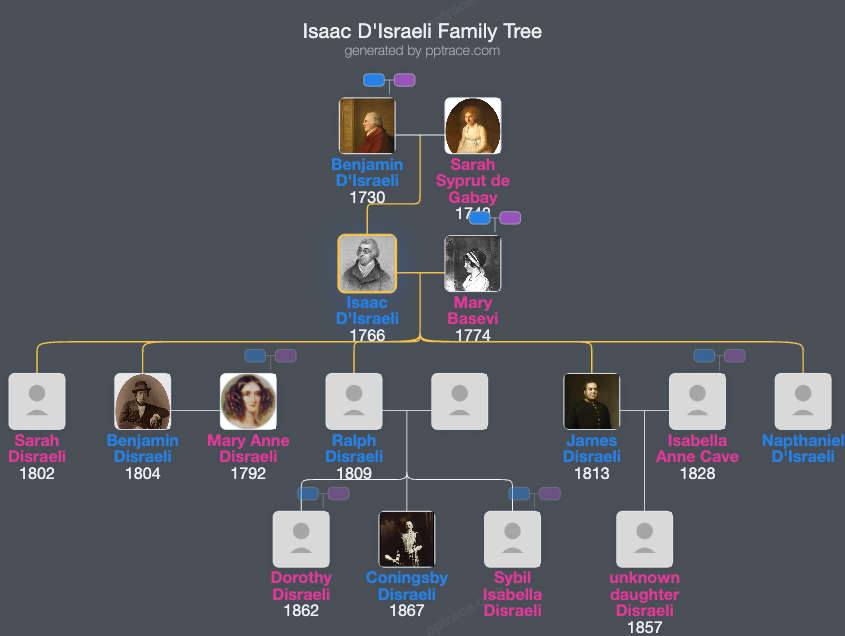
Family Tree
Tap  to expand more relatives
Introduction
Isaac D'Israeli was born on 11 May 1766 in Enfield, Middlesex, England. He was the only child of Benjamin D'Israeli, a Sephardic Jewish merchant who had emigrated from Cento, Italy, in 1748, and his second wife, Sarah Syprut de Gabay Villa Real. D'Israeli received much of his education in Leiden, Netherlands.
At age 16, D'Israeli began his literary pursuits with a set of verses addressed to Samuel Johnson, a prominent English writer and lexicographer. He was a frequent guest at the table of the publisher John Murray and became recognized as a bibliophile.
In 1797, D'Israeli published "Vaurien," a romantic novel set among radical circles after the French Revolution. The book received praise from conservative critics for its satire of radicals in England and its depiction of Vaurien, a French character engaging in revolutionary activities. The novel also featured social commentary on characters such as a prostitute, representing those forced into difficult circumstances, and included a chapter defending the Jewish community, condemning the discrimination they faced in England.
On 10 February 1802, Isaac D'Israeli married Maria Basevi, from a London merchant family of Italian-Jewish descent. They had five children: Sarah (1802–1859), Benjamin (1804–1881), Naphtali (born 1807, died in infancy), Raphael (1809–1898), and Jacobus (1813–1868). The children were named according to Jewish customs, and the boys were circumcised. Despite his Jewish heritage, D'Israeli appeared to set aside his religious beliefs; during an eight-year dispute with the Bevis Marks Synagogue, and upon advice from historian Sharon Turner, all his children were baptized into the Church of England in 1817.
In 1833, D'Israeli published "The Genius of Judaism," a critical analysis of contemporary Judaism. Although he did not convert to Christianity himself, he participated in the inauguration of the Reform Synagogue at Burton Street, London.
His literary works include essays, biographies, and adaptations of Middle Eastern tales. His most popular work, "Curiosities of Literature," a collection of anecdotes about historical figures, rare books, and book-collectors, was first published in 1791 and reached its eleventh edition in 1839. The book remained in print into the 20th century.
D'Israeli authored "The Life and Reign of Charles I" (1828), a historical biography for which he was awarded a Doctor of Civil Law degree from the University of Oxford. Other notable publications include "Calamities of Authors" (1812) and "Miscellanies." His career was hindered in 1841 when he became blind; he underwent an unsuccessful operation but continued writing with assistance from his daughter, producing "Amenities of Literature" (1841) and completing revisions of his earlier works.
Isaac D'Israeli died of influenza at age 81 on 19 January 1848 at his residence, Bradenham House, Buckinghamshire. His wife predeceased him in spring 1847. A monument commemorating him was erected near Hughenden Manor by his daughter-in-law in June 1862.