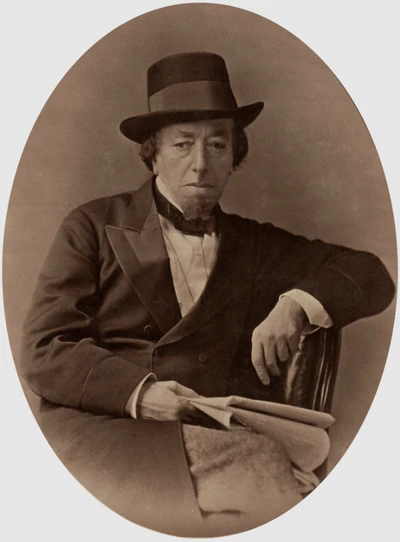
Benjamin Disraeli
| Name | Benjamin Disraeli |
| Title | British statesman (1804–1881) |
| Gender | Male |
| Birthday | 1804-12-21 |
| nationality | United Kingdom of Great Britain and Ireland |
| Source | https://www.wikidata.org/wiki/Q82006 |
| pptrace | View Family Tree |
| LastUpdate | 2025-11-26T23:30:01.522Z |
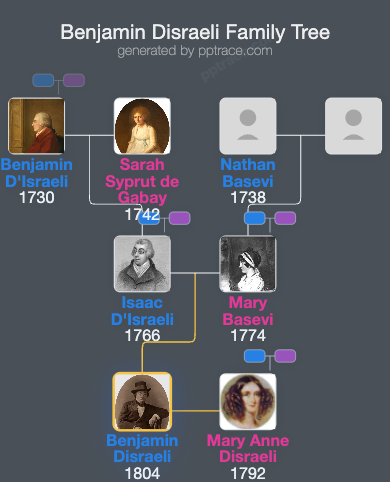
Family Tree
Tap  to expand more relatives
Introduction
Benjamin Disraeli, 1st Earl of Beaconsfield (21 December 1804 – 19 April 1881), was a British politician and writer who served as Prime Minister of the United Kingdom on two occasions. He was instrumental in the development of the modern Conservative Party, shaping its policies and broad appeal. Disraeli is recognized for his influence on international affairs, his political rivalry with William Ewart Gladstone, and his advocacy of one-nation conservatism, also referred to as "Tory democracy." His leadership contributed to the association of the Conservative Party with the British Empire and military expansion, which resonated with voters of the period. Disraeli remains notable for being the only British prime minister born Jewish.
Born in Bloomsbury, Middlesex, Disraeli was the second child and eldest son of Isaac D'Israeli, a literary critic and historian, and Maria (Miriam), née Basevi. The family was of Sephardic Jewish mercantile descent, with some Ashkenazi ancestry. Disraeli's father renounced Judaism after a dispute with his synagogue, and Benjamin was baptized into the Church of England at the age of 12. His family history was later self-curated by Disraeli, who claimed a distinguished ancestral background, although historical records vary. He had siblings named Sarah, Naphtali (who died young), Ralph, and James.
Disraeli's early education involved attending a dame school in Islington from approximately age six, followed by a boarding school at Blackheath, then known as St Piran's. After a quarrel with the Bevis Marks Synagogue in 1813, his father left Judaism and arranged for his children to be baptized. Disraeli was baptized at age twelve on 31 July 1817, an act that facilitated his pursuit of a parliamentary career because, prior to the Jews Relief Act of 1858, MPs of Jewish origin were required to take Christian oaths.
He was educated at a school run by Reverend John Potticary at Blackheath and later in private tuition. Disraeli's formal schooling was rigorous and classical, and he was particularly interested in Greek literature and languages. Despite his aspirations for a political career, his early ambition was influenced by his family’s connections and his personal interests.
In November 1821, on the eve of his seventeenth birthday, Disraeli was articled as a clerk at the law firm Swain, Stevens, Maples, Pearse, and Hunt in London. His employer, T. F. Maples, was a family friend and a prospective father-in-law, linking Disraeli's early career with social and professional networks that would influence his future. During his time in the firm, Disraeli adopted the surname "Disraeli," switching from his original family name "D'Israeli," possibly to distinguish himself from his father.
Following his apprenticeship, Disraeli toured the Rhine and Belgium with his father in 1824, during which he decided to leave the legal profession. He subsequently enrolled as a student at Lincoln's Inn with the intention of becoming a barrister. Disraeli also spent time in chambers of his uncle, Nathaniel Basevy, as part of his legal training, continuing to cultivate interests that would shape his later political and literary pursuits.
Throughout his career, Disraeli was also a prolific novelist, beginning his writing in 1826. His literary work culminated in his final novel, Endymion, published shortly before his death at the age of 76.